

 登录
Ⅱ. 阅读理解
A Fun Water-Saving Experiment You Can Do at Home
Do you know small habits save lots of water? Last week, my science teacher helped us do a su-
per easy experiment. It only needs 3 simple things, and it taught us how to protect the environment.
You can try it too!
Get ready:
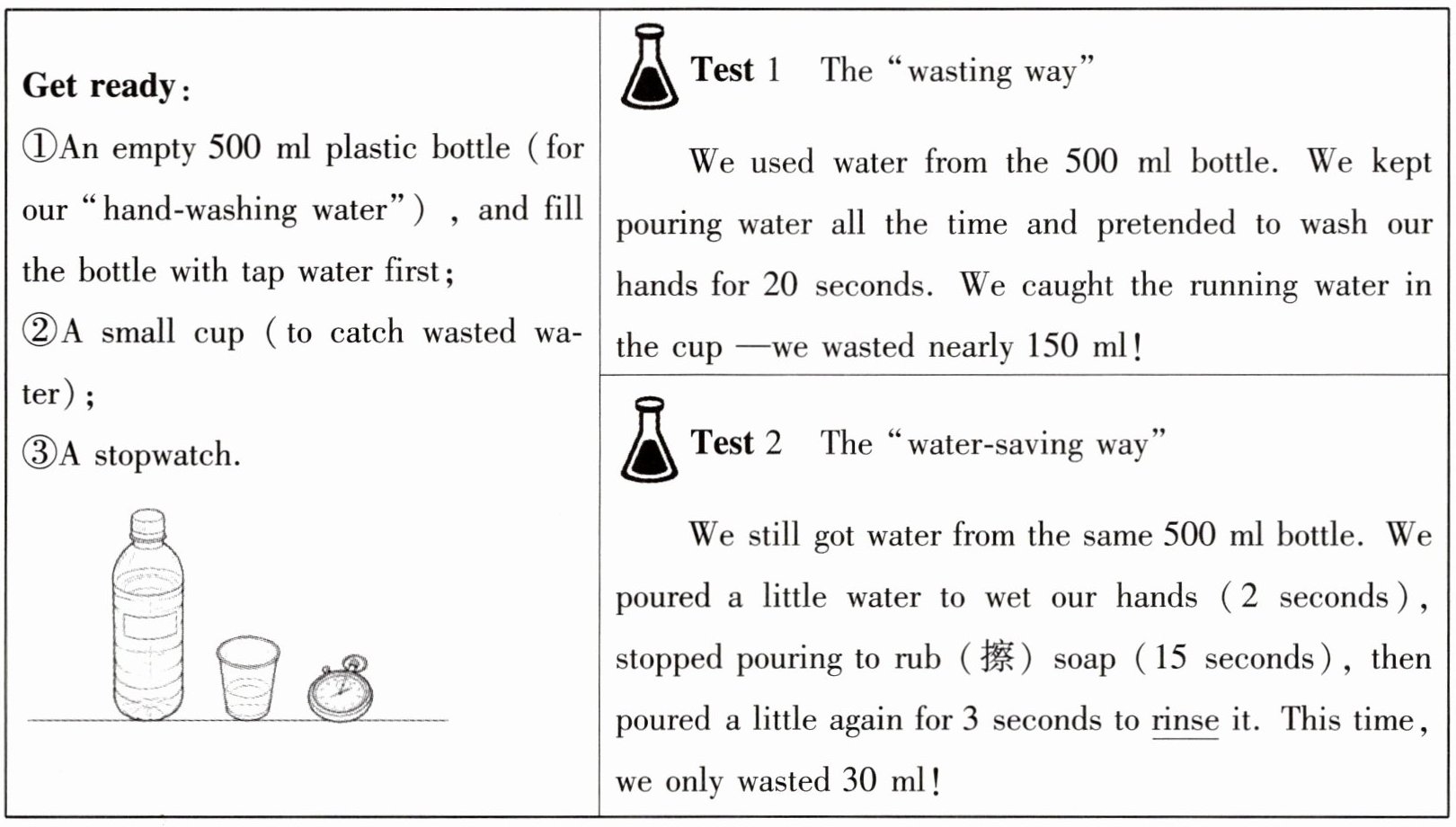
①An empty 500 ml plastic bottle (for our "hand-washing water") , and fill the bottle with tap water first;
②A small cup (to catch wasted wa-
ter);
③A stopwatch.
Test 1 The "wasting way"
We used water from the 500 ml bottle. We kept pouring water all the time and pretended to wash our hands for 20 seconds. We caught the running water in the cup —we wasted nearly 150 ml!
Test 2 The "water-saving way"
We still got water from the same 500 ml bottle. We poured a little water to wet our hands (2 seconds), stopped pouring to rub (擦) soap (15 seconds), then poured a little again for 3 seconds to rinse it. This time, we only wasted 30 ml!
Our teacher said a family of 4 could save over 170 liters a year this way. Small changes help the earth a lot. Now I always turn off the tap when I brush teeth or wash dishes. Will you be a wa-
ter-saving hero too?
1. What was the 500 ml plastic bottle used for?
A. Holding wasted water.
B. Putting away the stopwatch.
C. Preparing water for washing hands.
D. Preparing water for washing dishes.
2. How much water was wasted in the “water-saving way” test?
A. 30 ml.
B. 120 ml.
C. 150 ml.
D. 500 ml.
3. By the water-saving way, we can
A. let water run non-stop
B. catch wasted water
C. use more water to wash hands
D. waste less water when washing hands
4. The underlined word “rinse” probably means
A. rub with soap
B. stop pouring water
C. remove soap with water
D. dry hands
5. What’s the main idea of the passage?
A. How to do an experiment with bottles.
B. Turn on the tap when washing hands.
C. We should take small actions to save water.
D. It is not easy for us to save water.
A Fun Water-Saving Experiment You Can Do at Home
Do you know small habits save lots of water? Last week, my science teacher helped us do a su-
per easy experiment. It only needs 3 simple things, and it taught us how to protect the environment.
You can try it too!
Get ready:
①An empty 500 ml plastic bottle (for our "hand-washing water") , and fill the bottle with tap water first;
②A small cup (to catch wasted wa-
ter);
③A stopwatch.
Test 1 The "wasting way"
We used water from the 500 ml bottle. We kept pouring water all the time and pretended to wash our hands for 20 seconds. We caught the running water in the cup —we wasted nearly 150 ml!
Test 2 The "water-saving way"
We still got water from the same 500 ml bottle. We poured a little water to wet our hands (2 seconds), stopped pouring to rub (擦) soap (15 seconds), then poured a little again for 3 seconds to rinse it. This time, we only wasted 30 ml!
Our teacher said a family of 4 could save over 170 liters a year this way. Small changes help the earth a lot. Now I always turn off the tap when I brush teeth or wash dishes. Will you be a wa-
ter-saving hero too?
1. What was the 500 ml plastic bottle used for?
A. Holding wasted water.
B. Putting away the stopwatch.
C. Preparing water for washing hands.
D. Preparing water for washing dishes.
2. How much water was wasted in the “water-saving way” test?
A. 30 ml.
B. 120 ml.
C. 150 ml.
D. 500 ml.
3. By the water-saving way, we can
D
.A. let water run non-stop
B. catch wasted water
C. use more water to wash hands
D. waste less water when washing hands
4. The underlined word “rinse” probably means
C
.A. rub with soap
B. stop pouring water
C. remove soap with water
D. dry hands
5. What’s the main idea of the passage?
A. How to do an experiment with bottles.
B. Turn on the tap when washing hands.
C. We should take small actions to save water.
D. It is not easy for us to save water.
答案
1. C2. A3. D4. C5. C
解析
【分析】
本题为阅读理解题,共5道小题,需结合原文内容逐一分析:
1. 第1题:定位原文Get ready部分中500ml塑料瓶的用途描述,匹配选项得出答案;
2. 第2题:直接查找Test 2中节水方式的浪费水量数据,对应选项;
3. 第3题:对比两种洗手方式的浪费水量,理解节水方式的核心作用,排除错误选项;
4. 第4题:结合上下文(擦肥皂后再倒水的动作)推测划线词词义,匹配选项;
5. 第5题:梳理全文主旨,结合最后一段的总结句,确定文章核心观点。
【解析】
1. 解析:根据原文Get ready中“An empty 500 ml plastic bottle (for our "hand-washing water")”可知,该瓶子用于准备洗手用水,对应选项C。
2. 解析:根据Test 2中“This time, we only wasted 30 ml!”可知,节水方式下浪费30ml水,对应选项A。
3. 解析:Test 1浪费150ml,Test 2仅浪费30ml,说明节水方式是洗手时减少浪费水,选项D符合;A是浪费方式的特点,B是工具作用,C与节水相反,均排除。
4. 解析:上下文是“stopped pouring to rub soap,then poured a little again for 3 seconds to rinse it”,擦完肥皂后用水的动作是冲掉肥皂,故“rinse”意为“用水去除肥皂”,对应选项C。
5. 解析:全文通过节水实验说明小习惯能节约大量水,最后一段“Small changes help the earth a lot”点明主旨,即我们应采取小行动节水,对应选项C。
【答案】
1. C 2. A 3. D 4. C 5. C
【知识点】
阅读理解(细节理解)、阅读理解(词义猜测)、阅读理解(主旨大意)
【点评】
本文为节水主题的阅读理解,通过简单实验介绍节水方法,题目以基础细节查找和简单理解为主,贴近生活,易于学生作答。
【难度系数】
0.7
