

 登录
登录
7. —Congratulations! Can you share your secret to learning? —If you work hard enough, you'll succeed ____ achieving your goal.
A. on
B. in
C. for
D. about
A. on
B. in
C. for
D. about
答案
B
Ⅳ.句子翻译
1. 为什么不参加校足球队的选拔呢?
______
2. 他们被迫降落在一片田野上。
______
3. 结果,几乎没有人注意到他的到来。
______, little ____ his coming.
4. 他最终成功地让教练改变了主意。
He ______ at last.
5. 她的表现证明了她没有失去信心。
Her performance ______.
1. 为什么不参加校足球队的选拔呢?
______
2. 他们被迫降落在一片田野上。
______
3. 结果,几乎没有人注意到他的到来。
______, little ____ his coming.
4. 他最终成功地让教练改变了主意。
He ______ at last.
5. 她的表现证明了她没有失去信心。
Her performance ______.
答案
1. Why not try out for the school football team?
2. They were forced to land on a field.
3. As a result; notice is taken of
4. succeeded in getting the coach to/successfully got the coach to change his mind
5. proved that she didn't lose heart
2. They were forced to land on a field.
3. As a result; notice is taken of
4. succeeded in getting the coach to/successfully got the coach to change his mind
5. proved that she didn't lose heart
Ⅴ.阅读理解
I once thought I had superpower in my senior year of high school. I was living with my grandparents at that time. My grandparents had recently been out of work. While they'd managed to save money to buy a house, they didn't have enough money for living cost.
① So, my grandfather took a job as a doorkeeper of the Java school building. Keeping the whole building clean was a stressful job for an old man. Realizing this, I began helping him after school, sweeping rooms and emptying waste baskets, for a small payment.
② When winter arrived, he fired up the school's furnace (火炉). He quickly realized how difficult it had become for him to shovel (铲) the huge pile of coal to fill the furnace. I volunteered to take on that job, a promise that required me to get up an hour earlier each morning. I'd go over to the school, and shovel a half ton of coal, enough to keep the fire burning for 24 hours. After finishing that task, I'd return home, change clothes, and eat breakfast. Then I'd rush back to school, always at the last minute.
③ On two mornings, at the very moment I stepped onto the sidewalk (人行道) in front of the school, the first bell rang. That was the signal (信号) for students to go to class. This surprising coincidence caused me to improve my action. I carefully planned each step of my morning activity. I sped myself. Often I'd step onto the school's sidewalk just as the first bell rang. This effort gave me a huge sense of achievement—and some strange feelings.
④ Twenty years later, at a school get-together, I happened to meet Harold Spiry, the head teacher, who had been in control of ringing the bell by pushing a button (按钮) in his office. I couldn't stop talking about my superpower. I told Mr Spiry about how I had kept my difficult morning work in good order, how my timing had been perfect. “Oh that,” he said. “Do you remember my office windows? I used to look out through the windows. I often saw you coming. And when you hit the sidewalk, I'd ring the bell.”
1. Why did the writer's grandfather work as a doorkeeper after he was out of work?
A. Because he needed the job to support the family.
B. Because he was interested in working for extra hours.
C. Because he wanted to stay close to his grandson at school.
D. Because he found he could be well paid by taking on the job.
2. 新考法 补全文章 The sentence “It was during those morning rushes to school that I discovered my superpower.” should be put in ____.
A. ①
B. ②
C. ③
D. ④
3. What does the underlined word “coincidence” mean in Paragraph 4?
A. 巧合
B. 举措
C. 业绩
D. 表现
4. How would the writer feel after hearing what Harold Spiry said?
A. Proud.
B. Surprised.
C. Relaxed.
D. Calm.
5. What message does the writer's story express?
A. Our dream can be realized through hard work.
B. Personal superpower brings people joy and success.
C. Careful plans lead to the development of special skills.
D. Our achievements are often supported by unseen kindness.
I once thought I had superpower in my senior year of high school. I was living with my grandparents at that time. My grandparents had recently been out of work. While they'd managed to save money to buy a house, they didn't have enough money for living cost.
① So, my grandfather took a job as a doorkeeper of the Java school building. Keeping the whole building clean was a stressful job for an old man. Realizing this, I began helping him after school, sweeping rooms and emptying waste baskets, for a small payment.
② When winter arrived, he fired up the school's furnace (火炉). He quickly realized how difficult it had become for him to shovel (铲) the huge pile of coal to fill the furnace. I volunteered to take on that job, a promise that required me to get up an hour earlier each morning. I'd go over to the school, and shovel a half ton of coal, enough to keep the fire burning for 24 hours. After finishing that task, I'd return home, change clothes, and eat breakfast. Then I'd rush back to school, always at the last minute.
③ On two mornings, at the very moment I stepped onto the sidewalk (人行道) in front of the school, the first bell rang. That was the signal (信号) for students to go to class. This surprising coincidence caused me to improve my action. I carefully planned each step of my morning activity. I sped myself. Often I'd step onto the school's sidewalk just as the first bell rang. This effort gave me a huge sense of achievement—and some strange feelings.
④ Twenty years later, at a school get-together, I happened to meet Harold Spiry, the head teacher, who had been in control of ringing the bell by pushing a button (按钮) in his office. I couldn't stop talking about my superpower. I told Mr Spiry about how I had kept my difficult morning work in good order, how my timing had been perfect. “Oh that,” he said. “Do you remember my office windows? I used to look out through the windows. I often saw you coming. And when you hit the sidewalk, I'd ring the bell.”
1. Why did the writer's grandfather work as a doorkeeper after he was out of work?
A. Because he needed the job to support the family.
B. Because he was interested in working for extra hours.
C. Because he wanted to stay close to his grandson at school.
D. Because he found he could be well paid by taking on the job.
2. 新考法 补全文章 The sentence “It was during those morning rushes to school that I discovered my superpower.” should be put in ____.
A. ①
B. ②
C. ③
D. ④
3. What does the underlined word “coincidence” mean in Paragraph 4?
A. 巧合
B. 举措
C. 业绩
D. 表现
4. How would the writer feel after hearing what Harold Spiry said?
A. Proud.
B. Surprised.
C. Relaxed.
D. Calm.
5. What message does the writer's story express?
A. Our dream can be realized through hard work.
B. Personal superpower brings people joy and success.
C. Careful plans lead to the development of special skills.
D. Our achievements are often supported by unseen kindness.
答案
1~5 ACABD
【文章大意】本文是一篇记叙文,讲述了作者高中时期帮助祖父做繁重工作后赶回学校时发现自己有“超能力”,最终得知是学校老师在默默配合他的努力。
1. A 细节理解题。根据“My grandparents had recently been out of work. While they'd managed to save money to buy a house, they didn't have enough money for living cost.”可知,祖父当门卫是为了赚钱养家。故选 A。
2. C 补全文章题。结合文意及逻辑,句子“It was during those morning rushes to school that I discovered my superpower.”应放在描述早晨匆忙上学的段落,根据“On two mornings, at the very moment I stepped onto the
sidewalk in front of the school, the first bell rang.”可知,第③处符合语境。并且根据第 4 段内容可知,本段描写了作者认为自己有超能力的原因。故选 C。
3. A 词义猜测题。根据文段结构和对上下文的理解,“This surprising coincidence”指的是他到达学校时第一声铃声正好响起,结合语境可知,coincidence 意为“巧合”。故选 A。
4. B 观点态度题。从 Mr Spiry 说的“And when you hit the sidewalk, I'd ring the bell.”可以看出,铃声并不是因为作者的超能力,而是人为控制,所以作者会感到意外。故选 B。
5. D 主旨大意题。故事最后透露了在作者不知情的情况下,老师的关照和帮助成就了他的“成就感”,反映出我们的成就背后常有无形的善意支持。故选 D。
【文章大意】本文是一篇记叙文,讲述了作者高中时期帮助祖父做繁重工作后赶回学校时发现自己有“超能力”,最终得知是学校老师在默默配合他的努力。
1. A 细节理解题。根据“My grandparents had recently been out of work. While they'd managed to save money to buy a house, they didn't have enough money for living cost.”可知,祖父当门卫是为了赚钱养家。故选 A。
2. C 补全文章题。结合文意及逻辑,句子“It was during those morning rushes to school that I discovered my superpower.”应放在描述早晨匆忙上学的段落,根据“On two mornings, at the very moment I stepped onto the
sidewalk in front of the school, the first bell rang.”可知,第③处符合语境。并且根据第 4 段内容可知,本段描写了作者认为自己有超能力的原因。故选 C。
3. A 词义猜测题。根据文段结构和对上下文的理解,“This surprising coincidence”指的是他到达学校时第一声铃声正好响起,结合语境可知,coincidence 意为“巧合”。故选 A。
4. B 观点态度题。从 Mr Spiry 说的“And when you hit the sidewalk, I'd ring the bell.”可以看出,铃声并不是因为作者的超能力,而是人为控制,所以作者会感到意外。故选 B。
5. D 主旨大意题。故事最后透露了在作者不知情的情况下,老师的关照和帮助成就了他的“成就感”,反映出我们的成就背后常有无形的善意支持。故选 D。
Ⅶ.任务型阅读
阅读并根据下面的短文,在表格中的 1 到 8 题空格里填入一个最恰当的单词,第 9 题不限一词。
Guy de Maupassant was a famous French writer, born on August 5, 1850, in Normandy. He is best known for his short stories, which have a lasting influence on modern literature.
Maupassant's early years were difficult. His parents separated when he was just 11 years old, and his mother raised him and his younger brother by herself. Under his mother's influence, Maupassant developed an interest in reading and writing.
A turning point in his life came when he met the well-known writer Gustave Flaubert, his mother's friend. Flaubert became Maupassant's guide, helping him shape his writing style. Much like Flaubert's works, Maupassant's stories told the difficult life of poor people. Flaubert also introduced young Maupassant to some of the other famous writers of his day, such as Emile Zola and Henry James.
In 1880, Maupassant published his first major work, Boule de Suif (《羊脂球》). It was a big success. But his best-known work was The Necklace which was published in 1884. It tells the story of Mathilde Loisel, a woman who borrows a beautiful necklace to wear to a party. After losing it, she spends her whole life working hard to pay for it, only to discover that the necklace was a fake (假货). This story shows the problems of pride and the hard realities of life for many people.
Even though his writing career lasted only about ten years, Maupassant was very productive. He wrote around 300 short stories, six novels, and hundreds of newspaper articles. His clear and simple writing style, along with his ability to show human feelings, made him a pioneer in short stories.
Maupassant is often described as the father of the modern short story. His works were admired by people of the time. His style of writing has been copied by those who came after him. Maupassant inspired many other famous writers, including W. Somerset Maugham, O. Henry and Henry James. Sadly, Maupassant fought with mental illness in his later years and died on July 6, 1893, at the age of 43.
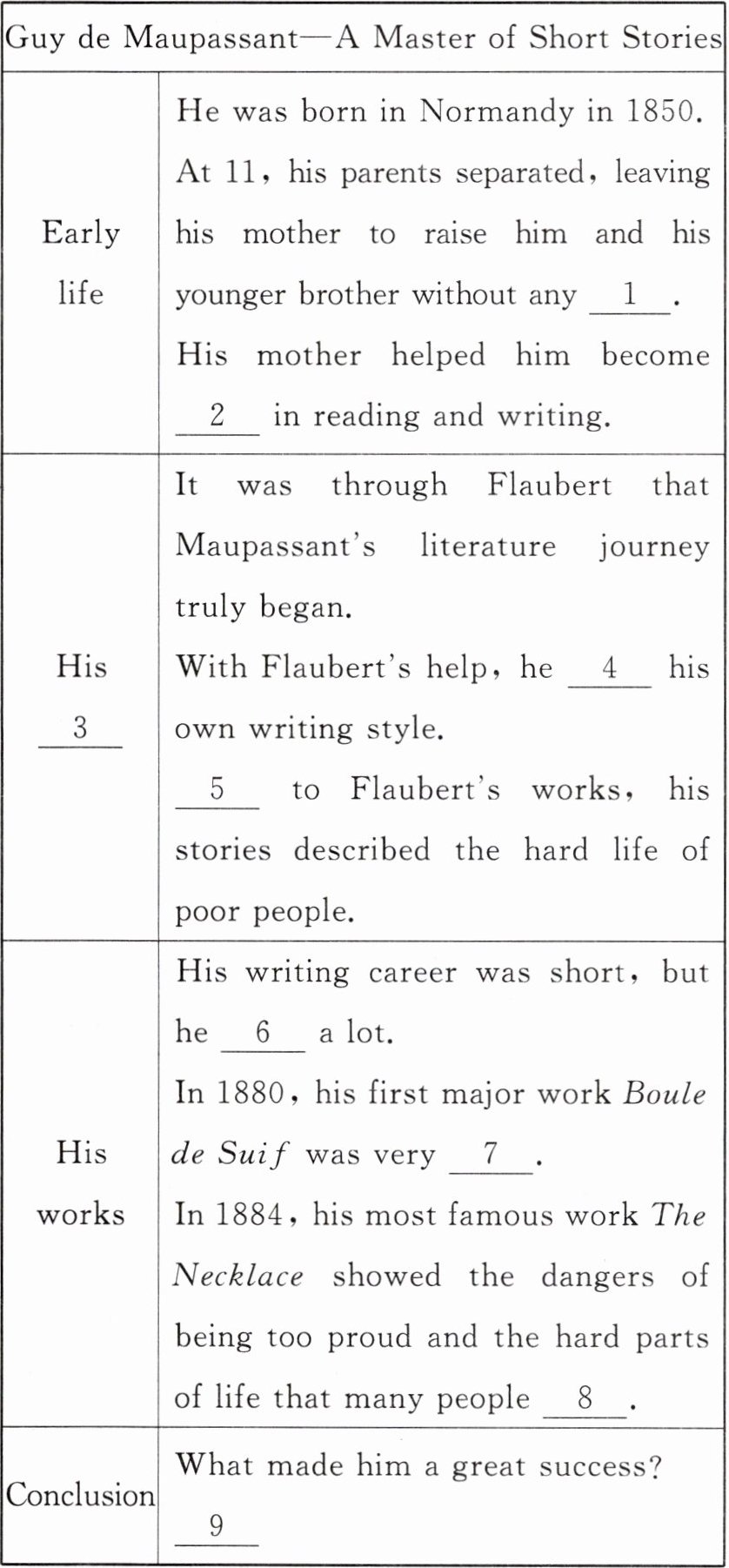
1. ____ 2. ____ 3. ____
4. ____ 5. ____ 6. ____
7. ____ 8. ____
9. ____
阅读并根据下面的短文,在表格中的 1 到 8 题空格里填入一个最恰当的单词,第 9 题不限一词。
Guy de Maupassant was a famous French writer, born on August 5, 1850, in Normandy. He is best known for his short stories, which have a lasting influence on modern literature.
Maupassant's early years were difficult. His parents separated when he was just 11 years old, and his mother raised him and his younger brother by herself. Under his mother's influence, Maupassant developed an interest in reading and writing.
A turning point in his life came when he met the well-known writer Gustave Flaubert, his mother's friend. Flaubert became Maupassant's guide, helping him shape his writing style. Much like Flaubert's works, Maupassant's stories told the difficult life of poor people. Flaubert also introduced young Maupassant to some of the other famous writers of his day, such as Emile Zola and Henry James.
In 1880, Maupassant published his first major work, Boule de Suif (《羊脂球》). It was a big success. But his best-known work was The Necklace which was published in 1884. It tells the story of Mathilde Loisel, a woman who borrows a beautiful necklace to wear to a party. After losing it, she spends her whole life working hard to pay for it, only to discover that the necklace was a fake (假货). This story shows the problems of pride and the hard realities of life for many people.
Even though his writing career lasted only about ten years, Maupassant was very productive. He wrote around 300 short stories, six novels, and hundreds of newspaper articles. His clear and simple writing style, along with his ability to show human feelings, made him a pioneer in short stories.
Maupassant is often described as the father of the modern short story. His works were admired by people of the time. His style of writing has been copied by those who came after him. Maupassant inspired many other famous writers, including W. Somerset Maugham, O. Henry and Henry James. Sadly, Maupassant fought with mental illness in his later years and died on July 6, 1893, at the age of 43.
1. ____ 2. ____ 3. ____
4. ____ 5. ____ 6. ____
7. ____ 8. ____
9. ____
答案
1. help 2. interested 3. guide 4. shaped 5. Similar
6. produced/wrote 7. successful 8. had 9. His short stories.
【文章大意】本文是一篇记叙文,讲述了法国著名作家莫泊桑的生平和成就。
6. produced/wrote 7. successful 8. had 9. His short stories.
【文章大意】本文是一篇记叙文,讲述了法国著名作家莫泊桑的生平和成就。
