

 登录
登录
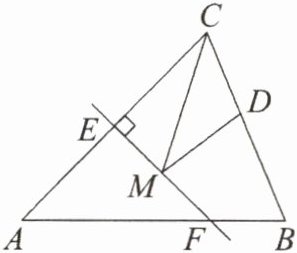
12. 如图,在等腰三角形$ABC$中,$AB = AC = 13$,$BC = 10$,$EF垂直平分AC$,分别交$AC$,$AB于点E$,$F$. 若$D为BC$上一动点,$M为EF$上一动点,连接$CM$,$DM$,则$CM + DM$的最小值为( )
A.8
B.10
C.12
D.13
A.8
B.10
C.12
D.13
答案
C [解析]如图,连接$AM$。
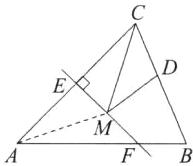
∵$EF$垂直平分$AC$,分别交$AC$,$AB$于点$E$,$F$,
$\therefore AM = CM$,
$\therefore CM + DM = AM + MD$,
∴当$A$,$M$,$D$三点共线,且$AD\perp BC$时,$CM + DM$取最小值。
∵$AB = AC = 13$,$BC = 10$,
∴当$AD\perp BC$时,$BD = \frac{1}{2}BC = 5$,则$AD = \sqrt{AB^{2} - BD^{2}} = \sqrt{13^{2} - 5^{2}} = 12$,
即$CM + DM$的最小值为$12$。
13. 25的算术平方根是
5
.答案
5 [解析]∵$5^{2} = 25$,
∴$25$的算术平方根是$5$。
∴$25$的算术平方根是$5$。
14. 比较大小:$\frac{\sqrt{5} - 1}{2}$
>
$\frac{1}{2}$(填“>”“<”或“=”).答案
> [解析]∵$4 < 5 < 9$,
$\therefore \sqrt{4} < \sqrt{5} < \sqrt{9}$,即$2 < \sqrt{5} < 3$,
$\therefore 1 < \sqrt{5} - 1 < 2$,
$\therefore \frac{\sqrt{5} - 1}{2} > \frac{1}{2}$。
$\therefore \sqrt{4} < \sqrt{5} < \sqrt{9}$,即$2 < \sqrt{5} < 3$,
$\therefore 1 < \sqrt{5} - 1 < 2$,
$\therefore \frac{\sqrt{5} - 1}{2} > \frac{1}{2}$。
15. 在平面直角坐标系中,若点$P的坐标为(1,-2)$,则点$P$到原点的距离为______
$\sqrt{5}$
.答案
$\sqrt{5}$ [解析]若点$P$的坐标为$(1,-2)$,则点$P$到原点$(0,0)$的距离$OP = \sqrt{(0 - 1)^{2} + (0 + 2)^{2}} = \sqrt{5}$。
16. 已知二元一次方程组$\begin{cases}x - y = -4,\\x + 2y = 2\end{cases} $的解为unitable1 则在同一平面直角坐标系中,函数y = x + 4与$y = -\frac{1}{2}x + 1$的图象的交点坐标为______
(-2,2)
.答案
$(-2,2)$
17. 如图,已知$B中的实数与A$中的实数之间的对应关系是某个正比例函数,则图中$a$的值为
$-\frac{2}{3}$
.答案
$-\frac{2}{3}$ [解析]设该正比例函数的表达式为$y = kx$。
把$(1,-3)$代入,得$k = - 3$,
∴该正比例函数的表达式为$y = - 3x$。
把$y = 2$代入,得$2 = - 3x$,
解得$x = -\frac{2}{3}$,
即$a$的值为$-\frac{2}{3}$。
把$(1,-3)$代入,得$k = - 3$,
∴该正比例函数的表达式为$y = - 3x$。
把$y = 2$代入,得$2 = - 3x$,
解得$x = -\frac{2}{3}$,
即$a$的值为$-\frac{2}{3}$。
18. 如图,直线$y = \frac{4}{3}x + 8与x$轴、$y轴分别交于点A$,$B$,$P是OB$上的一点,若将$\triangle PAB沿AP$折叠,使点$B恰好落在x轴上的点B'$处,则直线$AP$的函数表达式为______
$y = \frac{1}{2}x + 3$
.答案
$y = \frac{1}{2}x + 3$ [解析]令$x = 0$,则$y = 8$;令$y = 0$,
则$x = - 6$,
$\therefore A(-6,0)$,$B(0,8)$,
$\therefore AO = 6$,$BO = 8$,
$\therefore AB = \sqrt{AO^{2} + BO^{2}} = \sqrt{6^{2} + 8^{2}} = 10$。
由折叠的性质可得,$AB' = AB = 10$,$B'P = BP$,
$\therefore OB' = AB' - AO = 10 - 6 = 4$。
设$P(0,y)$,则$OP = y$,$B'P = BP = 8 - y$。
在$Rt\triangle POB'$中,由勾股定理,
得$y^{2} + 4^{2} = (8 - y)^{2}$,
解得$y = 3$,
$\therefore P(0,3)$。
设直线$AP$的函数表达式为$y = kx + b$。将$A(-6,0)$,$P(0,3)$分别代入,得
$\left\{\begin{array}{l}-6k + b = 0,\\ b = 3,\end{array}\right.$
解得$\left\{\begin{array}{l}k = \frac{1}{2},\\ b = 3,\end{array}\right.$
∴直线$AP$的函数表达式为$y = \frac{1}{2}x + 3$。
则$x = - 6$,
$\therefore A(-6,0)$,$B(0,8)$,
$\therefore AO = 6$,$BO = 8$,
$\therefore AB = \sqrt{AO^{2} + BO^{2}} = \sqrt{6^{2} + 8^{2}} = 10$。
由折叠的性质可得,$AB' = AB = 10$,$B'P = BP$,
$\therefore OB' = AB' - AO = 10 - 6 = 4$。
设$P(0,y)$,则$OP = y$,$B'P = BP = 8 - y$。
在$Rt\triangle POB'$中,由勾股定理,
得$y^{2} + 4^{2} = (8 - y)^{2}$,
解得$y = 3$,
$\therefore P(0,3)$。
设直线$AP$的函数表达式为$y = kx + b$。将$A(-6,0)$,$P(0,3)$分别代入,得
$\left\{\begin{array}{l}-6k + b = 0,\\ b = 3,\end{array}\right.$
解得$\left\{\begin{array}{l}k = \frac{1}{2},\\ b = 3,\end{array}\right.$
∴直线$AP$的函数表达式为$y = \frac{1}{2}x + 3$。
19. (6分)计算:(1)$\sqrt{64} + \sqrt[3]{-27} + (3 - \pi)^0$;
(2)$\sqrt{(-6)^2} + |1 - \sqrt{2}| + \sqrt[3]{-8}$.
(2)$\sqrt{(-6)^2} + |1 - \sqrt{2}| + \sqrt[3]{-8}$.
答案
解:(1)原式$= 8 - 3 + 1 = 6$。
(2)原式$= 6 + \sqrt{2} - 1 + (-2) = 3 + \sqrt{2}$。
(2)原式$= 6 + \sqrt{2} - 1 + (-2) = 3 + \sqrt{2}$。
20. (6分)已知实数$a + 5$的算术平方根是2,$a + 3b$的立方根是2. 求:
(1)$a$,$b$的值;
(2)$a + b$的平方根.
(1)$a$,$b$的值;
(2)$a + b$的平方根.
答案
解:(1)∵$a + 5$的算术平方根是$2$,
$\therefore a + 5 = 2^{2} = 4$,
$\therefore a = - 1$。
∵$a + 3b$的立方根是$2$,
$\therefore a + 3b = 2^{3} = 8$,
$\therefore b = 3$。
(2)由(1),知$a = - 1$,$b = 3$,
$\therefore a + b = - 1 + 3 = 2$,
$\therefore a + b$的平方根是$\pm\sqrt{2}$。
$\therefore a + 5 = 2^{2} = 4$,
$\therefore a = - 1$。
∵$a + 3b$的立方根是$2$,
$\therefore a + 3b = 2^{3} = 8$,
$\therefore b = 3$。
(2)由(1),知$a = - 1$,$b = 3$,
$\therefore a + b = - 1 + 3 = 2$,
$\therefore a + b$的平方根是$\pm\sqrt{2}$。
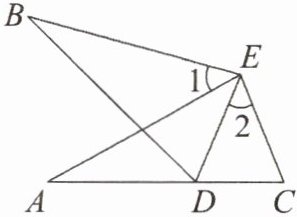
21. (8分)如图,$∠A = ∠B$,$∠1 = ∠2$,$AE = BE$,点$D在边AC$上.
(1)求证:$\triangle AEC≌\triangle BED$;
(2)若$∠BDE = 68^{\circ}$,求$∠1$的度数.
(1)证明:∵$\angle 1 = \angle 2$,
$\therefore \angle 1 + \angle AED = \angle 2 + \angle AED$,
$\therefore \angle AEC = \angle BED$。
在$\triangle AEC$和$\triangle BED$中,
$\left\{\begin{array}{l}\angle A = \angle B,\\ AE = BE,\\ \angle AEC = \angle BED,\end{array}\right.$
$\therefore \triangle AEC\cong\triangle BED$(
(2)由(1),知$\triangle AEC\cong\triangle BED$,
$\therefore ED = EC$,$\angle ACE = \angle BDE = 68^{\circ}$,
$\therefore \angle EDC = \angle ACE = 68^{\circ}$,
$\therefore \angle 2 = 180^{\circ} - 68^{\circ} - 68^{\circ} = 44^{\circ}$,
$\therefore \angle 1 = \angle 2 = $
(1)求证:$\triangle AEC≌\triangle BED$;
(2)若$∠BDE = 68^{\circ}$,求$∠1$的度数.
(1)证明:∵$\angle 1 = \angle 2$,
$\therefore \angle 1 + \angle AED = \angle 2 + \angle AED$,
$\therefore \angle AEC = \angle BED$。
在$\triangle AEC$和$\triangle BED$中,
$\left\{\begin{array}{l}\angle A = \angle B,\\ AE = BE,\\ \angle AEC = \angle BED,\end{array}\right.$
$\therefore \triangle AEC\cong\triangle BED$(
ASA
)。(2)由(1),知$\triangle AEC\cong\triangle BED$,
$\therefore ED = EC$,$\angle ACE = \angle BDE = 68^{\circ}$,
$\therefore \angle EDC = \angle ACE = 68^{\circ}$,
$\therefore \angle 2 = 180^{\circ} - 68^{\circ} - 68^{\circ} = 44^{\circ}$,
$\therefore \angle 1 = \angle 2 = $
44°
。答案
解:(1)证明:∵$\angle 1 = \angle 2$,
$\therefore \angle 1 + \angle AED = \angle 2 + \angle AED$,
$\therefore \angle AEC = \angle BED$。
在$\triangle AEC$和$\triangle BED$中,
$\left\{\begin{array}{l}\angle A = \angle B,\\ AE = BE,\\ \angle AEC = \angle BED,\end{array}\right.$
$\therefore \triangle AEC\cong\triangle BED(ASA)$。
(2)由(1),知$\triangle AEC\cong\triangle BED$,
$\therefore ED = EC$,$\angle ACE = \angle BDE = 68^{\circ}$,
$\therefore \angle EDC = \angle ACE = 68^{\circ}$,
$\therefore \angle 2 = 180^{\circ} - 68^{\circ} - 68^{\circ} = 44^{\circ}$,
$\therefore \angle 1 = \angle 2 = 44^{\circ}$。
$\therefore \angle 1 + \angle AED = \angle 2 + \angle AED$,
$\therefore \angle AEC = \angle BED$。
在$\triangle AEC$和$\triangle BED$中,
$\left\{\begin{array}{l}\angle A = \angle B,\\ AE = BE,\\ \angle AEC = \angle BED,\end{array}\right.$
$\therefore \triangle AEC\cong\triangle BED(ASA)$。
(2)由(1),知$\triangle AEC\cong\triangle BED$,
$\therefore ED = EC$,$\angle ACE = \angle BDE = 68^{\circ}$,
$\therefore \angle EDC = \angle ACE = 68^{\circ}$,
$\therefore \angle 2 = 180^{\circ} - 68^{\circ} - 68^{\circ} = 44^{\circ}$,
$\therefore \angle 1 = \angle 2 = 44^{\circ}$。
