

 登录
四、短文填空
ASK ME
I'm Maddy King. I come 1.
Dear Maddy,
My mom has a quick temper (急脾气), 3.
Rachel, 11, Shanghai
Hi, Rachel,
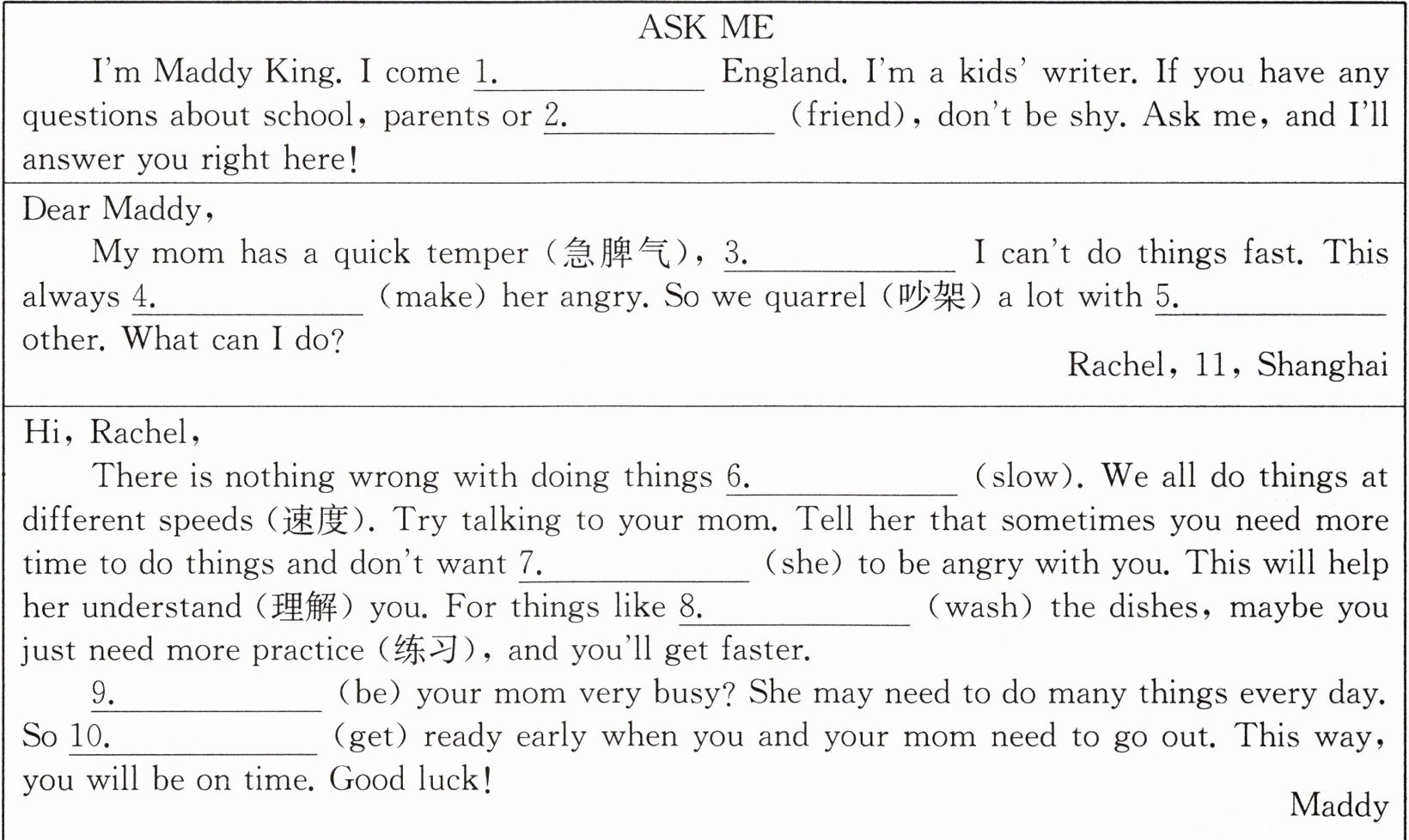
There is nothing wrong with doing things 6.
9.
Maddy
ASK ME
I'm Maddy King. I come 1.
from
England. I'm a kids' writer. If you have any questions about school, parents or 2.friends
(friend), don't be shy. Ask me, and I'll answer you right here!Dear Maddy,
My mom has a quick temper (急脾气), 3.
but
I can't do things fast. This always 4.makes
(make) her angry. So we quarrel (吵架) a lot with 5.each
other. What can I do?Rachel, 11, Shanghai
Hi, Rachel,
There is nothing wrong with doing things 6.
slowly
(slow). We all do things at different speeds (速度). Try talking to your mom. Tell her that sometimes you need more time to do things and don't want 7.her
(she) to be angry with you. This will help her understand (理解) you. For things like 8.washing
(wash) the dishes, maybe you just need more practice (练习), and you'll get faster.9.
Is
(be) your mom very busy? She may need to do many things every day. So 10.get
(get) ready early when you and your mom need to go out. This way, you will be on time. Good luck!Maddy
答案
1. from 2. friends 3. but 4. makes 5. each
6. slowly 7. her 8. washing 9. Is 10. get
解析
【分析】
做短文填空时,需结合语境、固定搭配、语法规则(词性、主谓一致等)逐一分析:1. 考查固定搭配“come from”(来自);2. 泛指“朋友”,可数名词用复数;3. 前后句为转折关系,需用转折连词;4. 主语是第三人称单数,一般现在时谓语用三单形式;5. 考查固定短语“each other”(互相);6. 修饰动词需用副词;7. 动词后接人称代词宾格;8. 介词后接动名词;9. 主语是单数,一般现在时be动词用对应形式;10. 祈使句以动词原形开头。
【解析】
1. 固定搭配“come from”表示“来自”,故填from;
2. 此处泛指各类朋友,friend为可数名词,用复数形式friends;
3. 前半句“妈妈急脾气”与后半句“我做事不快”是转折关系,填but;
4. 主语this是第三人称单数,一般现在时中谓语动词用三单,make变为makes;
5. 固定短语“each other”意为“互相”,符合语境,填each;
6. 此处修饰动词doing,需用副词,slow的副词形式是slowly;
7. want是动词,后接人称代词宾格作宾语,she的宾格是her;
8. like是介词,后接动词的动名词形式,wash的动名词是washing;
9. 句子主语your mom是第三人称单数,一般现在时的be动词用Is;
10. 此处为祈使句,以动词原形开头,故填get。
【答案】
1. from 2. friends 3. but 4. makes 5. each 6. slowly 7. her 8. washing 9. Is 10. get
【知识点】
固定搭配、词性转换、主谓一致
【点评】
本题为短文填空题,考查初中英语基础词汇、固定搭配及语法知识,需结合语境和语法规则分析,难度适中,适合初中学生巩固基础。
【难度系数】
0.6
五、阅读短文,回答问题
Baijiaxing is a book in the early Northern Song Dynasty (北宋朝代). It is a book of Chinese family names. There are 504 common(常见的)family names in it. 444 of them have only one character(汉字), and 60 have two characters. It is very important when Chinese children are learning about names.
The names of Chinese people have their own traditions(传统). Different from countries in the West, the family name in China is put first, and then the given name. Chinese names always show the best wishes to the new babies.
Now, the Chinese have about 3 500 one-character family names and more than(比)2 000 two-character family names.
Chinese family names have a history(历史)of more than 4 000 years. Chinese family names are not just the characters that Chinese people put before their given names, but a special part(部分)of the Chinese culture(文化).
1. What is the book Baijiaxing about?
2. Do people around the world all put family names first when writing their names?
3. What do Chinese names show?
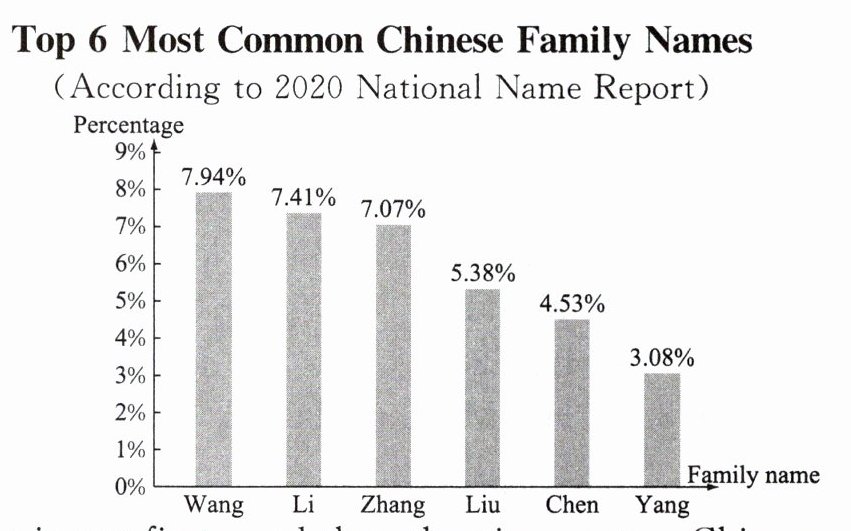
4. What is the most common family name according to the chart(图表)?
5. What's your family name? And given name? Why do your parents give the name to you?
Baijiaxing is a book in the early Northern Song Dynasty (北宋朝代). It is a book of Chinese family names. There are 504 common(常见的)family names in it. 444 of them have only one character(汉字), and 60 have two characters. It is very important when Chinese children are learning about names.
The names of Chinese people have their own traditions(传统). Different from countries in the West, the family name in China is put first, and then the given name. Chinese names always show the best wishes to the new babies.
Now, the Chinese have about 3 500 one-character family names and more than(比)2 000 two-character family names.
Chinese family names have a history(历史)of more than 4 000 years. Chinese family names are not just the characters that Chinese people put before their given names, but a special part(部分)of the Chinese culture(文化).
1. What is the book Baijiaxing about?
Chinese family names.
2. Do people around the world all put family names first when writing their names?
No, they don't.
3. What do Chinese names show?
The best wishes to the new babies.
4. What is the most common family name according to the chart(图表)?
Wang.
5. What's your family name? And given name? Why do your parents give the name to you?
Wang. Min. Because they want me to be clever. (Any reasonable answer is OK.)
答案
1. Chinese family names. 2. No, they don't.
3. The best wishes to the new babies. 4. Wang.
5. Wang. Min. Because they want me to be clever. (Any reasonable answer is OK.)
解析
【分析】本题为阅读理解题,需结合短文内容和图表信息逐一解答。解题思路:先通读短文与图表,明确各问题的考查方向;再针对每个问题定位原文或图表中的关键信息;最后组织语言准确作答,开放题需符合实际情况。
【解析】1. 根据短文第一段第二句“It is a book of Chinese family names.”,可知《百家姓》是关于中国姓氏的书;2. 根据短文第二段第二句“Different from countries in the West, the family name in China is put first...”,可知并非全世界都将姓氏放在名字前,故回答No;3. 根据短文第二段最后一句“Chinese names always show the best wishes to the new babies.”,可知中国名字表达对新生儿的美好祝愿;4. 观察图表,Wang对应的百分比最高(7.94%),是最常见的姓氏;5. 本题为开放题,结合自身实际作答,合理即可。
【答案】1. Chinese family names. 2. No, they don't. 3. The best wishes to the new babies. 4. Wang. 5. Wang. Min. Because they want me to be clever. (Any reasonable answer is OK.)
【知识点】英语阅读理解、信息提取、中西方姓名文化
【点评】本题结合文本与图表考查阅读理解能力,涵盖信息定位、文化常识等考点,难度适中,既考查学生提取关键信息的能力,也通过开放题体现灵活性。
【难度系数】0.6
