

 登录
登录
(一)阅读下列短文,从每题所给的A、B、C、D四个选项中选出最佳答案。

A
A Friendly Neighbourhood
Neighbours near and dear to our heart,
Living together, never apart.
We share smiles and give a helping hand,
A close-knit community, oh so grand(极好的).
Playing games and running free,
Our neighbourhood is where we want to be.
Gardens bloom(开花) with colours bright,
Children playing from morning till night.
Sharing stories and dreams so true,
In our neighbourhood, friendships ▲ .
(
A. How the writer feels.
B. What the writer does.
C. Where the writer works.
D. When the writer plays.
(
A. Shy. B. Creative.
C. Helpful. D. Hard-working.
(
A. got B. grew
C. left D. ended
B
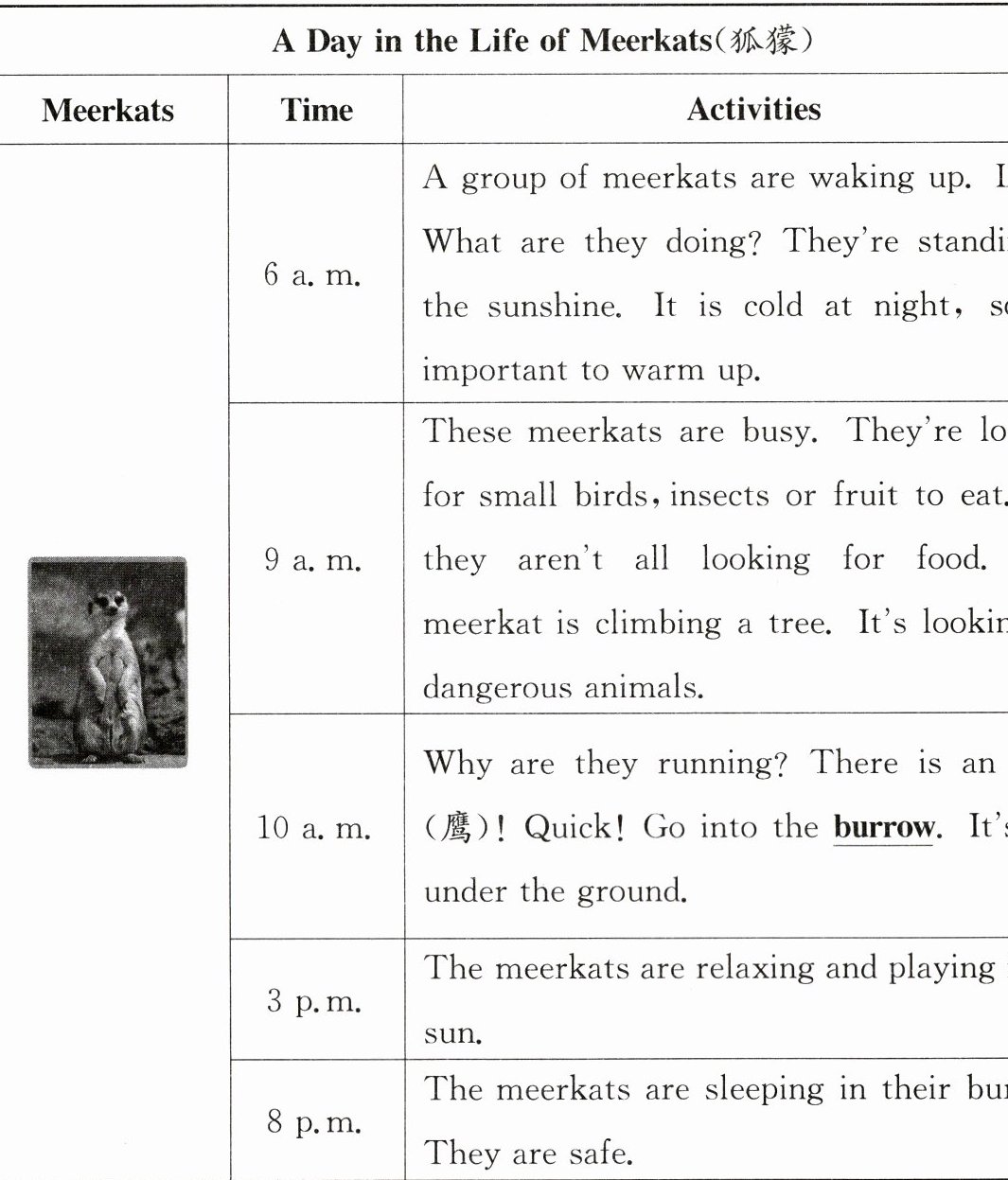
A Day in the Life of Meerkats(狐獴)
Meerkats Time Activities
6 a.m. A group of meerkats are waking up. Look! What are they doing? They're standing in the sunshine. It is cold at night, so it's important to warm up.
9 a.m. These meerkats are busy. They're looking for small birds, insects or fruit to eat. But they aren't all looking for food. One meerkat is climbing a tree. It's looking for dangerous animals.
10 a.m. Why are they running? There is an eagle(鹰)! Quick! Go into the burrow. It's safe under the ground.
3 p.m. The meerkats are relaxing and playing in the sun.
8 p.m. The meerkats are sleeping in their burrow. They are safe.
(
A. To keep safe. B. To keep warm.
C. To keep strong. D. To keep awake.
(
A. Taking a rest.
B. Playing with small birds.
C. Having a meal.
D. Watching for other animals.
(

A. B.
C. D.
(
A. Sports Fun. B. Animal World.
C. School Life. D. Travel Guide.
C
"More and more young people are getting interested in intangible cultural heritage(非物质文化遗产)," said Zhang Dingjuan. The 28-year-old lady often shares her bamboo weaving(编织) works online.
Zhang comes from Sichuan Province. In the past, bamboo weaving in the area was mainly for making tools. Now, it becomes a beautiful art form.
After college, Zhang went back to her hometown to work as a bamboo crafts designer. Zhang loves trying new ideas in her work. In this way, she adds a modern feel to traditional bamboo weaving works. For example, one of her famous pieces added new colours to the bamboo. This made the patterns look more lifelike.
Once, Zhang worked with an art student. The student advised her to make metal(金属) look like bamboo. This gave her new creative ideas. Traditional bamboo weaving only uses bamboo, but thinking differently brings more chances.
Today, Zhang works with many designers to make different bamboo-woven things. She once made a beautiful bamboo fan with panda designs for a company. The fan, using different colours, mixed a traditional look with a modern feel.
"With new ideas, traditional crafts are becoming part of our modern lives," she said.
(
A. A student. B. A painter.
C. A traveller. D. A craftsperson.
(
A. She takes online friends' advice.
B. She learns from other designers.
C. She tries creative ideas in her works.
D. She works with many different companies.
(
A. Young people's modern lives
B. Sharing bamboo tools online
C. Zhang Dingjuan's love for pandas
D. Making traditional bamboo art new
D
Charles Lutwidge Dodgson was born in 1832 in a small village in England. He studied Maths at college. After his degree, he became a Maths teacher.
In his free time, he wrote poems and short stories. In 1856, he published his first piece of work under the name Lewis Carroll. His best-known work, Alice's Adventures in Wonderland, was published in 1865. It was soon popular around the world. Carroll became famous but he still went on with his teaching. In 1871, he published another "Alice" book called Alice Through the Looking Glass.
Alice's Adventures in Wonderland is the story of a dream. Alice and her older sister were sitting on the grass in a field on a warm day in July. Alice fell asleep and dreamed that she went to a place called Wonderland.
Her adventures began when she followed a white rabbit down a rabbit hole. In the hole, she found a small door into a garden. Many strange things happened to her. She swam in a pool of her own tears(眼泪). She met a cat with a big smile. She had tea with a hatter, a hare and a dormouse. She then met some other characters and the Queen of Hearts invited her to play games. At last she went to a trial(审讯). The trial was very silly and Alice began to get angry. Then she woke up.
Alice's Adventures in Wonderland is more than just a fun story. In Wonderland, everything is new and different. This is like growing up! Alice is afraid sometimes, but she is brave(勇敢的) and stays true to herself. So remember, each problem we meet is a chance to learn about ourselves.
(
A. Lewis Carroll is his pen name.
B. He stopped teaching in 1865.
C. The second "Alice" book is his best book.
D. He learned Maths by himself.
(
A. Simple. B. Ordinary.
C. Magical. D. Comfortable.
(
A. On the grass. B. At a tea party.
C. In the garden. D. In a rabbit hole.
(
A. The plot of the story.
B. The dream of Alice's sister.
C. The places in Wonderland.
D. The looks of the characters.
(
A. Growing up is the same for everyone.
B. Dreams are different from our real life.
C. We should read more fun stories to cheer us up.
D. We should be willing to try in the face of problems.
A
A Friendly Neighbourhood
Neighbours near and dear to our heart,
Living together, never apart.
We share smiles and give a helping hand,
A close-knit community, oh so grand(极好的).
Playing games and running free,
Our neighbourhood is where we want to be.
Gardens bloom(开花) with colours bright,
Children playing from morning till night.
Sharing stories and dreams so true,
In our neighbourhood, friendships ▲ .
(
A
)31. What do the first two lines of the poem show?A. How the writer feels.
B. What the writer does.
C. Where the writer works.
D. When the writer plays.
(
C
)32. According to the poem, what are the writer's neighbours like?A. Shy. B. Creative.
C. Helpful. D. Hard-working.
(
B
)33. Which of the following can be best put in "▲"?A. got B. grew
C. left D. ended
B
A Day in the Life of Meerkats(狐獴)
Meerkats Time Activities
6 a.m. A group of meerkats are waking up. Look! What are they doing? They're standing in the sunshine. It is cold at night, so it's important to warm up.
9 a.m. These meerkats are busy. They're looking for small birds, insects or fruit to eat. But they aren't all looking for food. One meerkat is climbing a tree. It's looking for dangerous animals.
10 a.m. Why are they running? There is an eagle(鹰)! Quick! Go into the burrow. It's safe under the ground.
3 p.m. The meerkats are relaxing and playing in the sun.
8 p.m. The meerkats are sleeping in their burrow. They are safe.
(
B
)34. Why do the meerkats stay in the sun in the morning?A. To keep safe. B. To keep warm.
C. To keep strong. D. To keep awake.
(
D
)35. What is the meerkat in the tree doing?A. Taking a rest.
B. Playing with small birds.
C. Having a meal.
D. Watching for other animals.
(
C
)36. Which of the following can show the "burrow"?A. B.
C. D.
(
B
)37. Which part of a magazine is this text from?A. Sports Fun. B. Animal World.
C. School Life. D. Travel Guide.
C
"More and more young people are getting interested in intangible cultural heritage(非物质文化遗产)," said Zhang Dingjuan. The 28-year-old lady often shares her bamboo weaving(编织) works online.
Zhang comes from Sichuan Province. In the past, bamboo weaving in the area was mainly for making tools. Now, it becomes a beautiful art form.
After college, Zhang went back to her hometown to work as a bamboo crafts designer. Zhang loves trying new ideas in her work. In this way, she adds a modern feel to traditional bamboo weaving works. For example, one of her famous pieces added new colours to the bamboo. This made the patterns look more lifelike.
Once, Zhang worked with an art student. The student advised her to make metal(金属) look like bamboo. This gave her new creative ideas. Traditional bamboo weaving only uses bamboo, but thinking differently brings more chances.
Today, Zhang works with many designers to make different bamboo-woven things. She once made a beautiful bamboo fan with panda designs for a company. The fan, using different colours, mixed a traditional look with a modern feel.
"With new ideas, traditional crafts are becoming part of our modern lives," she said.
(
D
)38. What is Zhang Dingjuan according to the text?A. A student. B. A painter.
C. A traveller. D. A craftsperson.
(
C
)39. How does Zhang make traditional bamboo art look modern?A. She takes online friends' advice.
B. She learns from other designers.
C. She tries creative ideas in her works.
D. She works with many different companies.
(
D
)40. What is the best title for the text?A. Young people's modern lives
B. Sharing bamboo tools online
C. Zhang Dingjuan's love for pandas
D. Making traditional bamboo art new
D
Charles Lutwidge Dodgson was born in 1832 in a small village in England. He studied Maths at college. After his degree, he became a Maths teacher.
In his free time, he wrote poems and short stories. In 1856, he published his first piece of work under the name Lewis Carroll. His best-known work, Alice's Adventures in Wonderland, was published in 1865. It was soon popular around the world. Carroll became famous but he still went on with his teaching. In 1871, he published another "Alice" book called Alice Through the Looking Glass.
Alice's Adventures in Wonderland is the story of a dream. Alice and her older sister were sitting on the grass in a field on a warm day in July. Alice fell asleep and dreamed that she went to a place called Wonderland.
Her adventures began when she followed a white rabbit down a rabbit hole. In the hole, she found a small door into a garden. Many strange things happened to her. She swam in a pool of her own tears(眼泪). She met a cat with a big smile. She had tea with a hatter, a hare and a dormouse. She then met some other characters and the Queen of Hearts invited her to play games. At last she went to a trial(审讯). The trial was very silly and Alice began to get angry. Then she woke up.
Alice's Adventures in Wonderland is more than just a fun story. In Wonderland, everything is new and different. This is like growing up! Alice is afraid sometimes, but she is brave(勇敢的) and stays true to herself. So remember, each problem we meet is a chance to learn about ourselves.
(
A
)41. What can we learn about Charles Dodgson?A. Lewis Carroll is his pen name.
B. He stopped teaching in 1865.
C. The second "Alice" book is his best book.
D. He learned Maths by himself.
(
C
)42. Which word best shows Wonderland in the text?A. Simple. B. Ordinary.
C. Magical. D. Comfortable.
(
D
)43. Where did Alice's adventures start?A. On the grass. B. At a tea party.
C. In the garden. D. In a rabbit hole.
(
A
)44. What is Paragraph 4 mainly about?A. The plot of the story.
B. The dream of Alice's sister.
C. The places in Wonderland.
D. The looks of the characters.
(
D
)45. What does the last paragraph mainly want to tell us?A. Growing up is the same for everyone.
B. Dreams are different from our real life.
C. We should read more fun stories to cheer us up.
D. We should be willing to try in the face of problems.
答案
A【文章大意】本文是一首诗歌。这首诗歌描写了邻里之间互相帮助,人们愉快生活的场景。
31.A [解析]细节理解题。根据诗歌的前两行"Neighbours near and dear to our heart,Living together, never apart."可知,诗歌的前两行讲的是作者对于邻里之间关系的感受。故选A。
32.C [解析]推理判断题。根据诗歌中的"We share smiles and give a helping hand, A close-knit community, oh so grand(极好的)."可推知,作者的邻居们非常乐于助人。故选C。
33.B [解析]推理判断题。根据诗歌中的"Neighbours near and dear to our heart,Living together, never apart. We share smiles and give a helping hand, A close-knit community,oh so grand(极好的)."可推知,在作者的小区,邻里之间的友谊应该是在增长,且true和grew符合押韵规则。grow意为"增长"。故选B。
→grow可作及物动词,意为"种植",也可作不及物动词,意为"增长"。
B【文章大意】本文是一篇说明文。文章介绍了一种小型的哺乳动物——狐獴(meerkat),并向读者描述了它们一天的活动情况。
34.B [解析]细节理解题。根据6 a.m.后面的"They're standing in the sunshine. It is cold at night, so it's important to warm up."可知,因为夜晚很冷,所以狐獴早上站在阳光下晒太阳是为了保暖。故选B。
35.D [解析]细节理解题。根据9 a.m.后面的"One meerkat is climbing a tree. It's looking for dangerous animals."可知,它们正在树上寻找危险的动物。故选D。
36.C [解析]推理判断题。根据画线词下文"It's safe under the ground."可推知,burrow指的是"地下的洞穴,地道"。故选C。
37.B [解析]推理判断题。通读全文可知,本文介绍了一种小型的哺乳动物——狐獴,应该出自杂志的"动物世界"这一部分。故选B。
C【文章大意】本文是一篇记叙文。文章讲述了一位28岁的非物质文化传承人张丁娟的相关事迹,她把现代思想注入到传统的竹编艺术中,让传统竹编艺术焕发着新意。
38.D [解析]细节理解题。根据第一段最后一句"The 28-year-old lady often shares her bamboo weaving(编织)works online."可知,张丁娟是个竹编手工艺人。故选D。
39.C [解析]细节理解题。根据第三段中的"Zhang loves trying new ideas in her work. In this way, she adds a modern feel to traditional bamboo weaving works."可知,张丁娟把新的、创造性的想法注入到传统的竹编艺术中,让传统竹编艺术焕发着新意,看起来更现代。故选C。
40.D [解析]标题归纳题。通读全文可知,本文讲述了一位28岁的非物质文化传承人张丁娟把现代思想注入到传统的竹编艺术中,让传统竹编艺术焕发着新意。D选项"赋予传统竹编艺术新生"为本文的最佳标题。故选D。
D【文章大意】本文是一篇书评。文章介绍了《爱丽丝漫游奇境记》这本书的作者及其内容,并给予了高度评价。
41.A [解析]细节理解题。根据文章首句"Charles Lutwidged Dodgson was born in 1832 in a small village in England."可知,他原名是Charles Lutwidged Dodgson;再根据第二段中的"In 1856, he published his first piece of work under the name Lewis Carroll."可知,他以笔名Lewis Carroll出版了他的第一部作品,A项正确;根据第二段中的"Carroll became famous but he still went on with his teaching."可知,他出名之后仍然继续教书,B项错误;根据第二段中的"In 1856, he published his first piece of work under the name Lewis Carroll. His best-known work, Alice's Adventures in Wonderland, was published in 1865."可知,他的第一本书《爱丽丝漫游奇境记》是他最著名的书,C项错误;根据第一段中的"He studied Maths at college."可知,他在大学学的数学,D项错误。故选A。
思路引导 本题为细节理解题,是阅读理解最常见的题型。学生须找到答案的出处,仔细看选项是否和原文表达一样。
42.C [解析]推理判断题。根据第四段中的"she followed a white rabbit down a rabbit hole"以及下文她的境遇可知,爱丽丝在奇境的遭遇充满了魔幻。simple简单的;ordinary普通的;magical魔幻的;comfortable舒服的。故选C。
43.D [解析]细节理解题。根据第四段第一句"Her adventures began when she followed a white rabbit down a rabbit hole."可知,她的冒险之旅始于一个兔子洞。故选D。
44.A [解析]段落大意题。通读第四段内容可知,本段主要讲述了这部书的故事情节(plot)。故选A。
45.D [解析]推理判断题。根据最后一段中的"This is like growing up! Alice is afraid sometimes, but she is brave(勇敢的) and stays true to herself. So remember, each problem we meet is a chance to learn about ourselves."可推知,最后一段主要是想告诉我们要积极面对生活中的挑战和困难。故选D。
31.A [解析]细节理解题。根据诗歌的前两行"Neighbours near and dear to our heart,Living together, never apart."可知,诗歌的前两行讲的是作者对于邻里之间关系的感受。故选A。
32.C [解析]推理判断题。根据诗歌中的"We share smiles and give a helping hand, A close-knit community, oh so grand(极好的)."可推知,作者的邻居们非常乐于助人。故选C。
33.B [解析]推理判断题。根据诗歌中的"Neighbours near and dear to our heart,Living together, never apart. We share smiles and give a helping hand, A close-knit community,oh so grand(极好的)."可推知,在作者的小区,邻里之间的友谊应该是在增长,且true和grew符合押韵规则。grow意为"增长"。故选B。
→grow可作及物动词,意为"种植",也可作不及物动词,意为"增长"。
B【文章大意】本文是一篇说明文。文章介绍了一种小型的哺乳动物——狐獴(meerkat),并向读者描述了它们一天的活动情况。
34.B [解析]细节理解题。根据6 a.m.后面的"They're standing in the sunshine. It is cold at night, so it's important to warm up."可知,因为夜晚很冷,所以狐獴早上站在阳光下晒太阳是为了保暖。故选B。
35.D [解析]细节理解题。根据9 a.m.后面的"One meerkat is climbing a tree. It's looking for dangerous animals."可知,它们正在树上寻找危险的动物。故选D。
36.C [解析]推理判断题。根据画线词下文"It's safe under the ground."可推知,burrow指的是"地下的洞穴,地道"。故选C。
37.B [解析]推理判断题。通读全文可知,本文介绍了一种小型的哺乳动物——狐獴,应该出自杂志的"动物世界"这一部分。故选B。
C【文章大意】本文是一篇记叙文。文章讲述了一位28岁的非物质文化传承人张丁娟的相关事迹,她把现代思想注入到传统的竹编艺术中,让传统竹编艺术焕发着新意。
38.D [解析]细节理解题。根据第一段最后一句"The 28-year-old lady often shares her bamboo weaving(编织)works online."可知,张丁娟是个竹编手工艺人。故选D。
39.C [解析]细节理解题。根据第三段中的"Zhang loves trying new ideas in her work. In this way, she adds a modern feel to traditional bamboo weaving works."可知,张丁娟把新的、创造性的想法注入到传统的竹编艺术中,让传统竹编艺术焕发着新意,看起来更现代。故选C。
40.D [解析]标题归纳题。通读全文可知,本文讲述了一位28岁的非物质文化传承人张丁娟把现代思想注入到传统的竹编艺术中,让传统竹编艺术焕发着新意。D选项"赋予传统竹编艺术新生"为本文的最佳标题。故选D。
D【文章大意】本文是一篇书评。文章介绍了《爱丽丝漫游奇境记》这本书的作者及其内容,并给予了高度评价。
41.A [解析]细节理解题。根据文章首句"Charles Lutwidged Dodgson was born in 1832 in a small village in England."可知,他原名是Charles Lutwidged Dodgson;再根据第二段中的"In 1856, he published his first piece of work under the name Lewis Carroll."可知,他以笔名Lewis Carroll出版了他的第一部作品,A项正确;根据第二段中的"Carroll became famous but he still went on with his teaching."可知,他出名之后仍然继续教书,B项错误;根据第二段中的"In 1856, he published his first piece of work under the name Lewis Carroll. His best-known work, Alice's Adventures in Wonderland, was published in 1865."可知,他的第一本书《爱丽丝漫游奇境记》是他最著名的书,C项错误;根据第一段中的"He studied Maths at college."可知,他在大学学的数学,D项错误。故选A。
思路引导 本题为细节理解题,是阅读理解最常见的题型。学生须找到答案的出处,仔细看选项是否和原文表达一样。
42.C [解析]推理判断题。根据第四段中的"she followed a white rabbit down a rabbit hole"以及下文她的境遇可知,爱丽丝在奇境的遭遇充满了魔幻。simple简单的;ordinary普通的;magical魔幻的;comfortable舒服的。故选C。
43.D [解析]细节理解题。根据第四段第一句"Her adventures began when she followed a white rabbit down a rabbit hole."可知,她的冒险之旅始于一个兔子洞。故选D。
44.A [解析]段落大意题。通读第四段内容可知,本段主要讲述了这部书的故事情节(plot)。故选A。
45.D [解析]推理判断题。根据最后一段中的"This is like growing up! Alice is afraid sometimes, but she is brave(勇敢的) and stays true to herself. So remember, each problem we meet is a chance to learn about ourselves."可推知,最后一段主要是想告诉我们要积极面对生活中的挑战和困难。故选D。
解析
【分析】
本次是四篇英语阅读理解题,涵盖诗歌、动物说明文、人物记叙文、文学作品介绍四类文本,题型包含细节理解题、推理判断题、标题归纳题、段落大意题。解题思路为:1. 细节理解题:根据题干关键词定位原文,对比选项与原文表述选出匹配项;2. 推理判断题:结合原文语境、逻辑关系推断隐含信息,避免主观臆断;3. 标题归纳题:梳理全文主旨,提炼核心内容作为标题;4. 段落大意题:概括段落主要内容,明确段落核心。
【解析】
A篇(诗歌)
31. 细节理解题:定位诗歌前两句“Neighbours near and dear to our heart, Living together, never apart.”,该句表达作者对邻里关系的感受,对应选项A。
32. 推理判断题:定位诗歌中“We share smiles and give a helping hand”,可知邻居乐于助人,对应选项C。
33. 推理判断题:结合语境“friendships ▲”,诗歌需押韵且友谊是增长的,“grew”符合语境与押韵规则,对应选项B。
B篇(狐獴说明文)
34. 细节理解题:定位6 a.m.部分“It is cold at night, so it's important to warm up.”,可知狐獴早上晒太阳是为了保暖,对应选项B。
35. 细节理解题:定位9 a.m.部分“One meerkat is climbing a tree. It's looking for dangerous animals.”,可知树上狐獴在观察危险动物,对应选项D。
36. 推理判断题:定位原文“It's safe under the ground.”,可知burrow指地下洞穴,对应选项C。
37. 推理判断题:全文介绍狐獴,属于动物相关内容,应出自“Animal World”,对应选项B。
C篇(张丁娟记叙文)
38. 细节理解题:定位第一段“often shares her bamboo weaving works online”,可知张丁娟是竹编手工艺人,对应选项D。
39. 细节理解题:定位第三段“Zhang loves trying new ideas in her work. In this way, she adds a modern feel...”,可知她通过尝试新想法让竹编艺术现代化,对应选项C。
40. 标题归纳题:全文讲述张丁娟让传统竹编艺术焕发新生,对应选项D。
D篇(《爱丽丝》介绍)
41. 细节理解题:定位第二段“In 1856, he published his first piece of work under the name Lewis Carroll.”,可知Lewis Carroll是笔名,对应选项A。
42. 推理判断题:第四段描述爱丽丝在Wonderland的奇幻经历,可知其特点是魔幻的,对应选项C。
43. 细节理解题:定位第四段第一句“Her adventures began when she followed a white rabbit down a rabbit hole.”,可知冒险始于兔子洞,对应选项D。
44. 段落大意题:第四段讲述爱丽丝的冒险经历,即故事的情节,对应选项A。
45. 推理判断题:最后一段提到“each problem we meet is a chance to learn about ourselves”,即要积极面对问题,对应选项D。
【答案】
31.A 32.C 33.B 34.B 35.D 36.C 37.B 38.D 39.C 40.D 41.A 42.C 43.D 44.A 45.D
【知识点】
阅读理解(细节理解)、阅读理解(推理判断)、阅读理解(主旨大意)
【点评】
本次阅读理解涵盖多种文本类型,全面考察学生的细节定位、逻辑推理、主旨归纳等阅读能力,题型贴合初中英语课标要求,是常见的考试题型,需学生掌握不同题型的解题技巧,如关键词定位、语境分析等。
【难度系数】
0.7
本次是四篇英语阅读理解题,涵盖诗歌、动物说明文、人物记叙文、文学作品介绍四类文本,题型包含细节理解题、推理判断题、标题归纳题、段落大意题。解题思路为:1. 细节理解题:根据题干关键词定位原文,对比选项与原文表述选出匹配项;2. 推理判断题:结合原文语境、逻辑关系推断隐含信息,避免主观臆断;3. 标题归纳题:梳理全文主旨,提炼核心内容作为标题;4. 段落大意题:概括段落主要内容,明确段落核心。
【解析】
A篇(诗歌)
31. 细节理解题:定位诗歌前两句“Neighbours near and dear to our heart, Living together, never apart.”,该句表达作者对邻里关系的感受,对应选项A。
32. 推理判断题:定位诗歌中“We share smiles and give a helping hand”,可知邻居乐于助人,对应选项C。
33. 推理判断题:结合语境“friendships ▲”,诗歌需押韵且友谊是增长的,“grew”符合语境与押韵规则,对应选项B。
B篇(狐獴说明文)
34. 细节理解题:定位6 a.m.部分“It is cold at night, so it's important to warm up.”,可知狐獴早上晒太阳是为了保暖,对应选项B。
35. 细节理解题:定位9 a.m.部分“One meerkat is climbing a tree. It's looking for dangerous animals.”,可知树上狐獴在观察危险动物,对应选项D。
36. 推理判断题:定位原文“It's safe under the ground.”,可知burrow指地下洞穴,对应选项C。
37. 推理判断题:全文介绍狐獴,属于动物相关内容,应出自“Animal World”,对应选项B。
C篇(张丁娟记叙文)
38. 细节理解题:定位第一段“often shares her bamboo weaving works online”,可知张丁娟是竹编手工艺人,对应选项D。
39. 细节理解题:定位第三段“Zhang loves trying new ideas in her work. In this way, she adds a modern feel...”,可知她通过尝试新想法让竹编艺术现代化,对应选项C。
40. 标题归纳题:全文讲述张丁娟让传统竹编艺术焕发新生,对应选项D。
D篇(《爱丽丝》介绍)
41. 细节理解题:定位第二段“In 1856, he published his first piece of work under the name Lewis Carroll.”,可知Lewis Carroll是笔名,对应选项A。
42. 推理判断题:第四段描述爱丽丝在Wonderland的奇幻经历,可知其特点是魔幻的,对应选项C。
43. 细节理解题:定位第四段第一句“Her adventures began when she followed a white rabbit down a rabbit hole.”,可知冒险始于兔子洞,对应选项D。
44. 段落大意题:第四段讲述爱丽丝的冒险经历,即故事的情节,对应选项A。
45. 推理判断题:最后一段提到“each problem we meet is a chance to learn about ourselves”,即要积极面对问题,对应选项D。
【答案】
31.A 32.C 33.B 34.B 35.D 36.C 37.B 38.D 39.C 40.D 41.A 42.C 43.D 44.A 45.D
【知识点】
阅读理解(细节理解)、阅读理解(推理判断)、阅读理解(主旨大意)
【点评】
本次阅读理解涵盖多种文本类型,全面考察学生的细节定位、逻辑推理、主旨归纳等阅读能力,题型贴合初中英语课标要求,是常见的考试题型,需学生掌握不同题型的解题技巧,如关键词定位、语境分析等。
【难度系数】
0.7
