

 登录
登录
Ⅰ.根据汉语或首字母提示写出单词
1. She has devoted all her time to ____ (从事) colour therapy since she left college.
2. We ____ (发现) this beach while we were sailing around the island.
3. The teacher always s____ that we should learn English in a right way.
4. Another sleepless night! It seems that the sleeping pill didn't w____ at all.
5. —Why are you still waiting here?
—Doctor Yu p____ to attend the party, but he hasn't appeared yet.
1. She has devoted all her time to ____ (从事) colour therapy since she left college.
2. We ____ (发现) this beach while we were sailing around the island.
3. The teacher always s____ that we should learn English in a right way.
4. Another sleepless night! It seems that the sleeping pill didn't w____ at all.
5. —Why are you still waiting here?
—Doctor Yu p____ to attend the party, but he hasn't appeared yet.
答案
1. practising 2. discovered 3. suggests 4. work 5. promised
Ⅱ.用方框中所给词的正确形式填空
visit; dress; make; different; stress; believe
1. There are many ____ between baby boys' and baby girls' clothes.
2. ____ myself heard by my grandmother, I had to speak as loudly as I could on the phone.
3. When winter comes, the little kids would ____ in warm coats and scarves by their parents.
4. While we were discussing our family travel plan that day, Father suggested ____ Hawaii.
5. It was once ____ that blue had the power to drive evil spirits away.
6. Parents' wrong ways of education may make teenagers ____.
visit; dress; make; different; stress; believe
1. There are many ____ between baby boys' and baby girls' clothes.
2. ____ myself heard by my grandmother, I had to speak as loudly as I could on the phone.
3. When winter comes, the little kids would ____ in warm coats and scarves by their parents.
4. While we were discussing our family travel plan that day, Father suggested ____ Hawaii.
5. It was once ____ that blue had the power to drive evil spirits away.
6. Parents' wrong ways of education may make teenagers ____.
答案
1. differences 2. To make 3. be dressed 4. visiting 5. believed 6. stressed
1. When ____, we look for details such as names instead of reading every word.
A. skimming
B. scanning
C. guessing
D. predicting
A. skimming
B. scanning
C. guessing
D. predicting
答案
B
2. ____ from your mistakes, ____ you'll end up making the same mistakes over and over again.
A. Learn; or
B. Learning; so
C. To learn; and
D. Learn; and
A. Learn; or
B. Learning; so
C. To learn; and
D. Learn; and
答案
A
3. The boy is too young to ____ himself. You'd better give him a hand.
A. wear
B. put on
C. dress
D. dress up
A. wear
B. put on
C. dress
D. dress up
答案
C
4. Rather than ____ to school by bus, he preferred ____ a bike.
A. to go; to ride
B. go; riding
C. going; to ride
D. go; to ride
A. to go; to ride
B. go; riding
C. going; to ride
D. go; to ride
答案
D
5. —What about going fishing this afternoon, Sam?
—I would rather ____ at home than ____ fishing. It's too hot outside.
A. stay; going
B. stay; go
C. to stay; to go
D. to stay; going
—I would rather ____ at home than ____ fishing. It's too hot outside.
A. stay; going
B. stay; go
C. to stay; to go
D. to stay; going
答案
B
Ⅳ.句子翻译
1. 如果这药不奏效,你应该马上向医生求助。
______
2. 我妈妈答应在我生日的时候给我买点东西。
______
3. 如果我们接受他的建议,我们将没有任何困难地完成这项工作。
______
4. 爸爸周末宁愿在家睡觉也不愿陪妈妈购物。
______
1. 如果这药不奏效,你应该马上向医生求助。
______
2. 我妈妈答应在我生日的时候给我买点东西。
______
3. 如果我们接受他的建议,我们将没有任何困难地完成这项工作。
______
4. 爸爸周末宁愿在家睡觉也不愿陪妈妈购物。
______
答案
1. If the medicine doesn't work, you should ask the doctor(s) for help at once. 2. My mother promised to buy me something/buy something for me on my birthday. 3. If we accept/take his advice/suggestion, we will have no difficulty completing/finishing the work/job. 4. Dad would rather sleep at home than go shopping with Mum at the weekend./Dad prefers to sleep at home rather than go shopping with Mum at the weekend./Father prefers sleeping at home to going shopping with Mum at the weekend.
Ⅴ.阅读理解
跨学科 物理 Rainbows are created by light shining through water or clear objects. In nature, rainbows usually
appear where rain and sunlight meet. Rainbows are beautiful tricks of light. Science, though, has unlocked their mysteries.
Where and When Rainbows Appear
Notice the weather the next time you see a rainbow. There will be rain or mist (薄雾) in front of you, and the Sun will be shining from behind you. The rainbow will appear in the rain or mist. Water in the air and direct light are the two things needed to see a rainbow in nature. A rainbow won't appear if the sky is too cloudy.
The best time to see a rainbow is usually in the morning or late afternoon. That's when the Sun is in the best place to create one. If you're lucky, you might see a double or even a triple rainbow.
You can sometimes see rainbows in the mist of a waterfall, too. A fountain (喷泉) can create a small rainbow, and a sprinkler (洒水器) on a sunny day may put on a colourful show. Rainbows can even form under a bright moon. These special rainbows are called moonbows.
To a viewer, a rainbow looks like a half circle. However, a rainbow actually forms a full circle. From the ground, most times we can only see a rainbow's top half. Sometimes though, lucky airline pilots may see a rainbow's complete circle from the sky.
How Rainbows Form
René Descartes was a French scientist. He was born over four hundred years ago. He was attracted by rainbows and wanted to learn more about them. He used sunlight and a big ball filled with water to do experiments. Descartes discovered that to see a rainbow, the viewer must be looking at the light from the right angle (角度). To understand rainbows, it helps to understand how light travels. Light moves at different speeds through different mediums (介质). Think of running on land. Then imagine running in knee-deep water. You move slower through water. In the same way, light moves faster through air than through water. This happens because water is thicker than air. When light enters water, it slows and changes its original path (路线). This process makes objects, such as a pencil sitting in a glass of water seem to bend (弯曲).
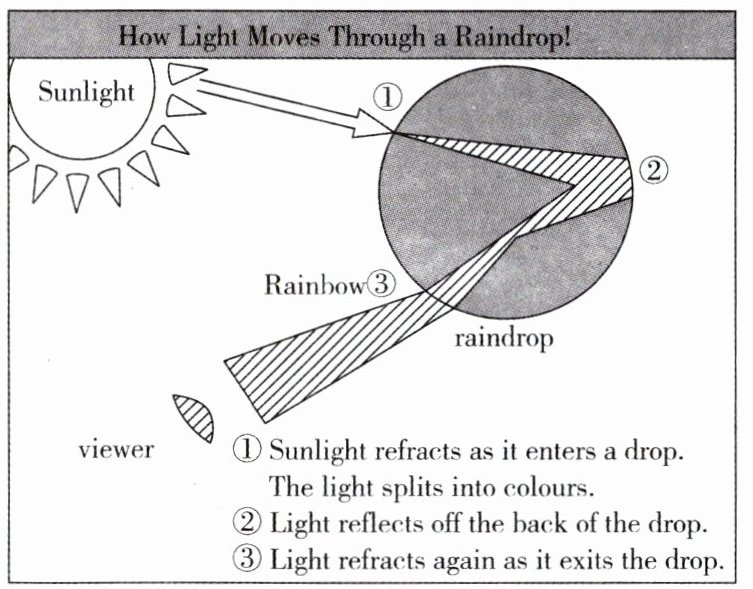
We can see rainbows in nature when direct light meets drops of rain. Sunlight refracts (折射) as it enters each drop. The light then reflects, or bounces, off the inside of each drop, like light off a mirror. The light refracts again as it exits the drop. Light refracts and reflects in millions of water droplets in the sky at the same time. This process makes all the colours of a rainbow.
1. Which sentence below can best explain the underlined sentence “Rainbows are beautiful tricks of light.” in Paragraph 1?
A. Rainbows are tricks made by many scientists.
B. Someone lied to us about the truth of rainbows.
C. Rainbows are made by some unknown magic tricks.
D. The light plays tricks on people's eyes and makes rainbows.
2. In which of the following situations, a rainbow CAN'T form?
A. Over a sprinkler on a very cloudy day.
B. On a misty morning.
C. Over a fountain under a bright moon.
D. In the mist of a waterfall.
3. 新考法 图示理解 Which could be the best picture for the underlined sentence in Paragraph 6?
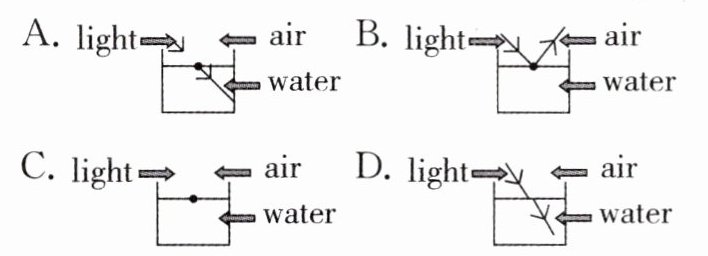
A. light→ air water
B. light→ air water
C. light→ air water
D. light→ air water
4. Which statement below is TRUE according to the article?
A. A rainbow can be a complete circle as well as a half circle.
B. You need to stand at a right angle to see a rainbow.
C. Light can actually make a pencil bend in water.
D. Light moves faster in thicker mediums like water.
跨学科 物理 Rainbows are created by light shining through water or clear objects. In nature, rainbows usually
appear where rain and sunlight meet. Rainbows are beautiful tricks of light. Science, though, has unlocked their mysteries.
Where and When Rainbows Appear
Notice the weather the next time you see a rainbow. There will be rain or mist (薄雾) in front of you, and the Sun will be shining from behind you. The rainbow will appear in the rain or mist. Water in the air and direct light are the two things needed to see a rainbow in nature. A rainbow won't appear if the sky is too cloudy.
The best time to see a rainbow is usually in the morning or late afternoon. That's when the Sun is in the best place to create one. If you're lucky, you might see a double or even a triple rainbow.
You can sometimes see rainbows in the mist of a waterfall, too. A fountain (喷泉) can create a small rainbow, and a sprinkler (洒水器) on a sunny day may put on a colourful show. Rainbows can even form under a bright moon. These special rainbows are called moonbows.
To a viewer, a rainbow looks like a half circle. However, a rainbow actually forms a full circle. From the ground, most times we can only see a rainbow's top half. Sometimes though, lucky airline pilots may see a rainbow's complete circle from the sky.
How Rainbows Form
René Descartes was a French scientist. He was born over four hundred years ago. He was attracted by rainbows and wanted to learn more about them. He used sunlight and a big ball filled with water to do experiments. Descartes discovered that to see a rainbow, the viewer must be looking at the light from the right angle (角度). To understand rainbows, it helps to understand how light travels. Light moves at different speeds through different mediums (介质). Think of running on land. Then imagine running in knee-deep water. You move slower through water. In the same way, light moves faster through air than through water. This happens because water is thicker than air. When light enters water, it slows and changes its original path (路线). This process makes objects, such as a pencil sitting in a glass of water seem to bend (弯曲).
We can see rainbows in nature when direct light meets drops of rain. Sunlight refracts (折射) as it enters each drop. The light then reflects, or bounces, off the inside of each drop, like light off a mirror. The light refracts again as it exits the drop. Light refracts and reflects in millions of water droplets in the sky at the same time. This process makes all the colours of a rainbow.
1. Which sentence below can best explain the underlined sentence “Rainbows are beautiful tricks of light.” in Paragraph 1?
A. Rainbows are tricks made by many scientists.
B. Someone lied to us about the truth of rainbows.
C. Rainbows are made by some unknown magic tricks.
D. The light plays tricks on people's eyes and makes rainbows.
2. In which of the following situations, a rainbow CAN'T form?
A. Over a sprinkler on a very cloudy day.
B. On a misty morning.
C. Over a fountain under a bright moon.
D. In the mist of a waterfall.
3. 新考法 图示理解 Which could be the best picture for the underlined sentence in Paragraph 6?
A. light→ air water
B. light→ air water
C. light→ air water
D. light→ air water
4. Which statement below is TRUE according to the article?
A. A rainbow can be a complete circle as well as a half circle.
B. You need to stand at a right angle to see a rainbow.
C. Light can actually make a pencil bend in water.
D. Light moves faster in thicker mediums like water.
答案
1~4 DADB
【文章大意】本文是一篇说明文,主要解释了彩虹是如何形成的,以及在什么条件下可以看到彩虹。
1. D 句意猜测题。根据“Rainbows are beautiful tricks of light.”可知,“彩虹是光的美丽把戏”,这句话的意思是光通过折射、反射等作用让我们看到彩虹,就好像在跟我们的眼睛玩把戏一样。因此 D 选项“光对人的眼睛玩把戏,从而形成彩虹”是最能解释这句话的。故选 D。
2. A 细节理解题。根据“A fountain can create a small rainbow, and a sprinkler on a sunny day may put on a colourful show.”及“A rainbow won't appear if the sky is too cloudy.”可知,洒水器在天气晴朗时可以形成彩虹,在多云天气不能形成彩虹。故选 A。
3. D 图示理解题。根据“When light enters water, it slows and changes its original path. This process makes objects, such as a pencil sitting in a glass of water seem to bend.”可知,当光进入水中时,它的速度会减慢,并且会改变其原本的传播路径。这一过程使得诸如放在水杯里的铅笔之类的物体看起来好像发生了弯曲。这里描述了光的折射现象,选项 D 显示了这个现象。故选 D。
4. B 判断正误题。根据“Descartes discovered that to see a rainbow, the viewer must be looking at the light from the right angle.”可知,观看者要在正确的角度才能看到彩虹。选项 B“你需要站在正确的角度才能看到彩虹。”表述正确。故选 B。
【文章大意】本文是一篇说明文,主要解释了彩虹是如何形成的,以及在什么条件下可以看到彩虹。
1. D 句意猜测题。根据“Rainbows are beautiful tricks of light.”可知,“彩虹是光的美丽把戏”,这句话的意思是光通过折射、反射等作用让我们看到彩虹,就好像在跟我们的眼睛玩把戏一样。因此 D 选项“光对人的眼睛玩把戏,从而形成彩虹”是最能解释这句话的。故选 D。
2. A 细节理解题。根据“A fountain can create a small rainbow, and a sprinkler on a sunny day may put on a colourful show.”及“A rainbow won't appear if the sky is too cloudy.”可知,洒水器在天气晴朗时可以形成彩虹,在多云天气不能形成彩虹。故选 A。
3. D 图示理解题。根据“When light enters water, it slows and changes its original path. This process makes objects, such as a pencil sitting in a glass of water seem to bend.”可知,当光进入水中时,它的速度会减慢,并且会改变其原本的传播路径。这一过程使得诸如放在水杯里的铅笔之类的物体看起来好像发生了弯曲。这里描述了光的折射现象,选项 D 显示了这个现象。故选 D。
4. B 判断正误题。根据“Descartes discovered that to see a rainbow, the viewer must be looking at the light from the right angle.”可知,观看者要在正确的角度才能看到彩虹。选项 B“你需要站在正确的角度才能看到彩虹。”表述正确。故选 B。
