

 登录
B(2025福建中考)
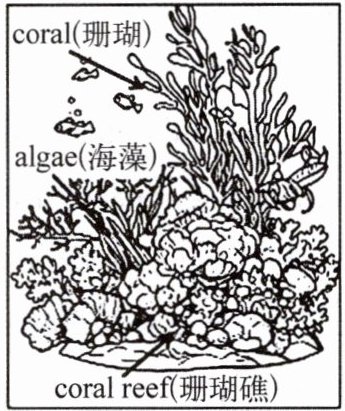
Deep under the Pacific Ocean lie coral reefs coloured by some algae that live with corals. Corals usually provide nitrogen(氮) for algae, and in return they get carbon(碳), which gives them energy.
In the early 1980s, a huge heat wave turned more than 90 percent of the corals a pale, lifeless white. And it was believed that about 50 percent of reefs with beautiful corals might disappear by 2030. Heat waves warmed up the same Pacific waters in the late 1990s and again in 2015-2016, but scientists noticed that these heat waves didn't influence the reefs as badly as the first. Maybe corals have found a way to adapt(适应).
$Swimming to cooler waters is not a good choice for corals, for it makes them easily hurt by the changing climate. But corals are able to adapt. Some turn to the algae that can deal well with heat. Others can use rows of tiny hairs on their bodies to "fan" away too much harmful oxygen(O_{2}) let out by stressed-out algae. Certain baby corals change their own metabolisms($新陈代谢) in order to fight the warming waters. But all these adaptations can protect themselves only to some degree.
After studying and understanding these adaptations, scientists are trying to find ways to help corals fight. If researchers can make corals accept algae that can deal with heat pressure or if they energize genes(基因) that can deal with heat pressure, it will raise corals' chance of living through future ocean heat waves.
"When I go down to the sea and see a beautiful healthy reef with these colourful corals, I feel this pleasure of being in this underwater world," a famous biologist says. "It will be really sad to see it dead. But that does drive you to want to use your skills and your love to help fight."
(
A. Corals make algae more colourful. B. Algae provide room for corals to live in.
C. Corals and algae depend on each other. D. Algae produce nitrogen to influence corals.
(
A. The heat wave in the early 1980s. B. The heat wave in the late 1990s.
C. The Pacific waters in 2015-2016. D. The reefs' disappearance by 2030.
(
A. They cannot completely adapt to heat waves.
B. They cannot change their own metabolisms.
C. They have no ability to swim to cooler waters.
D. They have no ability to drive away harmful oxygen.
(
A. It's necessary to live with corals. B. The ocean has become unhealthy.
C. We should try our best to save corals. D. Making a study of the ocean is a must.
(
A. Corals die out B. Corals fight back
C. Corals break down D. Corals come into being
Deep under the Pacific Ocean lie coral reefs coloured by some algae that live with corals. Corals usually provide nitrogen(氮) for algae, and in return they get carbon(碳), which gives them energy.
In the early 1980s, a huge heat wave turned more than 90 percent of the corals a pale, lifeless white. And it was believed that about 50 percent of reefs with beautiful corals might disappear by 2030. Heat waves warmed up the same Pacific waters in the late 1990s and again in 2015-2016, but scientists noticed that these heat waves didn't influence the reefs as badly as the first. Maybe corals have found a way to adapt(适应).
$Swimming to cooler waters is not a good choice for corals, for it makes them easily hurt by the changing climate. But corals are able to adapt. Some turn to the algae that can deal well with heat. Others can use rows of tiny hairs on their bodies to "fan" away too much harmful oxygen(O_{2}) let out by stressed-out algae. Certain baby corals change their own metabolisms($新陈代谢) in order to fight the warming waters. But all these adaptations can protect themselves only to some degree.
After studying and understanding these adaptations, scientists are trying to find ways to help corals fight. If researchers can make corals accept algae that can deal with heat pressure or if they energize genes(基因) that can deal with heat pressure, it will raise corals' chance of living through future ocean heat waves.
"When I go down to the sea and see a beautiful healthy reef with these colourful corals, I feel this pleasure of being in this underwater world," a famous biologist says. "It will be really sad to see it dead. But that does drive you to want to use your skills and your love to help fight."
(
C
) 5. What can we know from Paragraph 1?A. Corals make algae more colourful. B. Algae provide room for corals to live in.
C. Corals and algae depend on each other. D. Algae produce nitrogen to influence corals.
(
A
) 6. What does the underlined part "the first" in Paragraph 2 refer to?A. The heat wave in the early 1980s. B. The heat wave in the late 1990s.
C. The Pacific waters in 2015-2016. D. The reefs' disappearance by 2030.
(
A
) 7. What difficulty do corals face?A. They cannot completely adapt to heat waves.
B. They cannot change their own metabolisms.
C. They have no ability to swim to cooler waters.
D. They have no ability to drive away harmful oxygen.
(
C
) 8. What can we infer from the last paragraph?A. It's necessary to live with corals. B. The ocean has become unhealthy.
C. We should try our best to save corals. D. Making a study of the ocean is a must.
(
B
) 9. Which would be the best title for the text?A. Corals die out B. Corals fight back
C. Corals break down D. Corals come into being
答案
【语篇导读】本文阐述了海洋热浪给珊瑚礁带来的严重危害,介绍了珊瑚面对海洋热浪时的多种适应机制,并介绍了科学家为助力珊瑚礁应对海洋热浪所展开的一系列研究。
5. C 提示:推理判断题。根据第一段第二句"Corals usually provide nitrogen for algae, and in return they get carbon, which gives them energy."可知,珊瑚为海藻提供氮,作为回报,海藻给珊瑚提供给予它们能量的碳,这表明珊瑚和海藻相互依靠。
6. A 提示:语义指代题。文章第二段第一句"In the early 1980s, a huge heat wave turned more than 90 percent of the corals a pale, lifeless white."讲到了20世纪80年代初的热浪对珊瑚影响非常大;结合第二段倒数第二句"Heat waves warmed up the same Pacific waters in the late 1990s and again in 2015-2016, but scientists noticed that these heat waves didn't influence the reefs as badly as the first."可知,20世纪90年代末和2015—2016年的热浪对珊瑚的影响没有第一次那么严重,由此推知,画线词the first指代的是"20世纪80年代初的热浪"。
7. A 提示:细节理解题。根据第三段最后一句"But all these adaptations can protect themselves only to some degree."可知,珊瑚的这些适应都只能在一定程度上保护自己,意即它们不能完全适应热浪。
8. C 提示:推理判断题。根据最后一段最后两句"It will be really sad to see it dead. But that does drive you to want to use your skills and your love to help fight."可知,看到珊瑚死亡让人很难过,但这的确会驱使人们用技能和热爱去帮助它们对抗热浪,由此推知我们应该尽力去拯救珊瑚。
9. B 提示:主旨大意题。通读全文可知,文章介绍了热浪对珊瑚礁的影响、珊瑚对热浪的适应方式以及科学家为助力珊瑚礁应对热浪所开展的相关研究。归纳可知,文章围绕珊瑚对抗热浪展开,因此"珊瑚反击"最适合作为文章的标题。
