

 登录
二、读一读,连一连。
1. bulb
2. air conditioner
3. heater
4. electric car
B.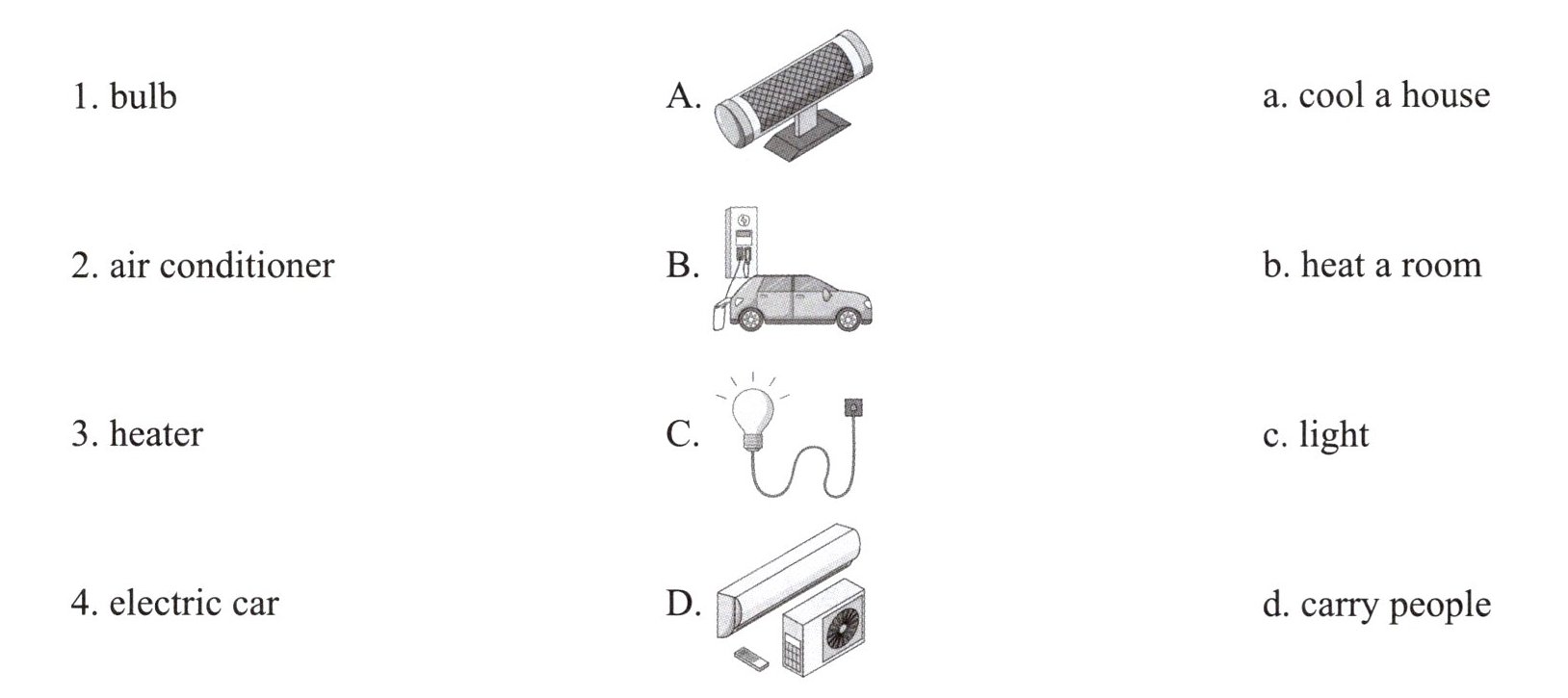
a. cool a house
b. heat a room
c. light
d. carry people
1. bulb
2. air conditioner
3. heater
4. electric car
B.
a. cool a house
b. heat a room
c. light
d. carry people
答案
1—C—c 2—D—a
3—A—b 4—B—d
3—A—b 4—B—d
解析
【分析】
本题为英语物品与功能的连线匹配题,解题思路为:先明确左侧每个英文物品的含义,再匹配中间对应的实物图,最后找到右侧对应的功能描述,逐一对应即可。具体步骤:1. 理解每个英文单词的词义;2. 匹配对应的实物图;3. 匹配对应的功能描述;4. 整理最终对应关系。
【解析】
1. bulb意为“灯泡”,对应图C(灯泡),功能是照明,对应c(light),故1—C—c;
2. air conditioner意为“空调”,对应图D(空调),功能是给房子降温,对应a(cool a house),故2—D—a;
3. heater意为“加热器/取暖器”,对应图A(取暖器),功能是给房间加热,对应b(heat a room),故3—A—b;
4. electric car意为“电动车”,对应图B(充电的汽车),功能是载人,对应d(carry people),故4—B—d。
【答案】
1—C—c 2—D—a 3—A—b 4—B—d
【知识点】
英语词汇匹配、日常物品功能
【点评】
本题为基础英语连线题,考察日常物品的英文词义与对应功能,难度较低,用于巩固基础词汇。
【难度系数】
0.3
三、阅读短文,判断句子正误,正确的写“T”,错误的写“F”。
Green energy in my life
My name is Lily. I live in a small town. In our town we use three types of green energy: wind power, solar power and water power. These types of energy are clean. They do not make the air dirty. In the morning, the sun shines (照耀) on our school roof (屋顶). Big black solar panels (太阳能板) catch the light. They turn the light into electricity. We use this electricity to turn on the TV and the computers in our classroom.
Near our school there is a tall windmill (风车). When the wind blows, the windmill turns around. The moving blades (转动的风片) make power. The power helps cook lunch in the school kitchen.
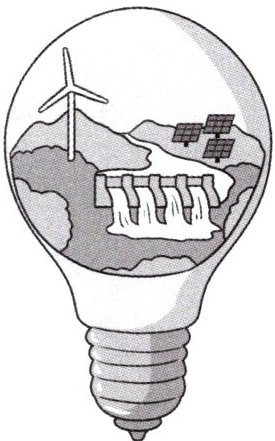
Behind the hill (小山), a river runs fast. A water wheel (水轮车) is in the river. The moving water pushes the wheel. The wheel gives power to the buses that take us home.
I like green energy because it keeps the sky blue and the river clean.
(
(
(
(
(
Green energy in my life
My name is Lily. I live in a small town. In our town we use three types of green energy: wind power, solar power and water power. These types of energy are clean. They do not make the air dirty. In the morning, the sun shines (照耀) on our school roof (屋顶). Big black solar panels (太阳能板) catch the light. They turn the light into electricity. We use this electricity to turn on the TV and the computers in our classroom.
Near our school there is a tall windmill (风车). When the wind blows, the windmill turns around. The moving blades (转动的风片) make power. The power helps cook lunch in the school kitchen.
Behind the hill (小山), a river runs fast. A water wheel (水轮车) is in the river. The moving water pushes the wheel. The wheel gives power to the buses that take us home.
I like green energy because it keeps the sky blue and the river clean.
(
F
) 1. The town uses four kinds of energy.(
T
) 2. The solar panels on the school roof make electricity for the TVs and computers.(
T
) 3. The windmill helps cook lunch in the school kitchen.(
F
) 4. The water wheel is in a lake behind the hill.(
F
) 5. Lily likes green energy because it keeps her home clean.答案
1. F 2. T 3. T 4. F 5. F
解析
【分析】
本题是英语阅读理解正误判断题,解题思路为:先通读短文理解大意,再针对每个题目中的句子,定位短文中对应的相关内容,将题目句子与原文信息逐一对比,判断是否一致,正确写“T”,错误写“F”。
【解析】
1. 题目1:短文明确提到小镇使用三种绿色能源(风能、太阳能、水能),并非四种,故判断为错误(F)。
2. 题目2:短文提到学校屋顶的太阳能板将光能转化为电能,用于教室的电视和电脑,与题目描述一致,故判断为正确(T)。
3. 题目3:短文提到风车产生的电力帮助学校厨房做午饭,与题目描述一致,故判断为正确(T)。
4. 题目4:短文提到水轮车在小山后的河里,并非湖里,故判断为错误(F)。
5. 题目5:短文提到Lily喜欢绿色能源是因为它让天空蓝、河流干净,并非让家干净,故判断为错误(F)。
【答案】
1.F 2.T 3.T 4.F 5.F
【知识点】
英语阅读理解、细节理解、正误判断
【点评】
本题考查学生对英语短文细节信息的提取与对比能力,属于基础题型,只要认真阅读原文、找准对应信息即可完成判断,难度较低。
【难度系数】
0.7
