

 登录
登录
问路小技巧,旅途更轻松
Asking for directions is a very common thing in our daily lives. However, do you know how to do that in foreign 1. (country)? Knowing it can make our stay there much 2. (easy). The way we ask for directions may influence the answers we get. Here 3. (be) some advice for you.
Use greetings and polite expressions
Starting the conversation 4. ______ a greeting is a must. If you want to get a nice explanation, begin by 5. ______ (say) “hello” first.
Know how to ask a question
Use proper words and try not 6. (leave) any information out. If you ask a question 7. (polite), there are more chances of getting an excellent answer.
Don’t be afraid of using landmarks(地标)
Every city in the world has its own landmarks. You can save some time if you know 8. the important landmarks are in the city. For example, in London, the main landmark is Big Ben.
There is no need to laugh at 9. (you) if you get lost. We may all get lost now and then, especially when visiting 10. new city!
视频精讲 口语朗读
语篇类型: 议论文
难度星级: ★★★★
建议用时: /10 min
参考答案: P15
Asking for directions is a very common thing in our daily lives. However, do you know how to do that in foreign 1. (country)? Knowing it can make our stay there much 2. (easy). The way we ask for directions may influence the answers we get. Here 3. (be) some advice for you.
Use greetings and polite expressions
Starting the conversation 4. ______ a greeting is a must. If you want to get a nice explanation, begin by 5. ______ (say) “hello” first.
Know how to ask a question
Use proper words and try not 6. (leave) any information out. If you ask a question 7. (polite), there are more chances of getting an excellent answer.
Don’t be afraid of using landmarks(地标)
Every city in the world has its own landmarks. You can save some time if you know 8. the important landmarks are in the city. For example, in London, the main landmark is Big Ben.
There is no need to laugh at 9. (you) if you get lost. We may all get lost now and then, especially when visiting 10. new city!
视频精讲 口语朗读
语篇类型: 议论文
难度星级: ★★★★
建议用时: /10 min
参考答案: P15
答案
1. countries 句意:然而,你知道如何在外国那样做吗?此处泛指外国,用复数形式 countries“国家”。
2. easier 句意:知道这一点可以使我们在那里的逗留更加容易。根据“much”可知,空处用比较级 easier“更容易的”。
3. is 句意:这里给你一些建议。句子是 here be 结构,主语 some advice 是不可数名词,且时态为一般现在时,be 动词用 is。
4. with 句意:以问候开始对话是必须的。根据“Starting the conversation ... a greeting”可知,是指以问候开始一段对话,介词 with“用”符合语境。
5. saying 句意:如果你想得到一个很好的解释,首先要说“你好”。by 是介词,后跟动名词。故填 saying。
6. to leave 句意:使用适当的词语,尽量不要遗漏任何信息。try not to do sth.“尽量不做某事”,空处用不定式。故填 to leave。
7. politely 句意:如果你礼貌地问一个问题,就更有可能得到一个很好的答案。空处修饰动词 ask,用副词形式 politely“礼貌地”。
8. what 句意:如果你知道这个城市的重要地标是什么,你可以节省一些时间。根据“the important landmarks are in the city”可知,是指这个城市重要的地标是什么,用 what 引导宾语从句。
9. yourself 句意:如果你迷路了,没有必要嘲笑自己。根据“if you get lost”可知,是指嘲笑自己,空处用反身代词 yourself“你自己”。
10. a 句意:我们可能都会时不时地迷路,尤其是在参观一座新城市的时候!此处泛指一座新城,且 new 是发音以辅音音素开头的单词,前面用不定冠词 a 修饰。
2. easier 句意:知道这一点可以使我们在那里的逗留更加容易。根据“much”可知,空处用比较级 easier“更容易的”。
3. is 句意:这里给你一些建议。句子是 here be 结构,主语 some advice 是不可数名词,且时态为一般现在时,be 动词用 is。
4. with 句意:以问候开始对话是必须的。根据“Starting the conversation ... a greeting”可知,是指以问候开始一段对话,介词 with“用”符合语境。
5. saying 句意:如果你想得到一个很好的解释,首先要说“你好”。by 是介词,后跟动名词。故填 saying。
6. to leave 句意:使用适当的词语,尽量不要遗漏任何信息。try not to do sth.“尽量不做某事”,空处用不定式。故填 to leave。
7. politely 句意:如果你礼貌地问一个问题,就更有可能得到一个很好的答案。空处修饰动词 ask,用副词形式 politely“礼貌地”。
8. what 句意:如果你知道这个城市的重要地标是什么,你可以节省一些时间。根据“the important landmarks are in the city”可知,是指这个城市重要的地标是什么,用 what 引导宾语从句。
9. yourself 句意:如果你迷路了,没有必要嘲笑自己。根据“if you get lost”可知,是指嘲笑自己,空处用反身代词 yourself“你自己”。
10. a 句意:我们可能都会时不时地迷路,尤其是在参观一座新城市的时候!此处泛指一座新城,且 new 是发音以辅音音素开头的单词,前面用不定冠词 a 修饰。
一、阅读短文,在空白处填入1个适当的单词或括号内单词的正确形式。
二、新考法 应用实践 假如你正在南京旅游,需要向路人问路。请填写合适的句子,完成对话。
You: 1.
Passer-by: Yeah. It's near Xuanwu Lake.
You: 2.
Passer-by: Take Metro Line 4, and get off at Jiming Temple Station. Then walk for a few minutes. You can find some signs there.
You: 3.
Passer-by: You're welcome. Enjoy your trip!
词汇积累
foreign /ˈfɒrən/ adj. 外国的
polite /pəˈlaɪt/ adj. 礼貌的
explanation /ˌekspləˈneɪʃn/ n. 解释
information /ˌɪnfəˈmeɪʃn/ n. 信息
excellent /ˈeksələnt/ adj. 优秀的
own /əʊn/ adj. 自己的
语法充电
if 意为“如果”,主要用于引导条件状语从句,表示某个条件必须满足才能发生另一件事。用于表达可能性、结果和假设。例:
If it rains, we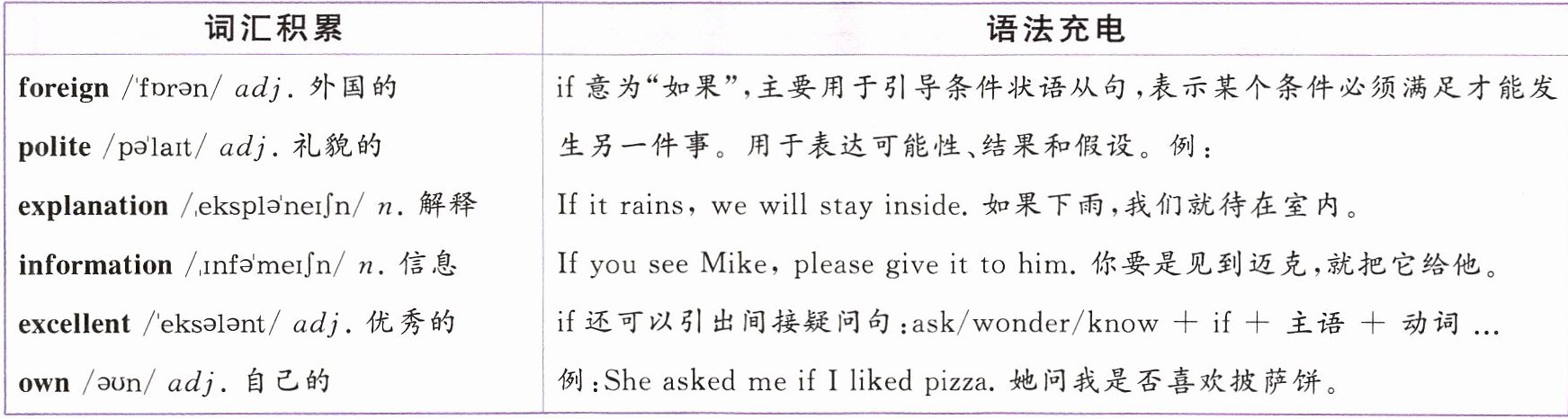 stay inside. 如果下雨,我们就待在室内。
If you see Mike, please give it to him. 你要是见到迈克,就把它给他。
if 还可以引出间接疑问句:ask/wonder/know + if + 主语 + 动词 ...
例:She asked me if I liked pizza. 她问我是否喜欢披萨饼。
二、新考法 应用实践 假如你正在南京旅游,需要向路人问路。请填写合适的句子,完成对话。
You: 1.
Excuse me./Hello.
Do you know where Jiming Temple is?Passer-by: Yeah. It's near Xuanwu Lake.
You: 2.
Could you please tell me how to get there?/How can I get there?
Passer-by: Take Metro Line 4, and get off at Jiming Temple Station. Then walk for a few minutes. You can find some signs there.
You: 3.
Thank you (very much)./Thanks for your help!/Great! Thanks!
Passer-by: You're welcome. Enjoy your trip!
词汇积累
foreign /ˈfɒrən/ adj. 外国的
polite /pəˈlaɪt/ adj. 礼貌的
explanation /ˌekspləˈneɪʃn/ n. 解释
information /ˌɪnfəˈmeɪʃn/ n. 信息
excellent /ˈeksələnt/ adj. 优秀的
own /əʊn/ adj. 自己的
语法充电
if 意为“如果”,主要用于引导条件状语从句,表示某个条件必须满足才能发生另一件事。用于表达可能性、结果和假设。例:
If it rains, we
stay inside. 如果下雨,我们就待在室内。If you see Mike, please give it to him. 你要是见到迈克,就把它给他。
if 还可以引出间接疑问句:ask/wonder/know + if + 主语 + 动词 ...
例:She asked me if I liked pizza. 她问我是否喜欢披萨饼。
答案
二、(答案不唯一)1. Excuse me./Hello.
2. Could you please tell me how to get there?/How can I get there?
3. Thank you (very much)./Thanks for your help!/Great! Thanks!
⚠学霸教研 问路实践举例
这里列举一些日常实用的问句型(通常开头都加上“Excuse me.”):
How do I get to [place] from here?
我从这儿到[地方]怎么走?
Is this the right way to [place]?
这条路是去[地方]的吗?
Do you know where [place] is?
你知道[地方]在哪里吗?
I'm trying to get to [place]. Can you help me out? 我正在找去[地方]的路,你能帮我一下吗?
Could you point me in the direction of [place]?
你能给我指一下[地方]的方向吗?
I'm looking for [place]. It's supposed to be near [landmark/street]. Are you familiar with the area? 我正在找[地方],应该靠近[地标/街道]。请问你熟悉这片区域吗?
2. Could you please tell me how to get there?/How can I get there?
3. Thank you (very much)./Thanks for your help!/Great! Thanks!
⚠学霸教研 问路实践举例
这里列举一些日常实用的问句型(通常开头都加上“Excuse me.”):
How do I get to [place] from here?
我从这儿到[地方]怎么走?
Is this the right way to [place]?
这条路是去[地方]的吗?
Do you know where [place] is?
你知道[地方]在哪里吗?
I'm trying to get to [place]. Can you help me out? 我正在找去[地方]的路,你能帮我一下吗?
Could you point me in the direction of [place]?
你能给我指一下[地方]的方向吗?
I'm looking for [place]. It's supposed to be near [landmark/street]. Are you familiar with the area? 我正在找[地方],应该靠近[地标/街道]。请问你熟悉这片区域吗?
