

 登录
任务1 完形填空
$Hi, everyone! Today I am talking about table manners. Table manners are all the \underline{\quad1\quad} we should follow when we are eating with other people.$
$My parents told me not to put too much food in my mouth, \underline{\quad2\quad} they told me not to put the knife in my mouth or lick it. This is about safety as well as manners. I hate it when people talk with food in their mouths. There is one thing I hate even more. It's when people \underline{\quad3\quad} about the food they are eating while they are still eating it.$
$The next important rule is that if you don't eat something, then you need to tell the host. Don't wait until you arrive, or everyone might have an \underline{\quad4\quad} time. If you forget to tell the host beforehand, then you need to eat what you are given.$
$It's okay if you do not want tea, coffee or another drink that is \underline{\quad5\quad}. But don't turn your cup over or put your hand over the top. Just tell whoever is serving that you do not want it.$
$An important rule is that if you cannot \underline{\quad6\quad} something, you should ask for it. So we often have to pass food and plates around. They should be passed around the table to the right. If you are passed something that you do not want, then you should \underline{\quad7\quad} passing it on. Don't just put it down.$
$Plates should be taken away only when \underline{\quad8\quad} at the table has finished eating. You should put your knife and fork together pointing up from the bottom of the plate. Then everyone knows you have finished.$
$Take care not to leave a meal too early. That looks as if you only came for the meal and not the \underline{\quad9\quad}. One thing that happens all too often is that people forget to say "thank you". Make sure you \underline{\quad10\quad} your host when you leave. Also send a text or an email after the meal. A handwritten thank-you note will show you really have manners!$
1. A. laws
B. rules
C. senses
D. messages
2. A. and
B. but
C. or
D. so
3. A. talk
B. care
C. agree
D. complain
4. A. unusual
B. excellent
C. enjoyable
D. uncomfortable
5. A. offered
B. needed
C. limited
D. finished
6. A. avoid
B. reach
C. afford
D. choose
7. A. keep
B. risk
C. stop
D. remember
8. A. someone
B. anyone
C. everyone
D. no one
9. A. food
B. drink
C. event
D. culture
10. A. treat
B. thank
C. greet
D. invite
任务2 阅读理解
新考法 推断写作手法 What is the way to organize the ideas in the article?
A. Time order.
B. Specific to general.
C. Space order.
D. General to specific.
答案
任务1:[文章大意]本文是一篇说明文。文章主要介绍了一些餐桌礼仪。
1. B [解析]考查名词辨析。句意:餐桌礼仪是指我们和他人一起用餐时应该遵守的所有规则。law法律;rule规则;sense感觉;message信息。根据"we should follow when we are eating with other people"可知,餐桌礼仪是我们和他人一起用餐时应该遵守的规则。故选 B。
2. A [解析]考查连词辨析。句意:我的父母告诉我不要把太多的食物放在嘴里,并且他们告诉我不要把刀放在嘴里或舔它。and 并且;but 但是;or 或者;so 所以。根据"My parents told me not to put too much food in my mouth... they told me not to put the knife in my mouth or lick it."可知,空格前后为并列关系,故应用 and。故选 A。
3. D [解析]考查动词辨析。句意:那就是人们一边吃一边抱怨他们正在吃的食物。talk 谈论;care 在意;agree 同意;complain 抱怨。根据"There is one thing I hate even more. It's when people... about the food they are eating while they are still eating it."可知,"我"非常讨厌人们一边抱怨他们所吃的食物,一边仍然在吃它。故选 D。
4. D [解析]考查形容词辨析。句意:不要等到你到达后(再说),否则每个人都可能会有一段不舒服的时光。unusual不同寻常的;excellent 极好的;enjoyable 使人快乐的;uncomfortable 不舒服的。根据“Don't wait until you arrive”可知,如果到地方后才说自己不吃某些食物,这可能会让大家感到不舒服。故选 D。
5. A [解析]考查动词辨析。句意:如果你不想喝提供的茶、咖啡或其他饮料,也没关系。offer 提供;need 需要;limit 限制;finish 完成。根据"It's okay if you do not want tea, coffee or another drink that is..."可知,这些饮料应该是被提供的。故选 A。
6. B [解析]考查动词辨析。句意:一个重要的规则是:如果你够不到某个东西,你应该提出请求。avoid 避免;reach 够得到;afford 买得起;choose 选择。根据“you should ask for it”可知,如果你够不到某个东西,应该提出请求。故选 B。
7. A [解析]考查动词辨析。句意:如果你被传递了一些你不想要的东西,那么你应该继续传递下去。keep 继续;risk 冒险;stop 停止;remember 记住。根据“Don't just put it down.”可知,此处指要继续传下去。故选 A。
8. C [解析]考查代词(短语)辨析。句意:盘子只有在餐桌上的每个人都吃完后才能收走。someone 某人;anyone 任何人;everyone 每人,所有人;no one 没有人。根据"Plates should be taken away only when... at the table has finished eating."可知,所有人都吃完后才能收走盘子。故选 C。
9. C [解析]考查名词辨析。句意:看起来你只是来吃饭而不是来参加聚餐这个活动的。food 食物;drink 饮料;event 活动;culture 文化。根据"Take care not to leave a meal too early. That looks as if you only came for the meal and not the..."可知,用完餐后应注意不要太早离开。这样做的话,看起来你只是来吃饭而不是来参加聚餐这个活动的。故选 C。
10. B [解析]考查动词辨析。句意:当你离开的时候一定要感谢主人。treat 招待;thank 感谢;greet 打招呼;invite 邀请。根据"One thing that happens all too often is that people forget to say 'thank you'."可知,此处指离开时要感谢主人。故选 B。
任务2:D
情境2 中国礼仪文化源远流长,自周朝便形成完整体系。古今礼制虽有所不同,但诸多传统礼仪仍在重要场合被奉为举止得体的典范。
实验班提优训练 英语八年级 下 YL
任务1 阅读理解
Since the Zhou Dynasty (1046 BC—256 BC), a complete etiquette system has been set up. Today, many of these rules are not as strict(严格的) as before. However, some are still followed on important occasions(场合) and are thought of as good examples of good manners.
Walking Etiquette
① In ancient China, while walking with someone with a higher status(地位) or an old person, one should lower his or her head, bend down, and walk a little bit behind them. If three people walk together, the elder or a teacher should be in the middle. One should bow down and walk fast using smaller steps when passing by an elder or a teacher.
Sitting Etiquette and Seating Rules
② Everyone should be sitting in a proper position(位置) at dining tables. It is based on their titles, ranks, or age. If someone doesn't know the exact position, they should wait and follow the host's lead. The best seat is the one that faces the east or the door. Hosts usually sit facing the west.
Bow and Fist-and-Palm Salute(抱拳)
③ Bowing in Chinese Yi Li or Zuo Yi means folding (折叠) one's hands in front in different ways. Today, however, the simplest Zuo Yi gesture is good enough, as well as nodding, smiling, and handshaking.
④ The Fist-and-Palm Salute is another type of Yi Li, with the right hand covered by the left hand. It first appeared in the army when people held weapons (武器) while showing respect to others. So, people always use the left hand to cover the right hand that holds weapons.
1. In ancient China, which place should your teacher be when walking with you and your classmate?
A. In the middle.
B. On the left.
C. On the right.
D. At the back.
2. 新考法 句子还原 Where can we put the sentence "The seating order is still widely used in family and business dinners." in the passage?
A. ①
B. ②
C. ③
D. ④
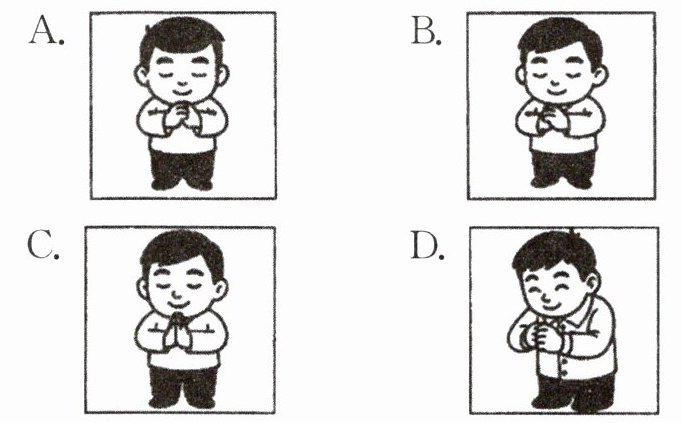
3. 新考法 图片理解 Which of the following pictures correctly describes "the Fist-and-Palm Salute"?
4. 新考法 推断作者写作意图 Why is the underlined sentence included in the last paragraph?
A. To give an example.
B. To set the order.
C. To add background information.
D. To show a result.
5. 新考法 推断后续发展 What may the writer talk about in the following paragraph?
A. Another kind of Chinese etiquette.
B. Another kind of Western etiquette.
C. Differences among the three kinds of etiquette.
D. Differences between Chinese and Western etiquette.
任务2 阅读表达
新考法 开放式谈个人看法 What do you think of traditional Chinese etiquette?
实验班提优训练 英语八年级 下 YL
任务1 阅读理解
Since the Zhou Dynasty (1046 BC—256 BC), a complete etiquette system has been set up. Today, many of these rules are not as strict(严格的) as before. However, some are still followed on important occasions(场合) and are thought of as good examples of good manners.
Walking Etiquette
① In ancient China, while walking with someone with a higher status(地位) or an old person, one should lower his or her head, bend down, and walk a little bit behind them. If three people walk together, the elder or a teacher should be in the middle. One should bow down and walk fast using smaller steps when passing by an elder or a teacher.
Sitting Etiquette and Seating Rules
② Everyone should be sitting in a proper position(位置) at dining tables. It is based on their titles, ranks, or age. If someone doesn't know the exact position, they should wait and follow the host's lead. The best seat is the one that faces the east or the door. Hosts usually sit facing the west.
Bow and Fist-and-Palm Salute(抱拳)
③ Bowing in Chinese Yi Li or Zuo Yi means folding (折叠) one's hands in front in different ways. Today, however, the simplest Zuo Yi gesture is good enough, as well as nodding, smiling, and handshaking.
④ The Fist-and-Palm Salute is another type of Yi Li, with the right hand covered by the left hand. It first appeared in the army when people held weapons (武器) while showing respect to others. So, people always use the left hand to cover the right hand that holds weapons.
1. In ancient China, which place should your teacher be when walking with you and your classmate?
A. In the middle.
B. On the left.
C. On the right.
D. At the back.
2. 新考法 句子还原 Where can we put the sentence "The seating order is still widely used in family and business dinners." in the passage?
A. ①
B. ②
C. ③
D. ④
3. 新考法 图片理解 Which of the following pictures correctly describes "the Fist-and-Palm Salute"?
4. 新考法 推断作者写作意图 Why is the underlined sentence included in the last paragraph?
A. To give an example.
B. To set the order.
C. To add background information.
D. To show a result.
5. 新考法 推断后续发展 What may the writer talk about in the following paragraph?
A. Another kind of Chinese etiquette.
B. Another kind of Western etiquette.
C. Differences among the three kinds of etiquette.
D. Differences between Chinese and Western etiquette.
任务2 阅读表达
新考法 开放式谈个人看法 What do you think of traditional Chinese etiquette?
It's great and valuable.
答案
任务1:[文章大意]本文是一篇说明文,主要介绍了中国古代的三种礼仪规范:行走礼仪、座次礼仪和作揖礼,并提及部分礼仪在现代的简化应用。
1. A [解析]细节理解题。根据第二段中的"If three people walk together, the elder or a teacher should be in the middle."可知,在古代,老师应走在"我"和"我"的同学之间。故选 A。
2. B [解析]句子还原题。根据"The seating order is still widely used in family and business dinners."可知,此句与座次礼仪和座位规则有关;结合第三段中的"Everyone should be sitting in a proper position(位置) at dining tables."可知,此处也与座位规则有关,故此句适合放在②处。故选 B。
3. B [解析]图片理解题。根据第五段中的"The Fist-and-Palm Salute is another type of Yi Li, with the right hand covered by the left hand."可知,抱拳礼为左手在上、右手在下。选项中仅 B 项符合描述。故选 B。
4. D [解析]推理判断题。根据画线句开头的逻辑连接词"So"可知,该句与前一句构成因果关系。前一句说明了抱拳礼最初出现在军队中,当时人们手持武器向他人表示敬意;画线句则解释了由此推导出的结果,即因此人们总是用左手盖住持武器的右手。故选 D。
5. A [解析]推理判断题。通读全文可知,全文围绕中国古代礼仪展开。因此,末段提及抱拳礼后,下文最可能延续同类主题,即介绍另一种中国礼仪。故选 A。
任务2:It's great and valuable.(开放性试题,言之有理即可)
