

 登录
1.写出下列语篇中代词it的用法
①It is sunny today, and our class is talking about Asian cultures. ② It is important for us to learn about different traditions across Asia. I love Chinese paper-cutting best. ③It carries a history of thousands of years in China. I find ④it interesting to compare Chinese tea culture with Japanese tea culture. ⑤It is necessary to respect every culture, because ⑥it makes the whole world colourful and wonderful.
①
④
2.用方框中所给短语的适当形式填空
cheer up pass down look up to work on
Yuan Longping ①
语法点1:代词it的用法
1.指代动物或者无生命的事物
2.指代不清楚性别的婴儿
3.指代不明身份的人
4.指代前面提到过的动作或事件
5.指代时间、日期、天气、距离、温度等
6.用作形式主语或形式宾语
➤更多讲练见本册P157
语法点2:动词短语
常见的三种形式:
1.动词+副词
2.动词+介词
3.动词+副词+介词
➤更多讲练见本册P174
①It is sunny today, and our class is talking about Asian cultures. ② It is important for us to learn about different traditions across Asia. I love Chinese paper-cutting best. ③It carries a history of thousands of years in China. I find ④it interesting to compare Chinese tea culture with Japanese tea culture. ⑤It is necessary to respect every culture, because ⑥it makes the whole world colourful and wonderful.
①
指代天气
②作形式主语
③指代上文的 paper-cutting
④
作形式宾语
⑤作形式主语
⑥指代上文提到的动作(尊重每一种文化)
2.用方框中所给短语的适当形式填空
cheer up pass down look up to work on
Yuan Longping ①
worked on
hybrid rice research in the test fields for decades. His achievements reduced the risk of food shortages and ②cheered up
millions of poor people. I ③have looked up to
him since I was a child because he devoted himself to feeding the whole world. His spirit will be ④passed down
from generation to generation.语法点1:代词it的用法
1.指代动物或者无生命的事物
2.指代不清楚性别的婴儿
3.指代不明身份的人
4.指代前面提到过的动作或事件
5.指代时间、日期、天气、距离、温度等
6.用作形式主语或形式宾语
➤更多讲练见本册P157
语法点2:动词短语
常见的三种形式:
1.动词+副词
2.动词+介词
3.动词+副词+介词
➤更多讲练见本册P174
答案
1. ① 指代天气 ② 作形式主语 ③ 指代上文的 paper-cutting ④ 作形式宾语 ⑤ 作形式主语 ⑥ 指代上文提到的动作(尊重每一种文化)
2. ① worked on ② cheered up ③ have looked up to ④ passed down
2. ① worked on ② cheered up ③ have looked up to ④ passed down
一词多义·提优 答案见答案精析册 P10
| 词汇 | 教材溯源 | 迁移中考(选出黑体词在不同语境中的最佳释义) |
| --- | --- | --- |
| 1.trade | vt.&vi.从事贸易
Many ships come in to trade every day. 每天有许多船只进港进行贸易。(九下 Unit 1 P15) | ①n.贸易,交易 ②vt.&vi.从事贸易 ③vt.互相交换;以物易物
•
•
•
| 2.serve | vt.&vi.端上,提供;服务,(为……)工作
Curry, often served with rice 咖喱通常与米饭搭配食用(九下 Unit 1 P17) | ①vt.&vi.端上,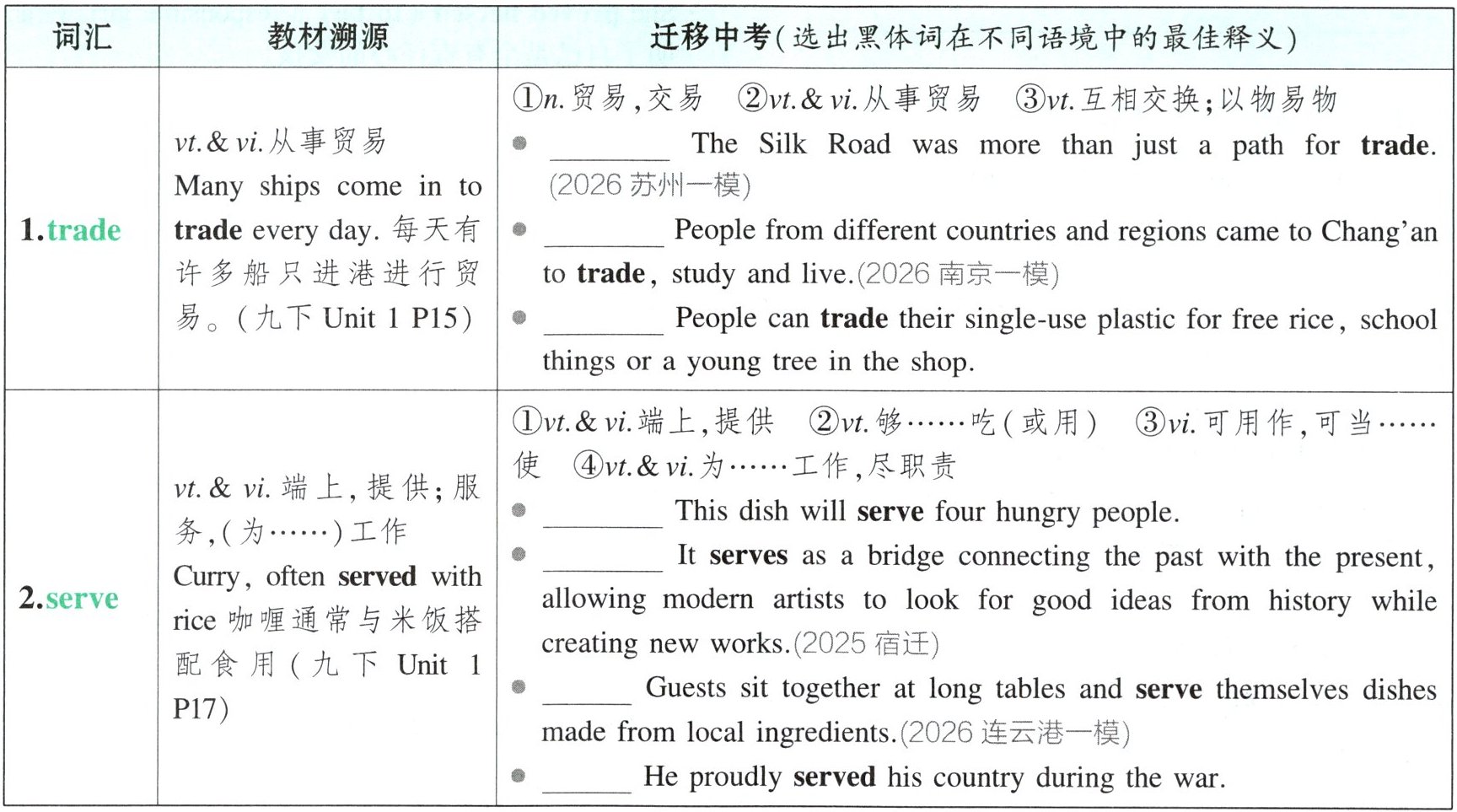 提供 ②vt.够……吃(或用) ③vi.可用作,可当……使 ④vt.&vi.为……工作,尽职责
•
•
•
•
| 词汇 | 教材溯源 | 迁移中考(选出黑体词在不同语境中的最佳释义) |
| --- | --- | --- |
| 1.trade | vt.&vi.从事贸易
Many ships come in to trade every day. 每天有许多船只进港进行贸易。(九下 Unit 1 P15) | ①n.贸易,交易 ②vt.&vi.从事贸易 ③vt.互相交换;以物易物
•
①
The Silk Road was more than just a path for trade.(2026苏州一模)•
②
People from different countries and regions came to Chang'an to trade, study and live.(2026南京一模)•
③
People can trade their single-use plastic for free rice, school things or a young tree in the shop. || 2.serve | vt.&vi.端上,提供;服务,(为……)工作
Curry, often served with rice 咖喱通常与米饭搭配食用(九下 Unit 1 P17) | ①vt.&vi.端上,
提供 ②vt.够……吃(或用) ③vi.可用作,可当……使 ④vt.&vi.为……工作,尽职责•
②
This dish will serve four hungry people.•
③
It serves as a bridge connecting the past with the present, allowing modern artists to look for good ideas from history while creating new works.(2025宿迁)•
①
Guests sit together at long tables and serve themselves dishes made from local ingredients.(2026连云港一模)•
④
He proudly served his country during the war. |答案
1. ①②③
2. ②③①④
2. ②③①④
