

 登录
B(2026·泰州泰兴期末)
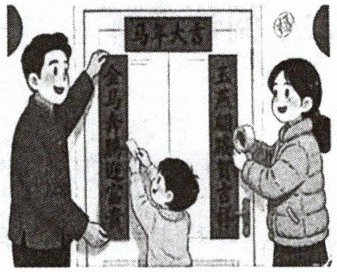
The Spring Festival couplets are an important part of the Chinese New Year culture. People write the Spring Festival couplets with black or golden words on red paper. They put up a pair of lines on each side of the front door. Putting up couplets shows people's happiness during the festival and wishes for a better life in the coming year.
In a pair of the Spring Festival couplets, the first line and the second line have the same number of words, and their meanings match each other well. The horizontal scroll(横批) is a four-word phrase. It has the two lines' meanings.
Reading the Spring Festival couplets is interesting. Here is the way: First, look at the horizontal scroll. If the four words are from left to right, the first line will be on the left and the second line on the right. If opposite, we read them from right to left.
The Spring Festival couplets started from taofu, some words on peach boards, in the Zhou Dynasty. At that time, people thought that peach trees could stop bad things, so they put peach boards with words on the doors. This tradition lasted till the Tang Dynasty. During the Song Dynasty, people began to write the Spring Festival couplets on paper. It became popular in the Ming Dynasty. Zhu Yuanzhang found those pairs of lines interesting, so he asked all families to put up the lines during the Chinese New Year.
1. What is the special meaning of putting up Spring Festival couplets?
A. It carries people's wishes for a good new year.
B. It helps people remember Zhu Yuanzhang forever.
C. It makes houses beautiful with no special meaning.
D. It helps people sell more red paper and peach boards.
2. What does the underlined word "opposite" mean in Chinese in Paragraph 4?
A. 类似 B. 可能 C. 相反 D. 必要
3. What does Paragraph 4 mainly talk about?
A. Where we read the Spring Festival couplets. B. How we read the Spring Festival couplets.
C. How we write the Spring Festival couplets. D. Where we write the Spring Festival couplets.
4. Which of the following is TRUE about the Spring Festival couplets?
A. The words are black or red. B. Each line of them has four words.
C. The meaning of each line matches. D. People put them up on their windows.
5. What can we learn about the Spring Festival couplets in different dynasties?
A. The peach boards in the Tang Dynasty had no words.
B. People in the Zhou Dynasty put paper couplets on their doors.
C. People in the Song Dynasty used peach boards with words.
D. All families began to put up paper couplets in the Ming Dynasty.
The Spring Festival couplets are an important part of the Chinese New Year culture. People write the Spring Festival couplets with black or golden words on red paper. They put up a pair of lines on each side of the front door. Putting up couplets shows people's happiness during the festival and wishes for a better life in the coming year.
In a pair of the Spring Festival couplets, the first line and the second line have the same number of words, and their meanings match each other well. The horizontal scroll(横批) is a four-word phrase. It has the two lines' meanings.
Reading the Spring Festival couplets is interesting. Here is the way: First, look at the horizontal scroll. If the four words are from left to right, the first line will be on the left and the second line on the right. If opposite, we read them from right to left.
The Spring Festival couplets started from taofu, some words on peach boards, in the Zhou Dynasty. At that time, people thought that peach trees could stop bad things, so they put peach boards with words on the doors. This tradition lasted till the Tang Dynasty. During the Song Dynasty, people began to write the Spring Festival couplets on paper. It became popular in the Ming Dynasty. Zhu Yuanzhang found those pairs of lines interesting, so he asked all families to put up the lines during the Chinese New Year.
1. What is the special meaning of putting up Spring Festival couplets?
A. It carries people's wishes for a good new year.
B. It helps people remember Zhu Yuanzhang forever.
C. It makes houses beautiful with no special meaning.
D. It helps people sell more red paper and peach boards.
2. What does the underlined word "opposite" mean in Chinese in Paragraph 4?
A. 类似 B. 可能 C. 相反 D. 必要
3. What does Paragraph 4 mainly talk about?
A. Where we read the Spring Festival couplets. B. How we read the Spring Festival couplets.
C. How we write the Spring Festival couplets. D. Where we write the Spring Festival couplets.
4. Which of the following is TRUE about the Spring Festival couplets?
A. The words are black or red. B. Each line of them has four words.
C. The meaning of each line matches. D. People put them up on their windows.
5. What can we learn about the Spring Festival couplets in different dynasties?
A. The peach boards in the Tang Dynasty had no words.
B. People in the Zhou Dynasty put paper couplets on their doors.
C. People in the Song Dynasty used peach boards with words.
D. All families began to put up paper couplets in the Ming Dynasty.
答案
B
【语篇导读】本文介绍了中国春节文化的重要组成部分——春联,包括其书写形式、结构特点、张贴与阅读方法、文化寓意及历史演变。
1. A 提示:细节理解题。根据第二段最后一句“Putting up couplets shows people's happiness during the festival and wishes for a better life in the coming year.”可知,贴春联表达了人们过春节的喜悦和对来年美好生活的期待。
2. C 提示:词义猜测题。根据第四段第三句“If the four words are from left to right, the first line will be on the left and the second line on the right.”以及画线词所在句“If opposite, we read them from right to left.”可知,文中对比了横批“从左到右”和“从右到左”书写时春联的两种不同的阅读方式,因此画线词 opposite 意为“相反”。
3. B 提示:段落大意题。根据第四段第一、二句“Reading the Spring Festival couplets is interesting. Here is the way...”可知,本段主要介绍了阅读春联的方式。
4. C 提示:细节理解题。根据第三段第一句“In a pair of the Spring Festival couplets, the first line and the second line have the same number of words, and their meanings match each other well.”可知,春联的上下联字数相同、意义相匹配。
5. D 提示:细节理解题。根据最后一段最后两句“It became popular in the Ming Dynasty. Zhu Yuanzhang found those pairs of lines interesting, so he asked all families to put up the lines during the Chinese New Year.”可知,在明朝,朱元璋要求所有家庭在春节期间贴春联,D项正确。
解析
【分析】
本题是关于春联的英语阅读理解题,共5道题型,包含细节理解、词义猜测、段落大意类题目。解题思路为:先通读全文把握春联相关内容,再针对每道题的问题,回到原文定位对应语句,分析选项与原文的匹配度,逐一排除错误选项得出答案。
【解析】
1. 第1题(细节理解题):根据原文第二段最后一句“Putting up couplets shows people's happiness during the festival and wishes for a better life in the coming year.”,可知贴春联表达人们对来年美好生活的祝愿,对应选项A。
2. 第2题(词义猜测题):原文提到横批从左到右时的贴法,“opposite”对应相反的情况,即横批从右到左,因此词义为“相反”,选C。
3. 第3题(段落大意题):第四段开头明确说明“Reading the Spring Festival couplets is interesting. Here is the way...”,可知本段主要介绍阅读春联的方式,选B。
4. 第4题(细节理解题):根据第三段第一句“In a pair of the Spring Festival couplets, the first line and the second line have the same number of words, and their meanings match each other well.”,可知春联上下联意义匹配,对应选项C;A选项是黑/金字写在红纸上,B选项横批为四字而非每联四字,D选项贴在门两侧而非窗户,均错误。
5. 第5题(细节理解题):根据最后一段最后两句“It became popular in the Ming Dynasty. Zhu Yuanzhang found those pairs of lines interesting, so he asked all families to put up the lines during the Chinese New Year.”,可知明朝时所有家庭开始贴春联,对应选项D;A选项周朝桃板有字,B选项宋朝才用纸春联,C选项宋朝用纸春联而非桃板,均错误。
【答案】
1.A 2.C 3.B 4.C 5.D
【知识点】
英语阅读理解、词义猜测、段落大意归纳
【点评】
本题围绕中国传统春联展开英语阅读考查,题型涵盖细节理解、词义猜测、段落大意,既考查学生的英语阅读能力,也涉及中国文化常识,题目设置贴合基础考点,难度适中。
【难度系数】
0.6
