

 登录
登录
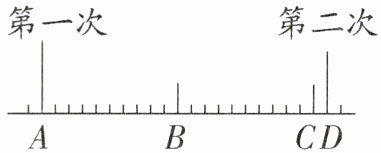
1. ★★★|新素材 为测试某步枪射出子弹飞行的平均速度,一士兵手持步枪在空旷的靶场瞄准510 m处的靶射击,射击位置旁边的声波探测器先后探测到两次较强声波,并在示波器上显示出来(如图所示)。已知第一次(A点)是枪响的声波,第二次(D点)是子弹击中靶的声波,示波器上AB之间时间相差1 s,且每个小格分布均匀。已知声音在空气中的传播速度是340 m/s。求:
(1)听到两次声音的时间间隔;
(2)子弹击中靶的声音传到人耳处所需时间;
(3)子弹飞行的平均速度。
(1)听到两次声音的时间间隔;
(2)子弹击中靶的声音传到人耳处所需时间;
(3)子弹飞行的平均速度。
答案
(1)2.1 s
(2)1.5 s
(3)850 m/s
解析:(1)示波器上AB之间有10个小格,时间相差1 s,每一小格为0.1 s,则两次声音的时间间隔Δt=2.1 s。
(2)靶与射击者的距离s=510 m,声音在空气中的传播速度v声=340 m/s,根据v=s/t可得,子弹击中靶的声音传到人耳处所需时间为t声=s/v声=510 m/340 m/s=1.5 s。
(3)两次声音的时间间隔等于子弹的飞行时间加上中靶声的传播时间,即t子弹+t声=Δt,则子弹飞行的时间为t子弹=Δt-t声=2.1 s-1.5 s=0.6 s,子弹飞行的平均速度为v子弹=s/t子弹=510 m/0.6 s=850 m/s。
(2)1.5 s
(3)850 m/s
解析:(1)示波器上AB之间有10个小格,时间相差1 s,每一小格为0.1 s,则两次声音的时间间隔Δt=2.1 s。
(2)靶与射击者的距离s=510 m,声音在空气中的传播速度v声=340 m/s,根据v=s/t可得,子弹击中靶的声音传到人耳处所需时间为t声=s/v声=510 m/340 m/s=1.5 s。
(3)两次声音的时间间隔等于子弹的飞行时间加上中靶声的传播时间,即t子弹+t声=Δt,则子弹飞行的时间为t子弹=Δt-t声=2.1 s-1.5 s=0.6 s,子弹飞行的平均速度为v子弹=s/t子弹=510 m/0.6 s=850 m/s。
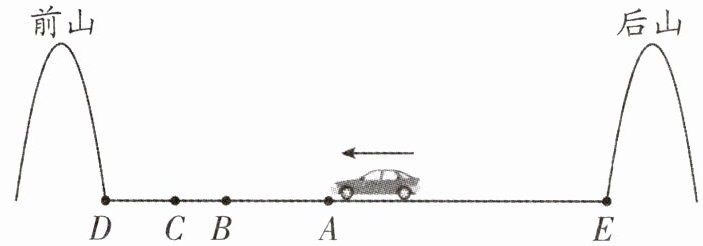
2. 国庆,小明一家自驾出去游玩。驶到两山之间一段平直公路上,在A点鸣笛一声,经过2 s于B点处听到前面山的回声,又隔了1 s于C点处听到了后面山的回声,期间汽车一直以20 m/s的速度前进。若声音传播速度为340 m/s,求:
(1)听到第一次回声时汽车前进的距离$s_{AB}$;
(2)鸣笛时,汽车与前山的距离$s_{AD}$;
(3)两山距离$s_{DE}$。
(1)听到第一次回声时汽车前进的距离$s_{AB}$;
(2)鸣笛时,汽车与前山的距离$s_{AD}$;
(3)两山距离$s_{DE}$。
答案
(1)40 m
(2)360 m
(3)840 m
解析:(1)听到第一次回声时汽车前进的距离$s_{AB}=v_{车} t_1=20\ \mathrm{m/s} × 2\ \mathrm{s}=40\ \mathrm{m}$。
(2)听到前山回声时,声音通过的距离$s_{声1}=v_{声} t_1=340\ \mathrm{m/s} × 2\ \mathrm{s}=680\ \mathrm{m}$,鸣笛时,汽车与前山的距离$s_{AD} = \frac{s_{声1}+s_{AB}}{2} = \frac{680\ \mathrm{m}+40\ \mathrm{m}}{2} = 360\ \mathrm{m}$。
(3)听到第二次回声时,声音向后山通过的距离$s_{声2}=v_{声}(t_1+t_2)=340\ \mathrm{m/s} × (2\ \mathrm{s}+1\ \mathrm{s})=1\ 020\ \mathrm{m}$,此时,车通过的距离$s_{AC}=v_{车}(t_1+t_2)=20\ \mathrm{m/s} × (2\ \mathrm{s}+1\ \mathrm{s})=60\ \mathrm{m}$,A点距后山的距离$s_{AE} = \frac{s_{声2}-s_{AC}}{2} = \frac{1\ 020\ \mathrm{m}-60\ \mathrm{m}}{2} = 480\ \mathrm{m}$,两山距离$s_{DE}=s_{AD}+s_{AE}=360\ \mathrm{m}+480\ \mathrm{m}=840\ \mathrm{m}$。
(2)360 m
(3)840 m
解析:(1)听到第一次回声时汽车前进的距离$s_{AB}=v_{车} t_1=20\ \mathrm{m/s} × 2\ \mathrm{s}=40\ \mathrm{m}$。
(2)听到前山回声时,声音通过的距离$s_{声1}=v_{声} t_1=340\ \mathrm{m/s} × 2\ \mathrm{s}=680\ \mathrm{m}$,鸣笛时,汽车与前山的距离$s_{AD} = \frac{s_{声1}+s_{AB}}{2} = \frac{680\ \mathrm{m}+40\ \mathrm{m}}{2} = 360\ \mathrm{m}$。
(3)听到第二次回声时,声音向后山通过的距离$s_{声2}=v_{声}(t_1+t_2)=340\ \mathrm{m/s} × (2\ \mathrm{s}+1\ \mathrm{s})=1\ 020\ \mathrm{m}$,此时,车通过的距离$s_{AC}=v_{车}(t_1+t_2)=20\ \mathrm{m/s} × (2\ \mathrm{s}+1\ \mathrm{s})=60\ \mathrm{m}$,A点距后山的距离$s_{AE} = \frac{s_{声2}-s_{AC}}{2} = \frac{1\ 020\ \mathrm{m}-60\ \mathrm{m}}{2} = 480\ \mathrm{m}$,两山距离$s_{DE}=s_{AD}+s_{AE}=360\ \mathrm{m}+480\ \mathrm{m}=840\ \mathrm{m}$。
