

 登录
Ⅰ. Listen and choose the best answers.
A teaching robot
What’s his name? Edu-bot
What does he look like? 1
What can he do? ◇Sing,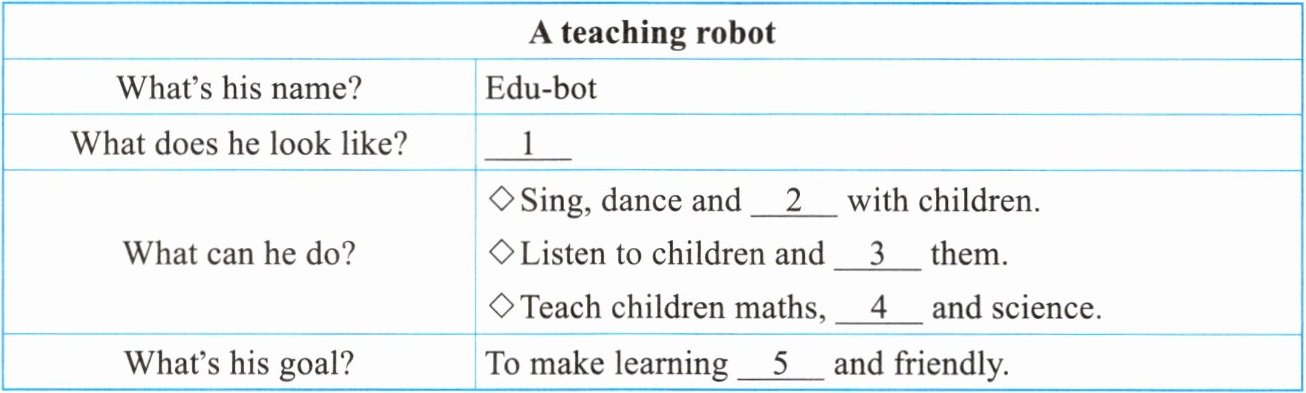 and 2 with children.
◇Listen to children and 3 them.
◇Teach children maths, 4 and science.
What’s his goal? To make learning 5 and friendly.
( C.
(
(
(
(
A teaching robot
What’s his name? Edu-bot
What does he look like? 1
What can he do? ◇Sing,
and 2 with children.◇Listen to children and 3 them.
◇Teach children maths, 4 and science.
What’s his goal? To make learning 5 and friendly.
(
A
)1. A. B. C.(
A
)2. A. play games B. do sports C. read books(
B
)3. A. guide B. understand C. encourage(
C
)4. A. history B. art C. English(
B
)5. A. funny B. exciting C. easy答案
1. A
2. A
3. B
4. C
5. B
2. A
3. B
4. C
5. B
Ⅱ. Complete the sentences according to the phonetic symbols given.
The following are the top five inventions at the School Science Fair.
Top 1: A magical box—It can
Top 2: A talking pen—Point the pen at words, and it speaks. The pen can read books aloud to help
Top 3: A candy-making
Top 4: A useful app—This app
Top 5: A
The following are the top five inventions at the School Science Fair.
Top 1: A magical box—It can
report
/rɪˈpɔːt/ daily air quality with colourful lights—green for good, red for bad!Top 2: A talking pen—Point the pen at words, and it speaks. The pen can read books aloud to help
blind
/blaɪnd/ students study easily.Top 3: A candy-making
machine
/məˈʃiːn/—Kids must love it. It can turn sugar and fruit into lollipops in five minutes.Top 4: A useful app—This app
allows
/əˈlaʊz/ you to turn lights on by clapping your handsTop 5: A
creative
/kriˈeɪtɪv/ fan—It works with sunlight and it can help you keep cool.答案
1. report
2. blind
3. machine
4. allows
5. creative
2. blind
3. machine
4. allows
5. creative
解析
【分析】
解题时需先根据每个空给出的音标匹配对应单词,再结合句子语境和语法规则(如词性、动词形式)验证答案。步骤为:1. 读准音标,回忆对应常见单词;2. 分析空格处的词性(动词原形/形容词/名词/动词三单等);3. 结合句子语义确认单词正确性。
【解析】
1. 音标/rɪˈpɔːt/,情态动词can后接动词原形,结合“报告日常空气质量”的语境,填report;
2. 音标/blaɪnd/,修饰名词students需用形容词,“盲人学生”对应blind,填blind;
3. 音标/məˈʃiːn/,candy-making修饰名词,“糖果制作机器”对应machine,填machine;
4. 音标/əˈlaʊz/,主语this app为第三人称单数,一般现在时谓语用三单形式,填allows;
5. 音标/kriˈeɪtɪv/,修饰名词fan需用形容词,“有创意的风扇”对应creative,填creative。
【答案】
report, blind, machine, allows, creative
【知识点】
英语音标拼写、词性辨析、动词第三人称单数
【点评】
本题为基础音标拼写题,考察常见单词的音形对应及基础语法,难度较低,需注意动词形式变化,适合初中低年级学生练习。
【难度系数】
0.7
Ⅲ. Read and complete the tasks.
A. Complete the conversation with proper sentences in the box. There is one extra option.
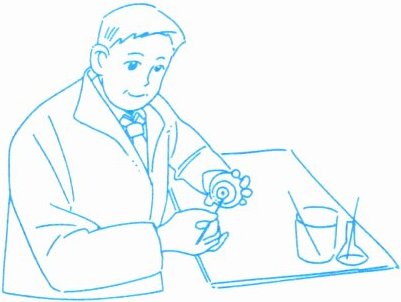
Emma: Hey, have you heard of penicillin?
Leo: Yes, it is one of the most used medicines. 1.
Emma: Not really. Can you tell me about it?
Leo: Sure, it was discovered by Dr Alexander Fleming in 1928. 2.
Emma: What did it take for him to make such an important discovery?
Leo: Well, it was actually an accident! He noticed that mould(霉) growing in one of his Petri dishes killed the bacteria(细菌) around it. 3.
Emma: So it was luck?
Leo: Kind of, but he was smart enough to realise it could help people. 4.
Emma: That’s amazing! 5.
Leo: No. It took a long time to make enough for everyone. During World War Ⅱ, it saved many lives!
Emma: Thanks for sharing. Now I see why it’s so important.
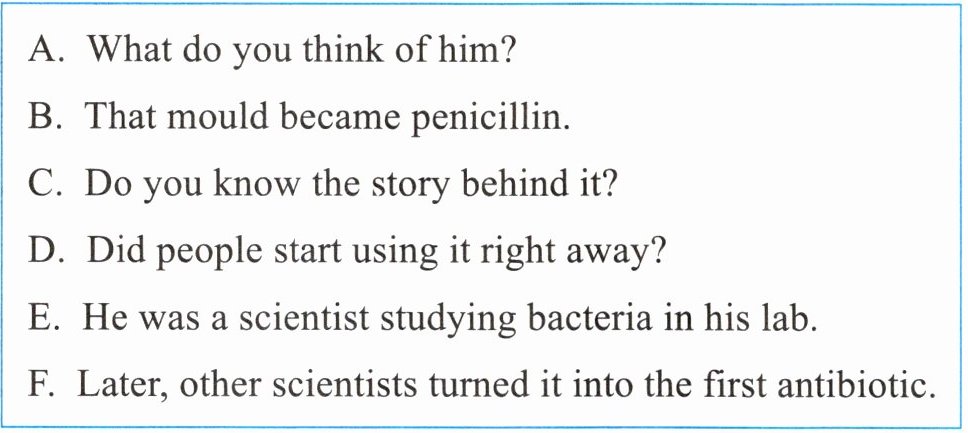
A. What do you think of him?
B. That mould became penicillin.
C. Do you know the story behind it?
D. Did people start using it right away?
E. He was a scientist studying bacteria in his lab.
F. Later, other scientists turned it into the first antibiotic.
B. Answer the questions.
(
A. It was created through careful experiments.
B. It was used widely soon after its discovery.
C. It was discovered by Dr Alexander Fleming.
D. It played an important role during World War II.
(
A. The influence of World War II.
B. The process of making penicillin.
C. Dr Alexander Fleming’s life story.
D. The discovery and application of penicillin.
3. Do you think Fleming’s discovery was just luck? Why or why not?
A. Complete the conversation with proper sentences in the box. There is one extra option.
Emma: Hey, have you heard of penicillin?
Leo: Yes, it is one of the most used medicines. 1.
C
Emma: Not really. Can you tell me about it?
Leo: Sure, it was discovered by Dr Alexander Fleming in 1928. 2.
E
Emma: What did it take for him to make such an important discovery?
Leo: Well, it was actually an accident! He noticed that mould(霉) growing in one of his Petri dishes killed the bacteria(细菌) around it. 3.
B
Emma: So it was luck?
Leo: Kind of, but he was smart enough to realise it could help people. 4.
F
Emma: That’s amazing! 5.
D
Leo: No. It took a long time to make enough for everyone. During World War Ⅱ, it saved many lives!
Emma: Thanks for sharing. Now I see why it’s so important.
A. What do you think of him?
B. That mould became penicillin.
C. Do you know the story behind it?
D. Did people start using it right away?
E. He was a scientist studying bacteria in his lab.
F. Later, other scientists turned it into the first antibiotic.
B. Answer the questions.
(
CD
)1. What can we learn about penicillin? (Choose two answers)A. It was created through careful experiments.
B. It was used widely soon after its discovery.
C. It was discovered by Dr Alexander Fleming.
D. It played an important role during World War II.
(
D
)2. What’s the conversation mainly about?A. The influence of World War II.
B. The process of making penicillin.
C. Dr Alexander Fleming’s life story.
D. The discovery and application of penicillin.
3. Do you think Fleming’s discovery was just luck? Why or why not?
One possible version: No, it wasn’t just luck. His intelligence turned the accident into an important discovery.
答案
A.
1. C
2. E
3. B
4. F
5. D
B.
1. CD
2. D
3. One possible version: No, it wasn’t just luck. His intelligence turned the accident into an important discovery.
1. C
2. E
3. B
4. F
5. D
B.
1. CD
2. D
3. One possible version: No, it wasn’t just luck. His intelligence turned the accident into an important discovery.
解析
【分析】
本题分为A补全对话和B阅读理解两部分。A部分需先通读对话与选项,把握上下文问答逻辑:1处Emma答“Not really”,说明Leo问的是是否知道青霉素的故事,选对应问句;2处介绍发现者后补充其身份;3处讲霉的作用后衔接霉与青霉素的关联;4处讲发现者的意识后衔接后续科学家的行动;5处下文答“花了很长时间”,故问是否马上使用。B部分1题需提取对话细节选两个正确选项;2题需概括对话主旨;3题按要求结合对话内容回答。
【解析】
A部分:1. 根据下文Emma的回应“Not really. Can you tell me about it?”,可知Leo询问是否知道青霉素的背后故事,对应选项C;2. 上文提及Alexander Fleming发现青霉素,此处补充他的身份,对应选项E;3. 前文提到霉杀死细菌,此处说明该霉转化为青霉素,对应选项B;4. 前文指出Fleming意识到青霉素的价值,此处说明后续其他科学家的行动,对应选项F;5. 下文答“花了很长时间才足够供应”,可知Emma问是否马上使用,对应选项D。
B部分:1. 对话明确提到青霉素由Alexander Fleming发现(C),二战中拯救了很多生命(D),故选CD;2. 对话围绕青霉素的发现与应用展开,主旨对应选项D;3. 结合对话中Fleming的智慧,回答:No, it wasn’t just luck. His intelligence turned the accident into an important discovery.
【答案】
A.1.C 2.E 3.B 4.F 5.D;B.1.CD 2.D 3.One possible version: No, it wasn’t just luck. His intelligence turned the accident into an important discovery.
【知识点】
补全对话、阅读理解、英语问答
【点评】
本题为英语综合能力考查题,涵盖补全对话与阅读理解,侧重逻辑衔接、细节提取及主旨概括,贴近学科基础要求,适合初中阶段学生练习。
【难度系数】
0.6
