

 登录
【例1】 如图15-1,$△ ABC$与$△ DEF$关于直线$MN$对称,其中,$∠ C=90°$,$AC=8\mathrm{cm}$,$DE=10\mathrm{cm}$,$BC=6\mathrm{cm}$.
(1)连接$AD$,则线段$AD$与直线$MN$的关系是什么?
(2)求$∠ F$的度数.
(3)求$△ ABC$的周长和$△ DEF$的面积.
思路分析:关于直线对称的对应线段相等,对应图形全等.
解:(1)$\because △ ABC$与$△ DEF$关于直线$MN$对称,
$\therefore$直线$MN$垂直平分线段$AD$.
(2)$\because △ ABC$与$△ DEF$关于直线$MN$对称,$\therefore △ ABC≌△ DEF$,$\therefore ∠ F=∠ C=90°$.
(3)$\because DE=10\mathrm{cm}$,$△ ABC≌△ DEF$,$\therefore AB=DE=10\mathrm{cm}$.
又$\because AC=8\mathrm{cm}$,$BC=6\mathrm{cm}$,$\therefore △ ABC$的周长$=6+8+10=24(\mathrm{cm})$.
易知$△ DEF$的面积$=△ ABC$的面积$=\frac{1}{2}×6×8=24(\mathrm{cm}^2)$.
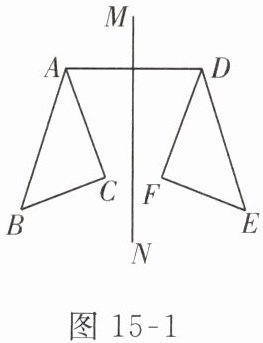
(1)连接$AD$,则线段$AD$与直线$MN$的关系是什么?
(2)求$∠ F$的度数.
(3)求$△ ABC$的周长和$△ DEF$的面积.
思路分析:关于直线对称的对应线段相等,对应图形全等.
解:(1)$\because △ ABC$与$△ DEF$关于直线$MN$对称,
$\therefore$直线$MN$垂直平分线段$AD$.
(2)$\because △ ABC$与$△ DEF$关于直线$MN$对称,$\therefore △ ABC≌△ DEF$,$\therefore ∠ F=∠ C=90°$.
(3)$\because DE=10\mathrm{cm}$,$△ ABC≌△ DEF$,$\therefore AB=DE=10\mathrm{cm}$.
又$\because AC=8\mathrm{cm}$,$BC=6\mathrm{cm}$,$\therefore △ ABC$的周长$=6+8+10=24(\mathrm{cm})$.
易知$△ DEF$的面积$=△ ABC$的面积$=\frac{1}{2}×6×8=24(\mathrm{cm}^2)$.
答案
解:
(1) ∵ △ABC与△DEF关于直线MN对称,点A和点D是对应点,
∴ 直线MN垂直平分线段AD。
(2) ∵ △ABC与△DEF关于直线MN对称,
∴ △ABC ≌ △DEF,
∴ ∠F = ∠C = 90°。
(3) ∵ △ABC ≌ △DEF,DE=10cm,
∴ AB = DE = 10cm,
又∵ AC=8cm,BC=6cm,
∴ △ABC的周长 = AB + BC + AC = 10 + 6 + 8 = 24(cm)。
∵ ∠C=90°,
∴ $S_{△ ABC}=\frac{1}{2}× AC× BC=\frac{1}{2}×8×6=24(\mathrm{cm}^2)$,
由△ABC≌△DEF可得,$S_{△ DEF}=S_{△ ABC}=24\mathrm{cm}^2$。
答:(1) 直线MN垂直平分线段AD;(2) ∠F的度数为90°;(3) △ABC的周长为24cm,△DEF的面积为24cm²。
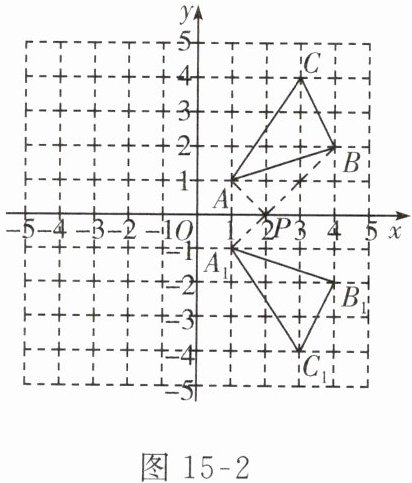
【例2】 如图15-2,在平面直角坐标系中,$A(1,1),B(4,2),C(3,4)$.
(1)画出$△ ABC$关于$x$轴对称的$△ A_1B_1C_1$.
(2)分别写出对应点$A_1,B_1,C_1$的坐标.
(3)请在图中的$x$轴上找一点$P$,使得$PA+PB$的值最小,并直接写出点$P$的坐标.
思路分析:(1)两点关于$x$轴对称,横坐标相同,纵坐标互为相反数;关于$y$轴对称,横坐标互为相反数,纵坐标相同.
解:(1)如图15-2,$△ A_1B_1C_1$即为所求.
(2)$A_1(1,-1),B_1(4,-2),C_1(3,-4)$.
(3)如图15-2,连接$A_1B$交$x$轴于点$P$,点$P$的坐标为$(2,0)$.
(1)画出$△ ABC$关于$x$轴对称的$△ A_1B_1C_1$.
(2)分别写出对应点$A_1,B_1,C_1$的坐标.
(3)请在图中的$x$轴上找一点$P$,使得$PA+PB$的值最小,并直接写出点$P$的坐标.
思路分析:(1)两点关于$x$轴对称,横坐标相同,纵坐标互为相反数;关于$y$轴对称,横坐标互为相反数,纵坐标相同.
解:(1)如图15-2,$△ A_1B_1C_1$即为所求.
(2)$A_1(1,-1),B_1(4,-2),C_1(3,-4)$.
(3)如图15-2,连接$A_1B$交$x$轴于点$P$,点$P$的坐标为$(2,0)$.
答案
解:
(1) 分别作出点$A$、$B$、$C$关于$x$轴的对称点$A_1$、$B_1$、$C_1$,顺次连接$A_1B_1$、$B_1C_1$、$C_1A_1$,所得的$△ A_1B_1C_1$即为所求。
(2) 根据关于$x$轴对称的点的坐标特征:横坐标相同,纵坐标互为相反数,可得:
$A_1(1,-1)$,$B_1(4,-2)$,$C_1(3,-4)$。
(3) 作点$A$关于$x$轴的对称点$A_1$,连接$A_1B$,$A_1B$与$x$轴的交点即为所求的点$P$,点$P$的坐标为$(2,0)$。
(1) 分别作出点$A$、$B$、$C$关于$x$轴的对称点$A_1$、$B_1$、$C_1$,顺次连接$A_1B_1$、$B_1C_1$、$C_1A_1$,所得的$△ A_1B_1C_1$即为所求。
(2) 根据关于$x$轴对称的点的坐标特征:横坐标相同,纵坐标互为相反数,可得:
$A_1(1,-1)$,$B_1(4,-2)$,$C_1(3,-4)$。
(3) 作点$A$关于$x$轴的对称点$A_1$,连接$A_1B$,$A_1B$与$x$轴的交点即为所求的点$P$,点$P$的坐标为$(2,0)$。
【例3】 如图15-3,在$△ ABC$中,$∠ BAC=108°,AB=AC$,BD平分$∠ ABC$,交AC于点D.求证$BC=AB+CD$.
图15-2
思路分析:如果题干中出现了几条线段之间的和差关系,一般考虑用截长补短作辅助线解题.
与角平分线有关的截长补短模型展示
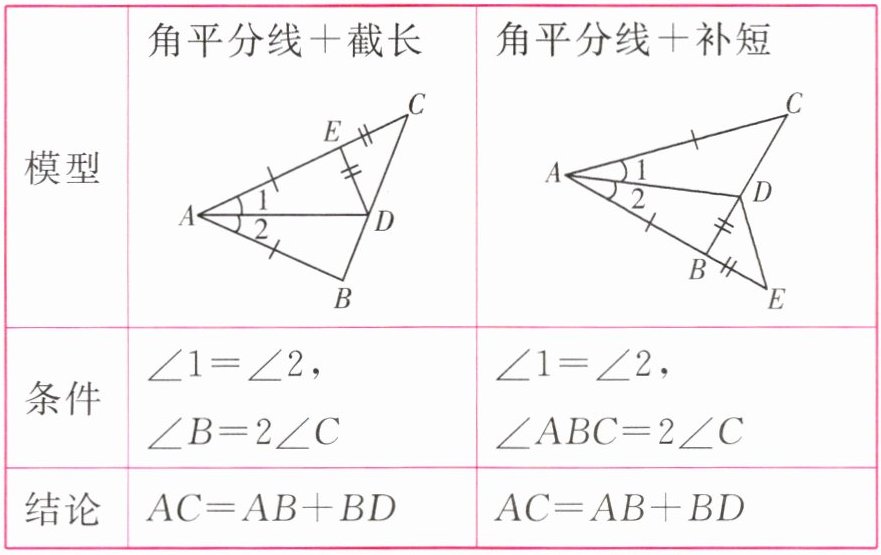
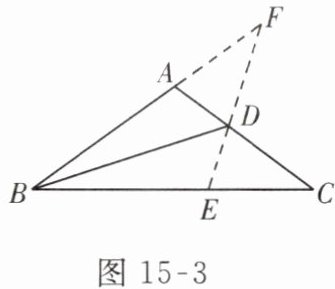
证明:方法一:(截长法)在BC上取点E,使$BE=BA$,连接DE.
$\because BD$平分$∠ ABC,\therefore ∠ ABD=∠ EBD$.
在$△ ABD$和$△ EBD$中,
$\{\begin{array}{l}AB=EB,\\∠ ABD=∠ EBD,\\BD=BD,\end{array} $
$\therefore △ ABD≌△ EBD(\mathrm{SAS}).\therefore ∠ BAC=∠ BED=108°$.
$\therefore ∠ DEC=72°$.
$\because AB=AC,∠ BAC=108°$
$\therefore ∠ C=∠ ABC=36°.\therefore ∠ CDE=72°$.
$\therefore ∠ CDE=∠ CED.\therefore CD=CE.\therefore BC=BE+EC=AB+CD$.
方法二:(补短法)延长BA至点F,使$BF=BC$,连接DF.
$\because BD$平分$∠ ABC,\therefore ∠ CBD=∠ FBD$.
在$△ FBD$和$△ CBD$中,
$\{\begin{array}{l}FB=CB,\\∠ FBD=∠ CBD,\\BD=BD,\end{array} $
$\therefore △ FBD≌△ CBD(\mathrm{SAS}).\therefore DF=DC,∠ F=∠ C$.
$\because AB=AC,∠ BAC=108°,\therefore ∠ C=∠ ABC=36°,∠ FAD=72°.\therefore ∠ F=36°.\therefore ∠ FDA=72°$.
$\therefore ∠ FDA=∠ FAD.\therefore FA=FD.\therefore CD=DF=AF.\therefore BC=BF=AB+AF=AB+CD$.
图15-2
思路分析:如果题干中出现了几条线段之间的和差关系,一般考虑用截长补短作辅助线解题.
与角平分线有关的截长补短模型展示
证明:方法一:(截长法)在BC上取点E,使$BE=BA$,连接DE.
$\because BD$平分$∠ ABC,\therefore ∠ ABD=∠ EBD$.
在$△ ABD$和$△ EBD$中,
$\{\begin{array}{l}AB=EB,\\∠ ABD=∠ EBD,\\BD=BD,\end{array} $
$\therefore △ ABD≌△ EBD(\mathrm{SAS}).\therefore ∠ BAC=∠ BED=108°$.
$\therefore ∠ DEC=72°$.
$\because AB=AC,∠ BAC=108°$
$\therefore ∠ C=∠ ABC=36°.\therefore ∠ CDE=72°$.
$\therefore ∠ CDE=∠ CED.\therefore CD=CE.\therefore BC=BE+EC=AB+CD$.
方法二:(补短法)延长BA至点F,使$BF=BC$,连接DF.
$\because BD$平分$∠ ABC,\therefore ∠ CBD=∠ FBD$.
在$△ FBD$和$△ CBD$中,
$\{\begin{array}{l}FB=CB,\\∠ FBD=∠ CBD,\\BD=BD,\end{array} $
$\therefore △ FBD≌△ CBD(\mathrm{SAS}).\therefore DF=DC,∠ F=∠ C$.
$\because AB=AC,∠ BAC=108°,\therefore ∠ C=∠ ABC=36°,∠ FAD=72°.\therefore ∠ F=36°.\therefore ∠ FDA=72°$.
$\therefore ∠ FDA=∠ FAD.\therefore FA=FD.\therefore CD=DF=AF.\therefore BC=BF=AB+AF=AB+CD$.
答案
证明:
方法一(截长法):
在BC上取点E,使$BE=AB$,连接DE。
∵ BD平分$∠ ABC$,
∴ $∠ ABD=∠ EBD$。
在$△ ABD$和$△ EBD$中,
$\begin{cases}AB=EB \\∠ ABD=∠ EBD \\BD=BD\end{cases}$
∴ $△ ABD ≌ △ EBD(\mathrm{SAS})$,
∴ $∠ BED=∠ BAC=108°$,
∴ $∠ DEC=180°-∠ BED=72°$。
∵ $AB=AC$,$∠ BAC=108°$,
∴ $∠ ABC=∠ C=\frac{180°-108°}{2}=36°$,
在$△ DEC$中,$∠ CDE=180°-∠ C-∠ DEC=180°-36°-72°=72°$,
∴ $∠ CDE=∠ DEC$,
∴ $CD=CE$。
又∵ $BC=BE+CE$,$BE=AB$,
∴ $BC=AB+CD$。
