

 登录
登录
四、短文填空。
阅读下面短文,从方框内选择正确的单词并用其适当形式填空,使短文内容完整,意思通顺。
India, proper, cheek, palm, difference,
be, nice, less, if, formal
Different countries have different social rules. It is important to learn about these cultural 1.
In Japan, people bow when they meet for the first time. It is a 2.
3.

In France, people kiss on both 6.
Remember, when you are in a new country, try to follow the local customs. 9.
阅读下面短文,从方框内选择正确的单词并用其适当形式填空,使短文内容完整,意思通顺。
India, proper, cheek, palm, difference,
be, nice, less, if, formal
Different countries have different social rules. It is important to learn about these cultural 1.
differences
. Here are some examples.In Japan, people bow when they meet for the first time. It is a 2.
formal
way to show respect. If you shake hands instead, they might feel embarrassed.3.
Indian
people often say “Namaste” with their 4. palms
together. They also eat with their right hand because using the left hand is considered 5. improper
.In France, people kiss on both 6.
cheeks
when meeting friends. Also, bringing a small gift, such as flowers, is polite when visiting a French home. Last but not 7. least
, it's also a good manner to dress 8. nicely
when you attend some big occasions.Remember, when you are in a new country, try to follow the local customs. 9.
If
you are not sure what to do, watch how others behave. Learning about different cultures 10. is
a great way to understand the world.答案
1. differences 2. formal 3. Indian 4. palms 5. improper 6. cheeks 7. least 8. nicely 9. If 10. is
解析
【分析】本题为文化类短文填空,需结合语境、词汇适当形式变化及固定搭配解题。首先通读全文,明确主题是不同国家的社交礼仪差异;再逐个分析空格:1. 对应前文“不同社会规则”,需用名词复数表“文化差异”;2. 修饰名词way,用形容词表“正式的”;3. 修饰people,用形容词表“印度的”;4. 表示“双手”,名词用复数;5. 结合语境,左手被认为“不合适的”,用proper的反义词;6. 表示“双颊”,名词用复数;7. 对应固定短语需用least;8. 修饰动词dress,用副词;9. 引导条件状语从句用if;10. 动名词作主语,谓语用单数is。
【解析】1. 由“different social rules”可知此处指文化差异,difference的复数形式为differences;2. 形容词formal修饰way,表“正式的方式”;3. 形容词Indian修饰people,表“印度的”;4. palm的复数palms对应“双手”;5. improper是proper的反义词,表“不合适的”;6. cheek的复数cheeks对应“双颊”;7. 固定短语last but not least需用least;8. 副词nicely修饰动词dress,表“得体地穿”;9. If引导条件状语从句;10. 动名词短语作主语,谓语用单数is。
【答案】1. differences 2. formal 3. Indian 4. palms 5. improper 6. cheeks 7. least 8. nicely 9. If 10. is
【知识点】名词复数变化、形容词副词用法、固定短语搭配、主谓一致、跨文化常识
【点评】本题围绕不同国家的社交礼仪展开,既考查词汇变形,又涉及固定搭配和语境理解,兼顾基础与应用,有助于学生了解文化差异。
【难度系数】0.5
【解析】1. 由“different social rules”可知此处指文化差异,difference的复数形式为differences;2. 形容词formal修饰way,表“正式的方式”;3. 形容词Indian修饰people,表“印度的”;4. palm的复数palms对应“双手”;5. improper是proper的反义词,表“不合适的”;6. cheek的复数cheeks对应“双颊”;7. 固定短语last but not least需用least;8. 副词nicely修饰动词dress,表“得体地穿”;9. If引导条件状语从句;10. 动名词短语作主语,谓语用单数is。
【答案】1. differences 2. formal 3. Indian 4. palms 5. improper 6. cheeks 7. least 8. nicely 9. If 10. is
【知识点】名词复数变化、形容词副词用法、固定短语搭配、主谓一致、跨文化常识
【点评】本题围绕不同国家的社交礼仪展开,既考查词汇变形,又涉及固定搭配和语境理解,兼顾基础与应用,有助于学生了解文化差异。
【难度系数】0.5
五、阅读还原。(选项中有一项多余)
主题:人与社会——人际沟通·文化差异
体裁:应用文
难易度:☆☆☆
Certain things you do at one place might be totally OK. But you do the same thing in another place and it does not come through at all or it might even be totally wrong. 1.
To start with, attention is paid to personal space by Finns a lot. When waiting in line, they keep one metre or more from each other. If you are standing too close to someone while talking, you will notice that 2.
Second, do not make eye contact with Finns. For them, eye contact is uncommon, even when they are talking to friends or family. It might be rude in other cultures not to look each other in the eye when they are talking. 3.
Also, touching strangers in Finland is not allowed. They might feel uncomfortable. For most Finns, physical contact while they are talking even among friends is not common. They do not give kisses on the cheeks when greeting each other. Mostly the greeting is saying hi or shaking hands.
Finns do not talk about their salaries(薪水) and it is very impolite to ask even friends about how much money they make. 4.
Because of all these, Finns are often considered unfriendly. Anyway, as the saying goes, "5.
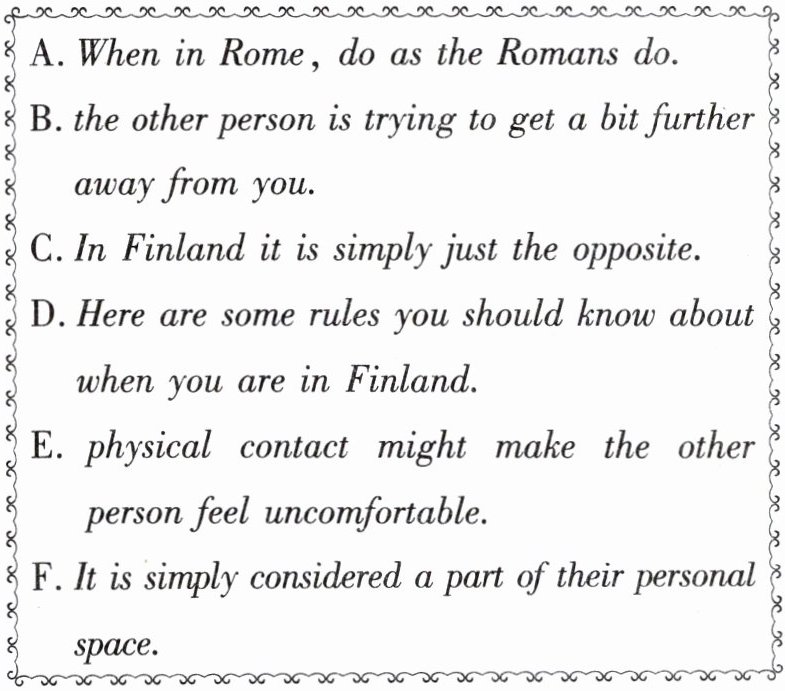
主题:人与社会——人际沟通·文化差异
体裁:应用文
难易度:☆☆☆
Certain things you do at one place might be totally OK. But you do the same thing in another place and it does not come through at all or it might even be totally wrong. 1.
D
To start with, attention is paid to personal space by Finns a lot. When waiting in line, they keep one metre or more from each other. If you are standing too close to someone while talking, you will notice that 2.
B
Second, do not make eye contact with Finns. For them, eye contact is uncommon, even when they are talking to friends or family. It might be rude in other cultures not to look each other in the eye when they are talking. 3.
C
Also, touching strangers in Finland is not allowed. They might feel uncomfortable. For most Finns, physical contact while they are talking even among friends is not common. They do not give kisses on the cheeks when greeting each other. Mostly the greeting is saying hi or shaking hands.
Finns do not talk about their salaries(薪水) and it is very impolite to ask even friends about how much money they make. 4.
F
No one talks about each other's appearance or clothes unless someone asks for an opinion.Because of all these, Finns are often considered unfriendly. Anyway, as the saying goes, "5.
A
" Next time you travel to Finland, remember these rules.答案
1.D 2.B 3.C 4.F 5.A
解析
【分析】
本题为英语阅读还原题,需结合上下文语境、逻辑关系(如承上启下、转折、因果等)匹配选项。解题思路:先通读全文把握主题是芬兰的人际沟通文化规则,再逐个分析每个空前后内容的衔接需求,对应选项的语义和逻辑,选出最合适的答案。
1. 第1空:前文提及不同地方行为的差异,后文开始介绍芬兰的规则,需选引出芬兰规则的句子;
2. 第2空:前文说明芬兰人重视个人空间,说话站太近的结果,需选体现该结果的句子;
3. 第3空:前文对比其他文化的眼神接触习惯,需选转折说明芬兰相反情况的句子;
4. 第4空:前文提到芬兰人不谈论薪水,需选解释该行为属于个人空间范畴的句子;
5. 第5空:前文总结要遵循芬兰规则,需选对应“入乡随俗”的谚语。
【解析】
1. 第1空:前文引出不同地域行为的差异,后文开始介绍芬兰的相关规则,选项D“Here are some rules you should know about when you are in Finland.”起到承上启下的作用,引出下文内容,故选D;
2. 第2空:前文指出芬兰人重视个人空间,排队保持一米以上距离,说话时站太近会导致对方远离,选项B“the other person is trying to get a bit further away from you.”符合语境,故选B;
3. 第3空:前文提到其他文化中不眼神接触可能粗鲁,此处转折说明芬兰的情况相反,选项C“In Finland it is simply just the opposite.”承接上文的对比逻辑,故选C;
4. 第4空:前文说明芬兰人不谈论薪水,这属于个人空间的一部分,选项F“It is simply considered a part of their personal space.”解释了该行为的原因,故选F;
5. 第5空:前文总结要遵循芬兰的文化规则,谚语“入乡随俗”符合语境,选项A“When in Rome, do as the Romans do.”对应,故选A。
【答案】1.D 2.B 3.C 4.F 5.A
【知识点】英语阅读还原;文化差异;个人空间
【点评】本题围绕芬兰的人际沟通文化差异展开,属于阅读还原类题型,考查学生对上下文逻辑关系的理解及文化常识的运用,需结合语境匹配合适的句子,难度适中。
【难度系数】
0.6
本题为英语阅读还原题,需结合上下文语境、逻辑关系(如承上启下、转折、因果等)匹配选项。解题思路:先通读全文把握主题是芬兰的人际沟通文化规则,再逐个分析每个空前后内容的衔接需求,对应选项的语义和逻辑,选出最合适的答案。
1. 第1空:前文提及不同地方行为的差异,后文开始介绍芬兰的规则,需选引出芬兰规则的句子;
2. 第2空:前文说明芬兰人重视个人空间,说话站太近的结果,需选体现该结果的句子;
3. 第3空:前文对比其他文化的眼神接触习惯,需选转折说明芬兰相反情况的句子;
4. 第4空:前文提到芬兰人不谈论薪水,需选解释该行为属于个人空间范畴的句子;
5. 第5空:前文总结要遵循芬兰规则,需选对应“入乡随俗”的谚语。
【解析】
1. 第1空:前文引出不同地域行为的差异,后文开始介绍芬兰的相关规则,选项D“Here are some rules you should know about when you are in Finland.”起到承上启下的作用,引出下文内容,故选D;
2. 第2空:前文指出芬兰人重视个人空间,排队保持一米以上距离,说话时站太近会导致对方远离,选项B“the other person is trying to get a bit further away from you.”符合语境,故选B;
3. 第3空:前文提到其他文化中不眼神接触可能粗鲁,此处转折说明芬兰的情况相反,选项C“In Finland it is simply just the opposite.”承接上文的对比逻辑,故选C;
4. 第4空:前文说明芬兰人不谈论薪水,这属于个人空间的一部分,选项F“It is simply considered a part of their personal space.”解释了该行为的原因,故选F;
5. 第5空:前文总结要遵循芬兰的文化规则,谚语“入乡随俗”符合语境,选项A“When in Rome, do as the Romans do.”对应,故选A。
【答案】1.D 2.B 3.C 4.F 5.A
【知识点】英语阅读还原;文化差异;个人空间
【点评】本题围绕芬兰的人际沟通文化差异展开,属于阅读还原类题型,考查学生对上下文逻辑关系的理解及文化常识的运用,需结合语境匹配合适的句子,难度适中。
【难度系数】
0.6
