

 登录
登录
三、还原信息
The past few years have shown that we need to prepare for the worst earthquakes. So an earthquake emergency kit (救生包) should be something we need to have. (1)____________
Well, that may not be a problem because you can buy one online easily.
According to researchers, around 275 earthquakes are felt every day around the world. (2)____________
There is a 30% higher chance that you will survive an earthquake if you have the kit.
Some people think they can go to a shelter (避难所) after an earthquake. (3)____________
There may be too many people in the shelter. You may not find food or water as well.
(4)____________
But whether you are near the fault line (断层线) or far from it, owning one for your household is still a must. You never know how earthquakes hit until they hit you.
So if you don’t have an earthquake emergency kit at home, make one yourself or buy one online.
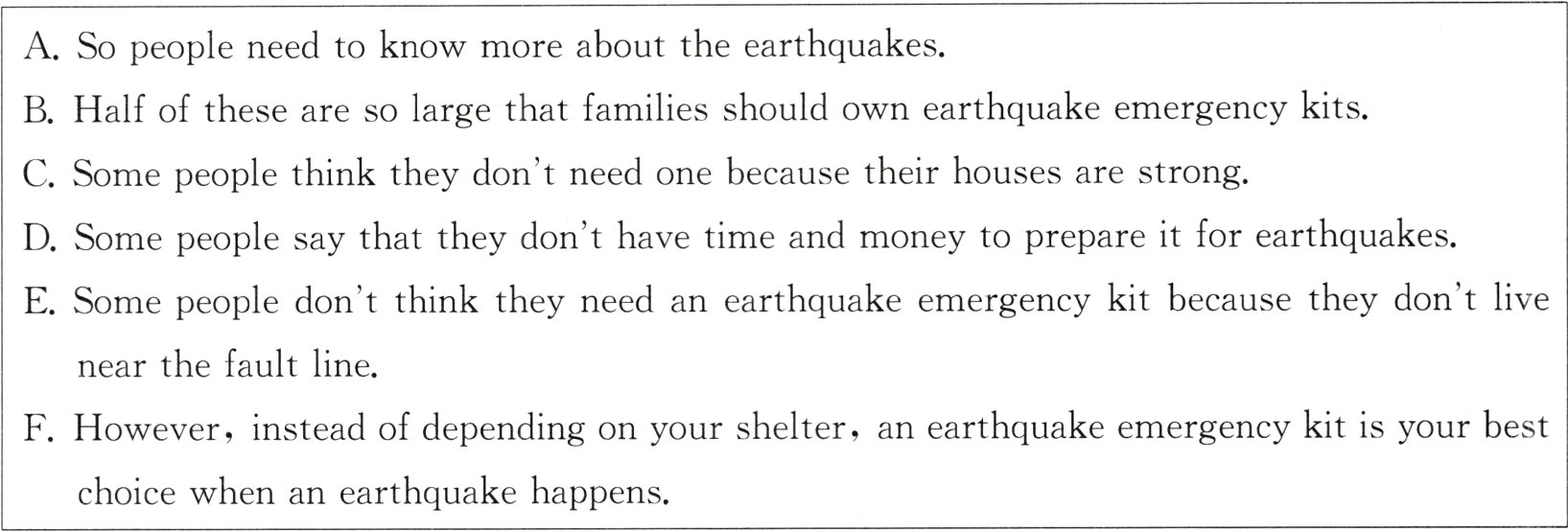
A. So people need to know more about the earthquakes.
B. Half of these are so large that families should own earthquake emergency kits.
C. Some people think they don’t need one because their houses are strong.
D. Some people say that they don’t have time and money to prepare it for earthquakes.
E. Some people don’t think they need an earthquake emergency kit because they don’t live near the fault line.
F. However, instead of depending on your shelter, an earthquake emergency kit is your best choice when an earthquake happens.
The past few years have shown that we need to prepare for the worst earthquakes. So an earthquake emergency kit (救生包) should be something we need to have. (1)____________
Well, that may not be a problem because you can buy one online easily.
According to researchers, around 275 earthquakes are felt every day around the world. (2)____________
There is a 30% higher chance that you will survive an earthquake if you have the kit.
Some people think they can go to a shelter (避难所) after an earthquake. (3)____________
There may be too many people in the shelter. You may not find food or water as well.
(4)____________
But whether you are near the fault line (断层线) or far from it, owning one for your household is still a must. You never know how earthquakes hit until they hit you.
So if you don’t have an earthquake emergency kit at home, make one yourself or buy one online.
A. So people need to know more about the earthquakes.
B. Half of these are so large that families should own earthquake emergency kits.
C. Some people think they don’t need one because their houses are strong.
D. Some people say that they don’t have time and money to prepare it for earthquakes.
E. Some people don’t think they need an earthquake emergency kit because they don’t live near the fault line.
F. However, instead of depending on your shelter, an earthquake emergency kit is your best choice when an earthquake happens.
答案
1-4 DBFE
四、综合填空
Spring starts on different dates in different places.
For most (1) (country) in the northern hemisphere (北半球), such as China, spring begins in March and ends in May. While September, October and November are spring months in many (2) (south) hemisphere countries like Australia.
Spring refers (指代) not only to the season, (3) the idea of rebirth (重生). Therefore, most countries have special traditions (4) (celebrate) the arrival of this beautiful season.
Chinese people often eat spring pancakes on the day called lichun. This tradition means “bite - the - spring (咬春)” in Chinese. In the past, people (5) (believe) this would lead to a good harvest year.
In Japan, families and friends celebrate spring by gathering in the parks to enjoy the beauty of cherry blossoms. It is a (6) (tradition) custom known as “hanami”, meaning “watching flowers”, which (7) (usual) lasts from late March to early May. People hold parties or picnics under the cherry trees. Food, drinks and even dancing (8) (be) all parts of “hanami”.
In the US, the groundhog (土拨鼠) helps to tell the coming of spring. There’s even (9) special day, Groundhog Day on every February 2. If a groundhog sees its shadow (影子) when it comes out, people can expect six more weeks of winter. If there’s no shadow, spring is (10) the way! But the groundhog isn’t always right. Its forecasts are only 39 per cent right, according to National Climate Data Centre of the US.
Spring starts on different dates in different places.
For most (1) (country) in the northern hemisphere (北半球), such as China, spring begins in March and ends in May. While September, October and November are spring months in many (2) (south) hemisphere countries like Australia.
Spring refers (指代) not only to the season, (3) the idea of rebirth (重生). Therefore, most countries have special traditions (4) (celebrate) the arrival of this beautiful season.
Chinese people often eat spring pancakes on the day called lichun. This tradition means “bite - the - spring (咬春)” in Chinese. In the past, people (5) (believe) this would lead to a good harvest year.
In Japan, families and friends celebrate spring by gathering in the parks to enjoy the beauty of cherry blossoms. It is a (6) (tradition) custom known as “hanami”, meaning “watching flowers”, which (7) (usual) lasts from late March to early May. People hold parties or picnics under the cherry trees. Food, drinks and even dancing (8) (be) all parts of “hanami”.
In the US, the groundhog (土拨鼠) helps to tell the coming of spring. There’s even (9) special day, Groundhog Day on every February 2. If a groundhog sees its shadow (影子) when it comes out, people can expect six more weeks of winter. If there’s no shadow, spring is (10) the way! But the groundhog isn’t always right. Its forecasts are only 39 per cent right, according to National Climate Data Centre of the US.
答案
1. countries 2. southern 3. but 4. to celebrate 5. believed 6. traditional 7. usually 8. are 9. a 10. on
