

 登录
登录
B
If you read Ernest Hemingway's *The* *Snows of Kilimanjaro*, you may love the story and feel surprised at Mount Kilimanjaro's snow - capped top. The mountain is the highest in northeastern Tanzania in Africa with the height (高度) of 5,895 metres.
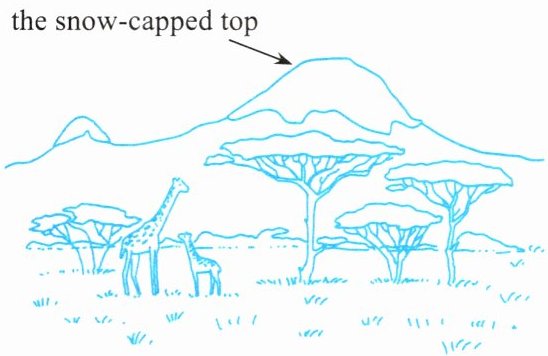
No one knows how Kilimanjaro got its name. It may come from the Swahili word “kilima” (meaning “mountain”) and the Chagga word “njaro” (meaning “shining” or “whiteness”).
Kilimanjaro is a popular hiking place. This is because the hiking routes do not require much experience. Thousands of climbers climb the mountain for fun each year.
In 1973, the government built Kilimanjaro National Park and it became a UNESCO World Heritage Site (世界遗产地) later in 1987. More and more animals live in this mountain and its forests, like the blue monkey, and it helped improve the area's special environment.
The mountain is famous for its snow on the top. Unluckily, the white snow may soon disappear. Over the last hundred years, all of Kilimanjaro's glaciers have begun to become smaller. Higher temperatures (温度) are a main reason, but they're not the only one. The less rain has also played a big role in losing snow. If this continues, most of the glaciers may disappear by 2040.
It's clear that we need to take action to protect the natural beauty now.
(
A. From the snow on its top.
B. From a place in the mountain.
C. From the height of the mountain.
D. From the book *The Snows of Kilimanjaro*.
(
A. The forests in Kilimanjaro.
B. The animals in Kilimanjaro.
C. The landscape of Kilimanjaro.
D. The importance of Kilimanjaro.
(
A. People think it's relaxing to go hiking there.
B. The snow will disappear in a hundred years.
C. People know about Kilimanjaro from a book.
D. Kilimanjaro is the highest mountain in Africa.
(
A. To save the animals in Kilimanjaro.
B. To ask people to protect Kilimanjaro.
C. To invite readers to visit Kilimanjaro.
D. To introduce Kilimanjaro National Park.
If you read Ernest Hemingway's *The* *Snows of Kilimanjaro*, you may love the story and feel surprised at Mount Kilimanjaro's snow - capped top. The mountain is the highest in northeastern Tanzania in Africa with the height (高度) of 5,895 metres.
No one knows how Kilimanjaro got its name. It may come from the Swahili word “kilima” (meaning “mountain”) and the Chagga word “njaro” (meaning “shining” or “whiteness”).
Kilimanjaro is a popular hiking place. This is because the hiking routes do not require much experience. Thousands of climbers climb the mountain for fun each year.
In 1973, the government built Kilimanjaro National Park and it became a UNESCO World Heritage Site (世界遗产地) later in 1987. More and more animals live in this mountain and its forests, like the blue monkey, and it helped improve the area's special environment.
The mountain is famous for its snow on the top. Unluckily, the white snow may soon disappear. Over the last hundred years, all of Kilimanjaro's glaciers have begun to become smaller. Higher temperatures (温度) are a main reason, but they're not the only one. The less rain has also played a big role in losing snow. If this continues, most of the glaciers may disappear by 2040.
It's clear that we need to take action to protect the natural beauty now.
(
A
)19. According to the passage, how might Kilimanjaro get its name?A. From the snow on its top.
B. From a place in the mountain.
C. From the height of the mountain.
D. From the book *The Snows of Kilimanjaro*.
(
D
)20. What is the main idea of Paragraph 4?A. The forests in Kilimanjaro.
B. The animals in Kilimanjaro.
C. The landscape of Kilimanjaro.
D. The importance of Kilimanjaro.
(
D
)21. What can we learn about Kilimanjaro from the passage?A. People think it's relaxing to go hiking there.
B. The snow will disappear in a hundred years.
C. People know about Kilimanjaro from a book.
D. Kilimanjaro is the highest mountain in Africa.
(
B
)22. Why does the writer write this passage?A. To save the animals in Kilimanjaro.
B. To ask people to protect Kilimanjaro.
C. To invite readers to visit Kilimanjaro.
D. To introduce Kilimanjaro National Park.
答案
19. A 20. D 21. D 22. B
解析
【解析】
19. 根据文章第二段内容,乞力马扎罗山的名字可能来自斯瓦希里语“kilima”(意为“山”)和查加语“njaro”(意为“闪耀”或“洁白”),“洁白”对应山顶的积雪,所以选A。
20. 第四段介绍了乞力马扎罗山被建成国家公园并成为世界遗产,还提到这里的动物和生态环境,核心是说明这座山的重要性,故选D。
21. 由文章第一段“The mountain is the highest in northeastern Tanzania in Africa with the height of 5,895 metres.”可知,乞力马扎罗山是非洲东北部坦桑尼亚的最高峰,也就是非洲的最高峰,D选项正确;A选项文中未提及徒步是放松的;B选项是到2040年大部分冰川可能消失,并非一百年后;C选项并非所有人都是通过书了解这座山,故选D。
22. 文章最后一段“It's clear that we need to take action to protect the natural beauty now.”表明作者的写作目的是呼吁人们保护乞力马扎罗山,故选B。
【答案】
19. A
20. D
21. D
22. B
【知识点】
阅读理解(科普类);细节查找;主旨大意
【点评】
本文介绍了非洲乞力马扎罗山的名称由来、旅游价值、生态地位以及面临的冰川消融问题,引导学生获取科普类文本信息,树立环保意识。
【难度系数】
0.6
19. 根据文章第二段内容,乞力马扎罗山的名字可能来自斯瓦希里语“kilima”(意为“山”)和查加语“njaro”(意为“闪耀”或“洁白”),“洁白”对应山顶的积雪,所以选A。
20. 第四段介绍了乞力马扎罗山被建成国家公园并成为世界遗产,还提到这里的动物和生态环境,核心是说明这座山的重要性,故选D。
21. 由文章第一段“The mountain is the highest in northeastern Tanzania in Africa with the height of 5,895 metres.”可知,乞力马扎罗山是非洲东北部坦桑尼亚的最高峰,也就是非洲的最高峰,D选项正确;A选项文中未提及徒步是放松的;B选项是到2040年大部分冰川可能消失,并非一百年后;C选项并非所有人都是通过书了解这座山,故选D。
22. 文章最后一段“It's clear that we need to take action to protect the natural beauty now.”表明作者的写作目的是呼吁人们保护乞力马扎罗山,故选B。
【答案】
19. A
20. D
21. D
22. B
【知识点】
阅读理解(科普类);细节查找;主旨大意
【点评】
本文介绍了非洲乞力马扎罗山的名称由来、旅游价值、生态地位以及面临的冰川消融问题,引导学生获取科普类文本信息,树立环保意识。
【难度系数】
0.6
