

 登录
登录
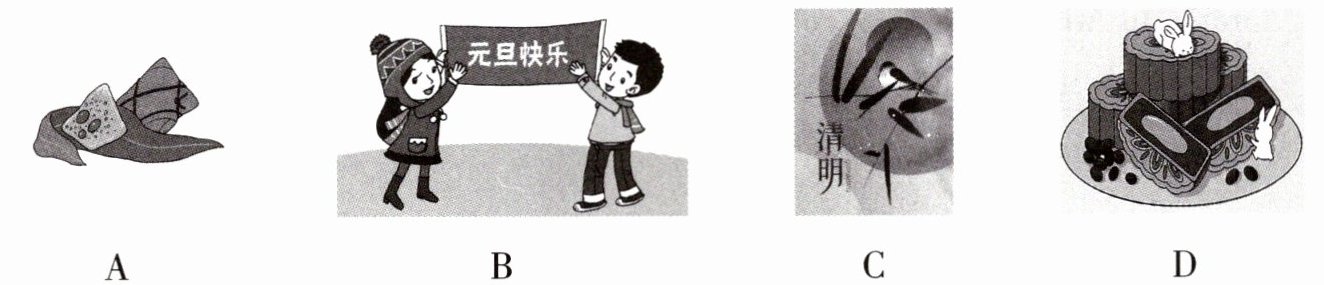
一、Look and choose.下面的四个节日分别在哪个季节呢?请你看一看,将相应图片的序号填写在横线上。
1. spring:
2. summer:
3. autumn:
4. winter:
1. spring:
C
2. summer:
A
3. autumn:
D
4. winter:
B
答案
1. C 2. A 3. D 4. B
解析
【分析】
首先我们需要先识别每张图片对应的节日:图A是粽子,对应端午节;图B是“元旦快乐”标语,对应元旦;图C标注“清明”,对应清明节;图D是月饼,对应中秋节。接着回忆各节日的时间,匹配对应的季节:清明节在公历4月,属于春季;端午节在农历五月,对应公历夏季;中秋节在农历八月,对应公历秋季;元旦在公历1月,属于冬季。最后将图片序号与季节对应填写即可。
【解析】
1. spring(春季):清明节(图C)处于春季,所以填C;
2. summer(夏季):端午节(图A)处于夏季,所以填A;
3. autumn(秋季):中秋节(图D)处于秋季,所以填D;
4. winter(冬季):元旦(图B)处于冬季,所以填B。
【答案】
1. C 2. A 3. D 4. B
【知识点】
传统节日与季节对应,英语季节词汇,节日文化常识
【点评】
本题将中国传统节日与英语季节词汇结合,既考查学生对常见传统节日时间的认知,也考查对英语季节单词的理解,注重文化常识与英语知识的融合,帮助学生建立文化与语言的联系。
【难度系数】
0.7
首先我们需要先识别每张图片对应的节日:图A是粽子,对应端午节;图B是“元旦快乐”标语,对应元旦;图C标注“清明”,对应清明节;图D是月饼,对应中秋节。接着回忆各节日的时间,匹配对应的季节:清明节在公历4月,属于春季;端午节在农历五月,对应公历夏季;中秋节在农历八月,对应公历秋季;元旦在公历1月,属于冬季。最后将图片序号与季节对应填写即可。
【解析】
1. spring(春季):清明节(图C)处于春季,所以填C;
2. summer(夏季):端午节(图A)处于夏季,所以填A;
3. autumn(秋季):中秋节(图D)处于秋季,所以填D;
4. winter(冬季):元旦(图B)处于冬季,所以填B。
【答案】
1. C 2. A 3. D 4. B
【知识点】
传统节日与季节对应,英语季节词汇,节日文化常识
【点评】
本题将中国传统节日与英语季节词汇结合,既考查学生对常见传统节日时间的认知,也考查对英语季节单词的理解,注重文化常识与英语知识的融合,帮助学生建立文化与语言的联系。
【难度系数】
0.7
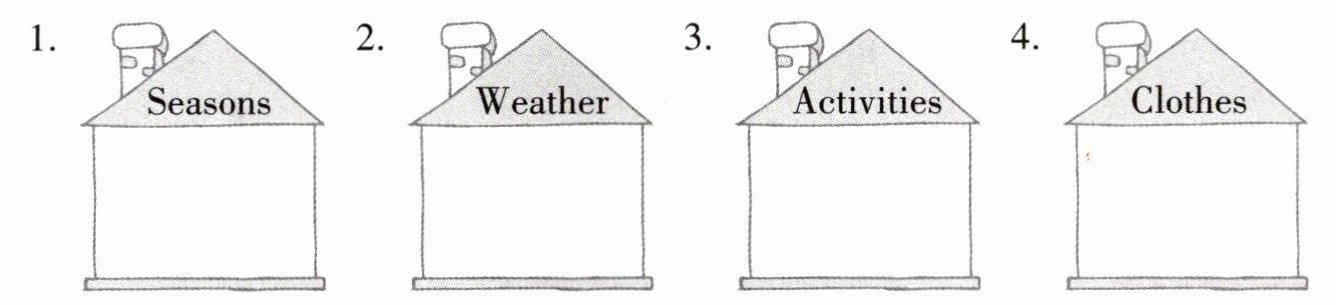
二、Read and write. 下面的单词和短语分别属于哪一类呢?请你读一读,帮它们分类。(写序号)
A. winter B. hot C. go on a picnic D. autumn
E. make a snowman F. go swimming G. spring
H. T-shirt I. summer J. jacket K. cool L. coat
M. warm N. pick apples O. dress P. cold
A. winter B. hot C. go on a picnic D. autumn
E. make a snowman F. go swimming G. spring
H. T-shirt I. summer J. jacket K. cool L. coat
M. warm N. pick apples O. dress P. cold
答案
1. A D G I
2. B K M P
3. C E F N
4. H J L O
2. B K M P
3. C E F N
4. H J L O
解析
【分析】
首先我们需要明确四个类别的含义:Seasons是季节类,Weather是天气类,Activities是活动类,Clothes是衣物类。接下来我们要逐个分析每个选项的词义,判断其所属类别:
1. 先识别季节类词汇:表示四季的单词都属于Seasons;
2. 再识别天气类词汇:描述气温、天气状况的形容词属于Weather;
3. 接着识别活动类词汇:表示具体行为、活动的短语属于Activities;
4. 最后识别衣物类词汇:表示服饰的名词属于Clothes。
通过这样的步骤,我们就能把所有选项准确归类。
【解析】
1. Seasons(季节):选项A.winter(冬天)、D.autumn(秋天)、G.spring(春天)、I.summer(夏天)都是表示季节的名词,因此归为此类。
2. Weather(天气):选项B.hot(炎热的)、K.cool(凉爽的)、M.warm(温暖的)、P.cold(寒冷的)都是描述天气温度状况的形容词,因此归为此类。
3. Activities(活动):选项C.go on a picnic(去野餐)、E.make a snowman(堆雪人)、F.go swimming(去游泳)、N.pick apples(摘苹果)都是表示日常活动的动词短语,因此归为此类。
4. Clothes(衣物):选项H.T-shirt(T恤衫)、J.jacket(夹克衫)、L.coat(外套)、O.dress(连衣裙)都是表示服饰的名词,因此归为此类。
【答案】
1. A D G I
2. B K M P
3. C E F N
4. H J L O
【知识点】
词汇分类、四季与天气词汇、日常活动与衣物词汇
【点评】
本题考查学生对不同类别英语词汇的辨析与归类能力,要求学生掌握常见的季节、天气、日常活动和衣物类词汇的词义,通过词义判断所属类别,既能巩固词汇积累,也能培养学生的分类认知能力。
【难度系数】
0.8
首先我们需要明确四个类别的含义:Seasons是季节类,Weather是天气类,Activities是活动类,Clothes是衣物类。接下来我们要逐个分析每个选项的词义,判断其所属类别:
1. 先识别季节类词汇:表示四季的单词都属于Seasons;
2. 再识别天气类词汇:描述气温、天气状况的形容词属于Weather;
3. 接着识别活动类词汇:表示具体行为、活动的短语属于Activities;
4. 最后识别衣物类词汇:表示服饰的名词属于Clothes。
通过这样的步骤,我们就能把所有选项准确归类。
【解析】
1. Seasons(季节):选项A.winter(冬天)、D.autumn(秋天)、G.spring(春天)、I.summer(夏天)都是表示季节的名词,因此归为此类。
2. Weather(天气):选项B.hot(炎热的)、K.cool(凉爽的)、M.warm(温暖的)、P.cold(寒冷的)都是描述天气温度状况的形容词,因此归为此类。
3. Activities(活动):选项C.go on a picnic(去野餐)、E.make a snowman(堆雪人)、F.go swimming(去游泳)、N.pick apples(摘苹果)都是表示日常活动的动词短语,因此归为此类。
4. Clothes(衣物):选项H.T-shirt(T恤衫)、J.jacket(夹克衫)、L.coat(外套)、O.dress(连衣裙)都是表示服饰的名词,因此归为此类。
【答案】
1. A D G I
2. B K M P
3. C E F N
4. H J L O
【知识点】
词汇分类、四季与天气词汇、日常活动与衣物词汇
【点评】
本题考查学生对不同类别英语词汇的辨析与归类能力,要求学生掌握常见的季节、天气、日常活动和衣物类词汇的词义,通过词义判断所属类别,既能巩固词汇积累,也能培养学生的分类认知能力。
【难度系数】
0.8
三、Read and judge. 下面是一个英语故事。请你读一读,根据故事内容判断句子正(T)误(F)。
Coco is a cute rabbit. She lives in the forest. She has many friends. They like playing together.
In spring, it's warm. Coco wants to plant(种植) carrots in her garden. She puts some seeds in the garden and pours some water. After that, she doesn't take care of the carrots. She often goes on a picnic with the little bird. They have a happy time. In summer, it's very hot. She likes eating ice cream with the little bear in the room. She doesn't go to the garden to see the carrots. In autumn, there are lots of fruits in the forest. She is busy picking the fruits with the squirrel. She forgets(忘记) the carrots. In winter, it gets cold. She invites(邀请) her friends to eat the carrots. But when they get into the garden, they can't find any carrots. Do you know why?
(
(
(
(
(
Coco is a cute rabbit. She lives in the forest. She has many friends. They like playing together.
In spring, it's warm. Coco wants to plant(种植) carrots in her garden. She puts some seeds in the garden and pours some water. After that, she doesn't take care of the carrots. She often goes on a picnic with the little bird. They have a happy time. In summer, it's very hot. She likes eating ice cream with the little bear in the room. She doesn't go to the garden to see the carrots. In autumn, there are lots of fruits in the forest. She is busy picking the fruits with the squirrel. She forgets(忘记) the carrots. In winter, it gets cold. She invites(邀请) her friends to eat the carrots. But when they get into the garden, they can't find any carrots. Do you know why?
(
F
)1. In spring, it's cool. Coco puts some carrot seeds in her garden.(
F
)2. In summer, Coco likes eating ice cream with the little squirrel.(
T
)3. In autumn, there are lots of fruits in the forest. Coco is busy picking the fruits.(
F
)4. In winter, Coco eats carrots with her friends happily(开心地).(
F
)5. Coco is a hard-working rabbit and takes good care of her carrots.答案
1. F 2. F 3. T 4. F 5. F
解析
【分析】
这是一道阅读理解判断题,解题思路为:首先通读全文,整体把握故事内容;然后针对每个题目,回到原文找到对应的段落和句子,逐一比对题目表述与原文细节是否一致,以此判断句子的正误。需要重点关注季节对应的天气、人物、事件等关键信息,避免因细节疏忽导致判断错误。
【解析】
1. 题目描述“In spring, it's cool. Coco puts some carrot seeds in her garden.”,原文提到“In spring, it's warm. Coco wants to plant carrots in her garden. She puts some seeds in the garden...”,原文中春天的天气是warm(温暖的),而非cool(凉爽的),与题目表述不符,故判断为F。
2. 题目描述“In summer, Coco likes eating ice cream with the little squirrel.”,原文表述为“In summer, it's very hot. She likes eating ice cream with the little bear in the room.”,Coco是和小熊一起吃冰淇淋,不是小松鼠,与题目表述不符,故判断为F。
3. 题目描述“In autumn, there are lots of fruits in the forest. Coco is busy picking the fruits.”,原文对应内容为“In autumn, there are lots of fruits in the forest. She is busy picking the fruits with the squirrel.”,题目表述与原文一致,故判断为T。
4. 题目描述“In winter, Coco eats carrots with her friends happily.”,原文提到“In winter, it gets cold. She invites her friends to eat the carrots. But when they get into the garden, they can't find any carrots.”,Coco和朋友找不到胡萝卜,无法一起吃,与题目表述不符,故判断为F。
5. 题目描述“Coco is a hard-working rabbit and takes good care of her carrots.”,根据原文内容,Coco种了胡萝卜后就没有照顾它,春、夏、秋都在和朋友玩耍或摘水果,最后找不到胡萝卜,说明她既不勤劳也没有好好照顾胡萝卜,与题目表述不符,故判断为F。
【答案】
1. F 2. F 3. T 4. F 5. F
【知识点】
细节信息比对、阅读理解判断、词汇语义理解
【点评】
本题重点考查学生对阅读理解文本细节信息的捕捉与比对能力,需要学生仔细甄别题目与原文在天气描述、人物搭配、事件结果等方面的差异,同时也涉及对基础英语词汇的理解。题目难度适中,只要学生认真通读原文、细致比对,就能做出正确判断。
【难度系数】
0.7
这是一道阅读理解判断题,解题思路为:首先通读全文,整体把握故事内容;然后针对每个题目,回到原文找到对应的段落和句子,逐一比对题目表述与原文细节是否一致,以此判断句子的正误。需要重点关注季节对应的天气、人物、事件等关键信息,避免因细节疏忽导致判断错误。
【解析】
1. 题目描述“In spring, it's cool. Coco puts some carrot seeds in her garden.”,原文提到“In spring, it's warm. Coco wants to plant carrots in her garden. She puts some seeds in the garden...”,原文中春天的天气是warm(温暖的),而非cool(凉爽的),与题目表述不符,故判断为F。
2. 题目描述“In summer, Coco likes eating ice cream with the little squirrel.”,原文表述为“In summer, it's very hot. She likes eating ice cream with the little bear in the room.”,Coco是和小熊一起吃冰淇淋,不是小松鼠,与题目表述不符,故判断为F。
3. 题目描述“In autumn, there are lots of fruits in the forest. Coco is busy picking the fruits.”,原文对应内容为“In autumn, there are lots of fruits in the forest. She is busy picking the fruits with the squirrel.”,题目表述与原文一致,故判断为T。
4. 题目描述“In winter, Coco eats carrots with her friends happily.”,原文提到“In winter, it gets cold. She invites her friends to eat the carrots. But when they get into the garden, they can't find any carrots.”,Coco和朋友找不到胡萝卜,无法一起吃,与题目表述不符,故判断为F。
5. 题目描述“Coco is a hard-working rabbit and takes good care of her carrots.”,根据原文内容,Coco种了胡萝卜后就没有照顾它,春、夏、秋都在和朋友玩耍或摘水果,最后找不到胡萝卜,说明她既不勤劳也没有好好照顾胡萝卜,与题目表述不符,故判断为F。
【答案】
1. F 2. F 3. T 4. F 5. F
【知识点】
细节信息比对、阅读理解判断、词汇语义理解
【点评】
本题重点考查学生对阅读理解文本细节信息的捕捉与比对能力,需要学生仔细甄别题目与原文在天气描述、人物搭配、事件结果等方面的差异,同时也涉及对基础英语词汇的理解。题目难度适中,只要学生认真通读原文、细致比对,就能做出正确判断。
【难度系数】
0.7
