

 登录
登录
三、还原信息
When you speak, write a letter or make a phone call, your words carry a message. People communicate with words. (1)
(3)
People can communicate in many other ways. An artist can use his drawings to tell about the beautiful mountains, the blue seas and many other things. A writer writes books to tell you about all the wonderful things in the world and also about people and their ideas. (4)
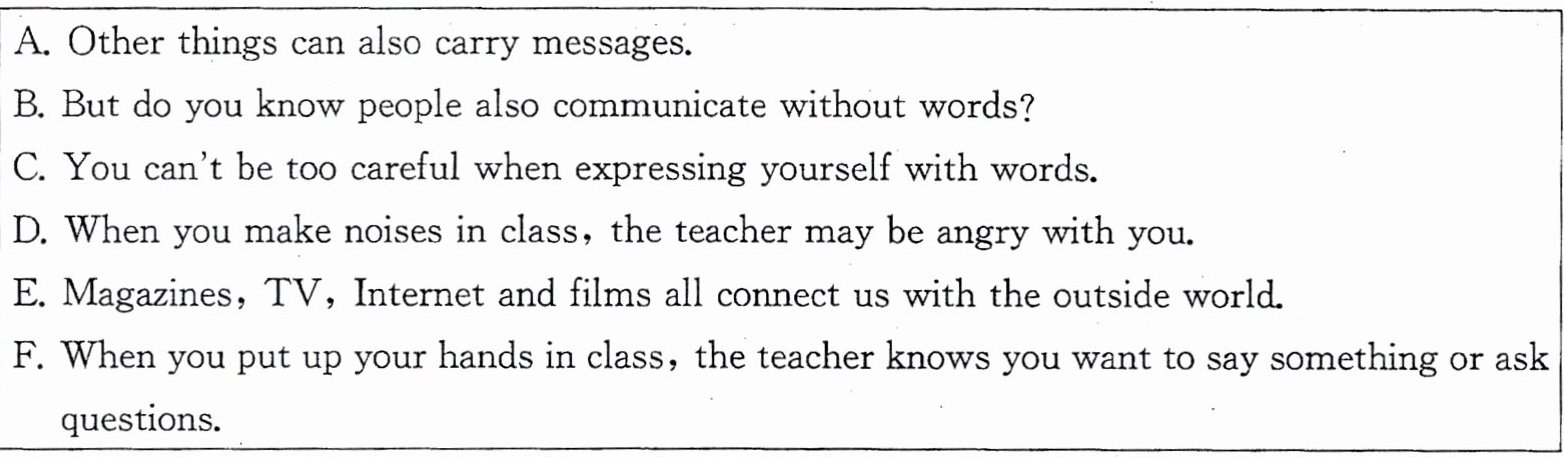
A. Other things can also carry messages.
B. But do you know people also communicate without words?
C. You can't be too careful when expressing yourself with words.
D. When you make noises in class, the teacher may be angry with you.
E. Magazines, TV, Internet and films all connect us with the outside world.
F. When you put up your hands in class, the teacher knows you want to say something or ask questions.
When you speak, write a letter or make a phone call, your words carry a message. People communicate with words. (1)
B
A smile on your face shows you are happy or friendly. Tears in your eyes tell others that you are sad. (2) F
You shake your head and people know you are saying "no". You nod and people know you are saying "yes".(3)
A
For example, a sign at the bus stop helps you to know which bus to take. A sign on the door tells you where to go in or out. Have you ever thought that there are a lot of other signs around you and that you receive messages from them all the time?People can communicate in many other ways. An artist can use his drawings to tell about the beautiful mountains, the blue seas and many other things. A writer writes books to tell you about all the wonderful things in the world and also about people and their ideas. (4)
E
They can help us to know what is going on in the world and what other people are thinking about.A. Other things can also carry messages.
B. But do you know people also communicate without words?
C. You can't be too careful when expressing yourself with words.
D. When you make noises in class, the teacher may be angry with you.
E. Magazines, TV, Internet and films all connect us with the outside world.
F. When you put up your hands in class, the teacher knows you want to say something or ask questions.
答案
三、1.B 2.F 3.A 4.E
四、综合填空
Millions of people turn off their televisions every April as part of TV-Turnoff Week, which is organized by anti-television (1)
"Sure, TV can sometimes be fun, especially when you're tired (2)
The result of a research on how much television we watch is surprising. The average American family watches TV for 7 hours and 40 minutes every day. This means we spend over ten years of (5)
Every American child sees 16 000 killings and 20 000 ads on TV every year before he or she is 18. "This is (7)
TV-Turnoff Week (9)
Millions of people turn off their televisions every April as part of TV-Turnoff Week, which is organized by anti-television (1)
groups
(group) like NoTV.com and White Dot."Sure, TV can sometimes be fun, especially when you're tired (2)
at
the end of the day," says Rudy from NoTV.com, "but most of the time it's just (3) boring
(bored). We expect people (4) to leave
(leave) the TV for a week and do something more interesting instead."The result of a research on how much television we watch is surprising. The average American family watches TV for 7 hours and 40 minutes every day. This means we spend over ten years of (5)
our
(we) life watching TV. (6) How
frightening the result is!Every American child sees 16 000 killings and 20 000 ads on TV every year before he or she is 18. "This is (7)
a
problem," Teacher Susan says. "Children in the USA spend (8) more
(much) time watching TV than in school and that's very worrying."TV-Turnoff Week (9)
started
(start) in America in 1995 and now takes place every year in the UK, France and Australia. We hope that more and more people (10) will join
(join) in this meaningful activity in the future. Let's turn off our televisions, computers and mobile phones for a while and go outside!答案
四、1. groups 2. at 3. boring 4. to leave 5. our
6. How 7. a 8. more 9. started 10. will join
6. How 7. a 8. more 9. started 10. will join
