

 登录
登录
Ⅳ.句子翻译
1. 中国家庭成员喜欢聚在一起。
Chinese family members like to
2. 你妹妹最喜欢什么节日?
3. 你们家通常怎样庆祝中秋节?
4. 人们举行龙舟赛来庆祝端午节。
5. 你通常在中秋节做什么?
1. 中国家庭成员喜欢聚在一起。
Chinese family members like to
get together
.2. 你妹妹最喜欢什么节日?
What is your sister's favourite festival?/What festival does your sister like best?
3. 你们家通常怎样庆祝中秋节?
How does your family usually celebrate the Mid-Autumn Festival?
4. 人们举行龙舟赛来庆祝端午节。
People have dragon boat races to celebrate the Dragon Boat Festival.
5. 你通常在中秋节做什么?
What do you usually do on the Mid-Autumn Festival?
答案
1. get together
2. What is your sister's favourite festival?/What festival does your sister like best?
3. How does your family usually celebrate the Mid-Autumn Festival?
4. People have dragon boat races to celebrate the Dragon Boat Festival.
5. What do you usually do on the Mid-Autumn Festival?
2. What is your sister's favourite festival?/What festival does your sister like best?
3. How does your family usually celebrate the Mid-Autumn Festival?
4. People have dragon boat races to celebrate the Dragon Boat Festival.
5. What do you usually do on the Mid-Autumn Festival?
解析
【分析】本题为英语句子翻译题,需结合日常交际用语、固定短语、特殊疑问句结构及中国传统节日的英文表达解题。步骤如下:1. 先确定每个句子核心中文含义对应的英文固定搭配或词汇;2. 特殊疑问句遵循“疑问词+一般疑问句”语序,注意第三人称单数主语的助动词使用;3. 掌握节日前的介词搭配(如用on接节日);4. 确认时态(均为一般现在时,表日常习惯),确保翻译符合英语表达习惯。
【解析】1. “聚在一起”的固定英文表达为get together,like to后接动词原形,故填get together;2. 该句为特殊疑问句,“什么节日”对应What festival,“你妹妹最喜欢”对应your sister's favourite,译为What is your sister's favourite festival?(或同义表达);3. “怎样”对应How,“庆祝”对应celebrate,“通常”对应usually,主语your family为第三人称单数,助动词用does,“中秋节”对应the Mid-Autumn Festival,故译为How does your family usually celebrate the Mid-Autumn Festival?;4. “人们”对应People,“举行龙舟赛”对应have dragon boat races,“来庆祝”用不定式表目的,“端午节”对应the Dragon Boat Festival,故译为People have dragon boat races to celebrate the Dragon Boat Festival.;5. “什么”对应What,“通常”对应usually,“做”对应do,“在中秋节”用介词on,故译为What do you usually do on the Mid-Autumn Festival?
【答案】1. get together
2. What is your sister's favourite festival?/What festival does your sister like best?
3. How does your family usually celebrate the Mid-Autumn Festival?
4. People have dragon boat races to celebrate the Dragon Boat Festival.
5. What do you usually do on the Mid-Autumn Festival?
【知识点】短语搭配、特殊疑问句、节日英文表达
【点评】本题考查日常交际及中国传统节日相关的英语翻译,属于基础题型,需掌握常用固定短语、特殊疑问句结构及传统节日的英文说法,难度较低,适合巩固英语基础。
【难度系数】0.8
【解析】1. “聚在一起”的固定英文表达为get together,like to后接动词原形,故填get together;2. 该句为特殊疑问句,“什么节日”对应What festival,“你妹妹最喜欢”对应your sister's favourite,译为What is your sister's favourite festival?(或同义表达);3. “怎样”对应How,“庆祝”对应celebrate,“通常”对应usually,主语your family为第三人称单数,助动词用does,“中秋节”对应the Mid-Autumn Festival,故译为How does your family usually celebrate the Mid-Autumn Festival?;4. “人们”对应People,“举行龙舟赛”对应have dragon boat races,“来庆祝”用不定式表目的,“端午节”对应the Dragon Boat Festival,故译为People have dragon boat races to celebrate the Dragon Boat Festival.;5. “什么”对应What,“通常”对应usually,“做”对应do,“在中秋节”用介词on,故译为What do you usually do on the Mid-Autumn Festival?
【答案】1. get together
2. What is your sister's favourite festival?/What festival does your sister like best?
3. How does your family usually celebrate the Mid-Autumn Festival?
4. People have dragon boat races to celebrate the Dragon Boat Festival.
5. What do you usually do on the Mid-Autumn Festival?
【知识点】短语搭配、特殊疑问句、节日英文表达
【点评】本题考查日常交际及中国传统节日相关的英语翻译,属于基础题型,需掌握常用固定短语、特殊疑问句结构及传统节日的英文说法,难度较低,适合巩固英语基础。
【难度系数】0.8
Ⅴ. 完形填空
In 1, the 8th day of the 12th lunar month is the Laba Festival. It has a long 2. It is more than 1,000 years old. 3 the Spring Festival, it takes place every year.
People do 4 special things on that day. Many people eat the 5 Laba porridge(粥). And 6 often cook it with eight different things. It 7 contains rice, dried lotus seeds(莲子), red beans and many other kinds of dried fruits. So the porridge is 8 called Eight Treasure Porridge. You can 9 your favourite things in the porridge, too. People 10 to make the porridge delicious, so they usually cook it for a long time.
______ 11 ______ the festival, people begin to ______ 12 ______ their houses and buy things to welcome the Spring Festival. Chinese people like having Laba porridge ______ 13 ______ it shows good wishes for the coming of the Spring Festival. Now people even ______ 14 ______ it to their friends as presents.
Is your family 15 for making the porridge this year?
1. A. China B. Chinese
C. England D. English
2. A. history B. time
C. celebration D. day
3. A. On B. With
C. Like D. In
4. A. some B. any
C. every D. no
5. A. wide B. bright
C. serious D. traditional
6. A. you B. they
C. he D. she
7. A. like B. seldom
C. never D. usually
8. A. even B. either
C. also D. too
9. A. pull B. hang
C. put D. hide
10. A. regret B. need
C. remember D. want
11. A. Before B. After
C. When D. Later
12. A. point out B. look out
C. clean up D. give up
13. A. or B. if
C. but D. because
14. A. give B. buy
C. sell D. make
15. A. ready B. joy
C. smile D. plan
In 1, the 8th day of the 12th lunar month is the Laba Festival. It has a long 2. It is more than 1,000 years old. 3 the Spring Festival, it takes place every year.
People do 4 special things on that day. Many people eat the 5 Laba porridge(粥). And 6 often cook it with eight different things. It 7 contains rice, dried lotus seeds(莲子), red beans and many other kinds of dried fruits. So the porridge is 8 called Eight Treasure Porridge. You can 9 your favourite things in the porridge, too. People 10 to make the porridge delicious, so they usually cook it for a long time.
______ 11 ______ the festival, people begin to ______ 12 ______ their houses and buy things to welcome the Spring Festival. Chinese people like having Laba porridge ______ 13 ______ it shows good wishes for the coming of the Spring Festival. Now people even ______ 14 ______ it to their friends as presents.
Is your family 15 for making the porridge this year?
1. A. China B. Chinese
C. England D. English
2. A. history B. time
C. celebration D. day
3. A. On B. With
C. Like D. In
4. A. some B. any
C. every D. no
5. A. wide B. bright
C. serious D. traditional
6. A. you B. they
C. he D. she
7. A. like B. seldom
C. never D. usually
8. A. even B. either
C. also D. too
9. A. pull B. hang
C. put D. hide
10. A. regret B. need
C. remember D. want
11. A. Before B. After
C. When D. Later
12. A. point out B. look out
C. clean up D. give up
13. A. or B. if
C. but D. because
14. A. give B. buy
C. sell D. make
15. A. ready B. joy
C. smile D. plan
答案
1.A 2.A 3.C 4.A 5.D 6.B 7.D 8.C 9.C 10.D 11.B 12.C 13.D 14.A 15.A
【语篇解读】本文是一篇说明文,主要介绍了中国传统节日腊八节的时间、历史、习俗,重点描述了腊八粥的制作与寓意,以及人们为迎接春节所做的准备。
1. A 解析:句意:在中国,农历十二月初八是腊八节。根据句意,表示“在中国”,应用介词 In 加 China。Chinese“中国的”为形容词,England“英格兰”、English“英语”均不符合语境。
2. A 解析:句意:它有着悠久的历史。固定搭配 have a long history,意为“有悠久的历史”,应用 history。time“时间”、celebration“庆祝”、day“天”均不符合此搭配。
3. C 解析:句意:它像春节一样,每年都会举行。根据句意,腊八节与春节类似,应用 Like,意为“像”。On“在……上”、With“和”、In“在……里”均不符合句意。
4. A 解析:句意:人们在那天会做一些特别的事情。肯定句中表示“一些”,应用 some。any 用于否定或疑问句,every“每一个”、no“没有”均不符合句意。
5. D 解析:句意:许多人吃传统的腊八粥。根据语境,腊八粥是“传统的”食物,应用 traditional。wide“宽的”、bright“明亮的”、serious“严肃的”均不符合语境。
6. B 解析:句意:他们常常用八种不同的东西来煮粥。根据前文“Many people”可知,此处代词应用 they,指代人们。you“你”、he“他”、she“她”均不符合句意。
7. D 解析:句意:它通常包含大米、干莲子、红豆和许多其他种类的干果。根据句意,描述腊八粥的常见成分,应用 usually,表示“通常”。like“像”、seldom“很少”、never“从不”均不符合语境。
8. C 解析:句意:所以这种粥也被称为八宝粥。根据句意,表示“也被称为”,应用 also。even“甚至”、either“也(用于否定句)”、too“也(用于肯定句末)”均不符合此处位置。
9. C 解析:句意:你也可以在粥里放你最喜欢的东西。根据句意,表示“放入”,应用 put。pull“拉”、hang“悬挂”、hide“隐藏”均不符合语境。
10. D 解析:句意:人们想让粥美味,所以他们通常煮很长时间。根据句意,表示“想要”,应用 want。regret“遗憾”、need“需要”、remember“记住”均不如 want 符合意图。
11. B 解析:句意:节日过后,人们开始打扫房屋和购买物品来迎接春节。根据句意,腊八节在春节前,所以应是“过后”开始准备,应用 After。Before“之前”、When“当……时”、Later“后来”均不符合句意。
12. C 解析:句意:节日过后,人们开始打扫房屋和购买物品来迎接春节。固定搭配 clean up,意为“打扫干净”,应用 clean up。point out“指出”、look out“小心”、give up“放弃”均不符合语境。
13. D 解析:句意:中国人喜欢喝腊八粥,因为它表达了对春节到来的美好祝愿。前句喜欢喝腊八粥,后句说明原因,应用 because,表示“因为”。or“或者”、if“如果”、but“但是”均不符合因果关系。
14. A 解析:句意:现在人们甚至把它作为礼物送给朋友。根据句意,表示“赠送”,应用 give。buy“买”、sell“卖”、make“制作”均不符合赠送礼物的语境。
15. A 解析:句意:今年你家准备好做粥了吗? 固定搭配 be ready for,意为“为……做好准备”,应用 ready。joy“快乐”、smile“微笑”、plan“计划”均不符合句意。
【语篇解读】本文是一篇说明文,主要介绍了中国传统节日腊八节的时间、历史、习俗,重点描述了腊八粥的制作与寓意,以及人们为迎接春节所做的准备。
1. A 解析:句意:在中国,农历十二月初八是腊八节。根据句意,表示“在中国”,应用介词 In 加 China。Chinese“中国的”为形容词,England“英格兰”、English“英语”均不符合语境。
2. A 解析:句意:它有着悠久的历史。固定搭配 have a long history,意为“有悠久的历史”,应用 history。time“时间”、celebration“庆祝”、day“天”均不符合此搭配。
3. C 解析:句意:它像春节一样,每年都会举行。根据句意,腊八节与春节类似,应用 Like,意为“像”。On“在……上”、With“和”、In“在……里”均不符合句意。
4. A 解析:句意:人们在那天会做一些特别的事情。肯定句中表示“一些”,应用 some。any 用于否定或疑问句,every“每一个”、no“没有”均不符合句意。
5. D 解析:句意:许多人吃传统的腊八粥。根据语境,腊八粥是“传统的”食物,应用 traditional。wide“宽的”、bright“明亮的”、serious“严肃的”均不符合语境。
6. B 解析:句意:他们常常用八种不同的东西来煮粥。根据前文“Many people”可知,此处代词应用 they,指代人们。you“你”、he“他”、she“她”均不符合句意。
7. D 解析:句意:它通常包含大米、干莲子、红豆和许多其他种类的干果。根据句意,描述腊八粥的常见成分,应用 usually,表示“通常”。like“像”、seldom“很少”、never“从不”均不符合语境。
8. C 解析:句意:所以这种粥也被称为八宝粥。根据句意,表示“也被称为”,应用 also。even“甚至”、either“也(用于否定句)”、too“也(用于肯定句末)”均不符合此处位置。
9. C 解析:句意:你也可以在粥里放你最喜欢的东西。根据句意,表示“放入”,应用 put。pull“拉”、hang“悬挂”、hide“隐藏”均不符合语境。
10. D 解析:句意:人们想让粥美味,所以他们通常煮很长时间。根据句意,表示“想要”,应用 want。regret“遗憾”、need“需要”、remember“记住”均不如 want 符合意图。
11. B 解析:句意:节日过后,人们开始打扫房屋和购买物品来迎接春节。根据句意,腊八节在春节前,所以应是“过后”开始准备,应用 After。Before“之前”、When“当……时”、Later“后来”均不符合句意。
12. C 解析:句意:节日过后,人们开始打扫房屋和购买物品来迎接春节。固定搭配 clean up,意为“打扫干净”,应用 clean up。point out“指出”、look out“小心”、give up“放弃”均不符合语境。
13. D 解析:句意:中国人喜欢喝腊八粥,因为它表达了对春节到来的美好祝愿。前句喜欢喝腊八粥,后句说明原因,应用 because,表示“因为”。or“或者”、if“如果”、but“但是”均不符合因果关系。
14. A 解析:句意:现在人们甚至把它作为礼物送给朋友。根据句意,表示“赠送”,应用 give。buy“买”、sell“卖”、make“制作”均不符合赠送礼物的语境。
15. A 解析:句意:今年你家准备好做粥了吗? 固定搭配 be ready for,意为“为……做好准备”,应用 ready。joy“快乐”、smile“微笑”、plan“计划”均不符合句意。
解析
【分析】本题是一篇介绍中国传统节日腊八节的完形填空题,解题思路为:先通读全文把握主旨(介绍腊八节的时间、历史、习俗及迎接春节的相关活动),再逐空分析语境、固定搭配、词义差异,结合选项选出最贴合文意的答案,最后通读验证确保逻辑通顺。
【解析】1. 句意:在中国,农历十二月初八是腊八节。“在中国”用In+国家,故选A China;2. 固定搭配have a long history(有悠久的历史),故选A history;3. 句意:它像春节一样每年举行,Like表“像”,故选C Like;4. 肯定句中表“一些”用some,故选A;5. 腊八粥是传统食物,故选D traditional;6. 指代前文的Many people用they,故选B;7. 描述腊八粥通常包含的成分,usually表“通常”,故选D;8. 句中表“也”且用于句中用also,故选C;9. 表示“放入”用put,故选C;10. 句意:人们想让粥美味,want表“想要”,故选D;11. 腊八节后准备春节,After表“在……之后”,故选B;12. 固定搭配clean up(打扫),故选C;13. 前句是结果,后句说明原因,用because,故选D;14. 固定搭配give sth to sb(把某物给某人),故选A;15. 固定搭配be ready for(为……做准备),故选A。
【答案】1.A 2.A 3.C 4.A 5.D 6.B 7.D 8.C 9.C 10.D 11.B 12.C 13.D 14.A 15.A
【知识点】完形填空、腊八节文化、词义辨析
【点评】本题围绕中国传统节日腊八节展开,考查词汇辨析、固定搭配及语境理解,结合文化背景降低解题难度,是中等难度的完形填空练习题,适合学生巩固相关解题技巧。
【难度系数】0.6
【解析】1. 句意:在中国,农历十二月初八是腊八节。“在中国”用In+国家,故选A China;2. 固定搭配have a long history(有悠久的历史),故选A history;3. 句意:它像春节一样每年举行,Like表“像”,故选C Like;4. 肯定句中表“一些”用some,故选A;5. 腊八粥是传统食物,故选D traditional;6. 指代前文的Many people用they,故选B;7. 描述腊八粥通常包含的成分,usually表“通常”,故选D;8. 句中表“也”且用于句中用also,故选C;9. 表示“放入”用put,故选C;10. 句意:人们想让粥美味,want表“想要”,故选D;11. 腊八节后准备春节,After表“在……之后”,故选B;12. 固定搭配clean up(打扫),故选C;13. 前句是结果,后句说明原因,用because,故选D;14. 固定搭配give sth to sb(把某物给某人),故选A;15. 固定搭配be ready for(为……做准备),故选A。
【答案】1.A 2.A 3.C 4.A 5.D 6.B 7.D 8.C 9.C 10.D 11.B 12.C 13.D 14.A 15.A
【知识点】完形填空、腊八节文化、词义辨析
【点评】本题围绕中国传统节日腊八节展开,考查词汇辨析、固定搭配及语境理解,结合文化背景降低解题难度,是中等难度的完形填空练习题,适合学生巩固相关解题技巧。
【难度系数】0.6
Ⅵ.任务型阅读
阅读并根据下面的短文,在表格中的空格里填入一个最恰当的单词。
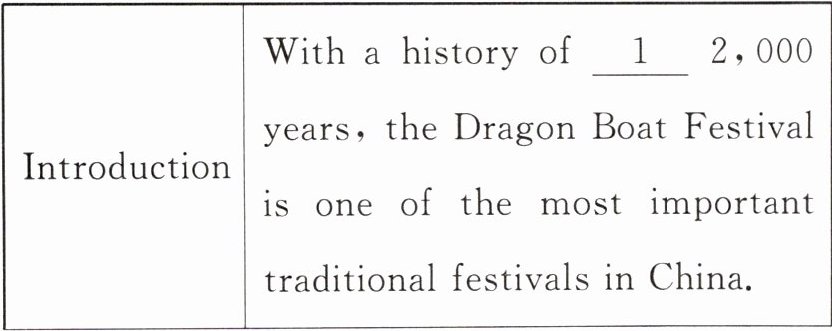
With a history of more than 2,000 years, the Dragon Boat Festival is one of the most important traditional festivals in China, falling on the 5th day of the 5th month in the Chinese lunar calendar.
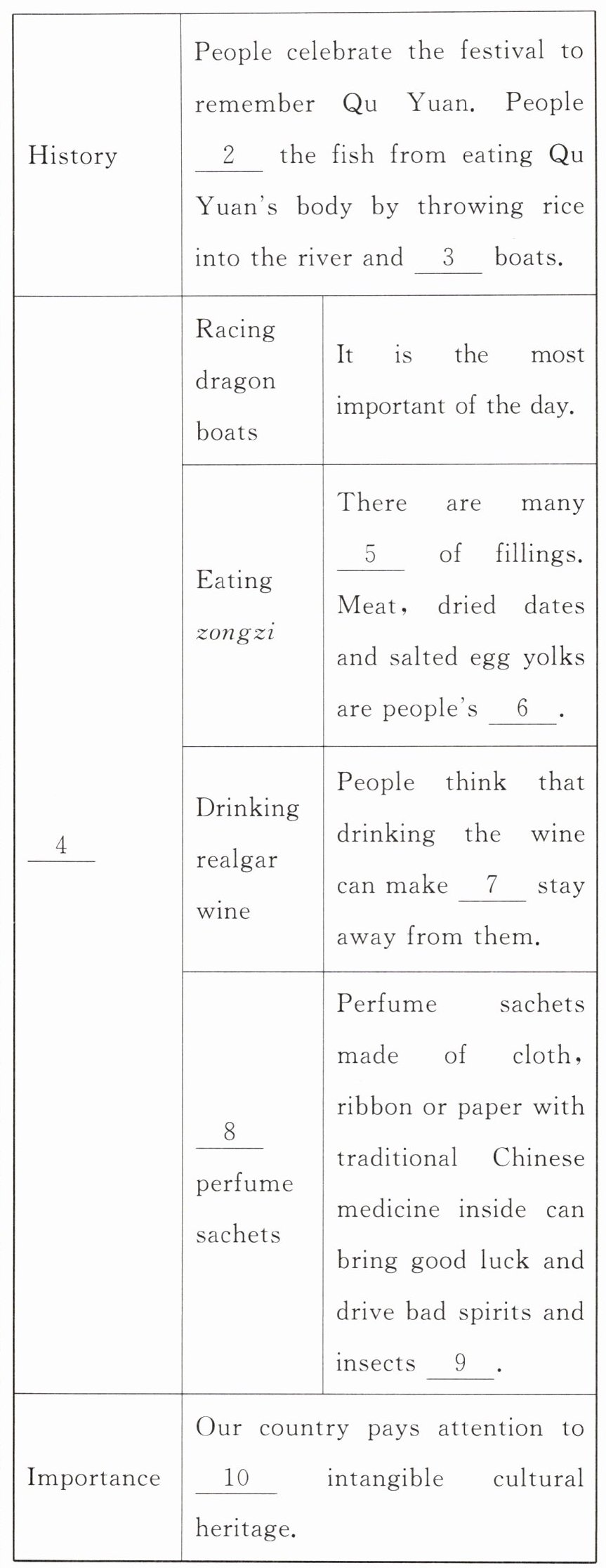
Behind the festival, there is a sad story. The festival is held to remember Qu Yuan. He threw himself into the Miluo River in Hunan Province after his motherland fell under the enemy's rule. People threw rice into the river to drive fish away from his body.
Then the tradition of eating zongzi and racing dragon boats began. The dragon boat race may be the most important of the day, and eating zongzi is a close second. Zongzi is made of sticky rice wrapped in bamboo leaves. The fillings for zongzi are various—meat, dried dates and salted egg yolks are among the most popular choices. Another Dragon Boat Festival tradition is drinking realgar(雄黄) wine. Drinking the wine is thought to protect people from illnesses. During the holiday, people also make perfume sachets(香包) which are made of cloth, ribbon or paper with traditional Chinese medicine inside. They can bring good luck and fight off bad spirits and insects.
Today, the Dragon Boat Festival is still a very popular festival among Chinese people. Our country pays attention to the protection of intangible cultural heritage(非物质文化遗产).
阅读并根据下面的短文,在表格中的空格里填入一个最恰当的单词。
With a history of more than 2,000 years, the Dragon Boat Festival is one of the most important traditional festivals in China, falling on the 5th day of the 5th month in the Chinese lunar calendar.
Behind the festival, there is a sad story. The festival is held to remember Qu Yuan. He threw himself into the Miluo River in Hunan Province after his motherland fell under the enemy's rule. People threw rice into the river to drive fish away from his body.
Then the tradition of eating zongzi and racing dragon boats began. The dragon boat race may be the most important of the day, and eating zongzi is a close second. Zongzi is made of sticky rice wrapped in bamboo leaves. The fillings for zongzi are various—meat, dried dates and salted egg yolks are among the most popular choices. Another Dragon Boat Festival tradition is drinking realgar(雄黄) wine. Drinking the wine is thought to protect people from illnesses. During the holiday, people also make perfume sachets(香包) which are made of cloth, ribbon or paper with traditional Chinese medicine inside. They can bring good luck and fight off bad spirits and insects.
Today, the Dragon Boat Festival is still a very popular festival among Chinese people. Our country pays attention to the protection of intangible cultural heritage(非物质文化遗产).
答案
1. over 2. stopped 3. racing 4. Traditions/Customs 5. kinds 6. favourites 7. illnesses 8. Making 9. away 10. protecting
【语篇解读】本文是一篇说明文,介绍了端午节的起源、习俗及其文化意义。
【语篇解读】本文是一篇说明文,介绍了端午节的起源、习俗及其文化意义。
解析
【分析】
本题为任务型阅读,需根据短文内容在空格处填入恰当单词。解题思路:首先通读全文,理解短文关于端午节的起源、习俗及文化意义的核心内容;接着分析每个空格前后的语境,结合短文中的原句,匹配对应的词汇,同时注意语法和语义的通顺性,确保所填单词符合上下文逻辑。
【解析】
1. 由短文第一段“With a history of more than 2,000 years”可知,此处需表达“超过”,故填over;
2. 由短文第二段“after his motherland fell under the enemy's rule”可知,此处指祖国被敌人统治(失去独立),对应填stopped;
3. 由短文第三段“The dragon boat race may be the most important of the day”可知,此处指赛龙舟,故填racing;
4. 后文介绍了端午节的各类传统习俗,此处需概括“传统/习俗”,故填Traditions/Customs;
5. 由短文第三段“various—meat, dried dates and salted egg yolks are among the most popular choices”可知,此处指“各种各样的”,对应填kinds;
6. 由短文第三段“the most popular choices”可知,此处指最受欢迎的选择,对应填favourites;
7. 由短文第三段“Drinking the wine is thought to protect people from illnesses”可知,此处指疾病,故填illnesses;
8. 由短文第三段“people also make perfume sachets”可知,此处指制作香包,对应填Making;
9. 由短文第三段“fight off bad spirits and insects”可知,fight off与drive away语义相近,此处填away;
10. 由短文第四段“Our country pays attention to the protection of intangible cultural heritage”可知,此处需用动名词形式对应,故填protecting。
【答案】
1. over 2. stopped 3. racing 4. Traditions/Customs 5. kinds 6. favourites 7. illnesses 8. Making 9. away 10. protecting
【知识点】
任务型阅读;英语词汇运用;短文理解
【点评】
本题围绕端午节的相关内容考查学生的阅读理解能力及词汇运用能力,要求学生结合语境匹配原文词汇,难度适中,能有效检验学生对短文细节的把握。
【难度系数】
0.5
本题为任务型阅读,需根据短文内容在空格处填入恰当单词。解题思路:首先通读全文,理解短文关于端午节的起源、习俗及文化意义的核心内容;接着分析每个空格前后的语境,结合短文中的原句,匹配对应的词汇,同时注意语法和语义的通顺性,确保所填单词符合上下文逻辑。
【解析】
1. 由短文第一段“With a history of more than 2,000 years”可知,此处需表达“超过”,故填over;
2. 由短文第二段“after his motherland fell under the enemy's rule”可知,此处指祖国被敌人统治(失去独立),对应填stopped;
3. 由短文第三段“The dragon boat race may be the most important of the day”可知,此处指赛龙舟,故填racing;
4. 后文介绍了端午节的各类传统习俗,此处需概括“传统/习俗”,故填Traditions/Customs;
5. 由短文第三段“various—meat, dried dates and salted egg yolks are among the most popular choices”可知,此处指“各种各样的”,对应填kinds;
6. 由短文第三段“the most popular choices”可知,此处指最受欢迎的选择,对应填favourites;
7. 由短文第三段“Drinking the wine is thought to protect people from illnesses”可知,此处指疾病,故填illnesses;
8. 由短文第三段“people also make perfume sachets”可知,此处指制作香包,对应填Making;
9. 由短文第三段“fight off bad spirits and insects”可知,fight off与drive away语义相近,此处填away;
10. 由短文第四段“Our country pays attention to the protection of intangible cultural heritage”可知,此处需用动名词形式对应,故填protecting。
【答案】
1. over 2. stopped 3. racing 4. Traditions/Customs 5. kinds 6. favourites 7. illnesses 8. Making 9. away 10. protecting
【知识点】
任务型阅读;英语词汇运用;短文理解
【点评】
本题围绕端午节的相关内容考查学生的阅读理解能力及词汇运用能力,要求学生结合语境匹配原文词汇,难度适中,能有效检验学生对短文细节的把握。
【难度系数】
0.5
