

 登录
登录
(二) 选词填空
从方框中选择恰当的单词,并用其正确形式填空。

Redwood forests are amazing. The redwood trees are some of the 1 trees on earth. They can reach over 100 metres 2. Walking into a redwood forest feels like entering a 3 world.
These forests are home to many 4. Birds sing 5 in the trees, and small animals run around. The redwood bark(皮) is thick and strong. People use it to make 6 things like boxes and some other things.
Redwood trees can live more than 2,000 years old. They grow 7. Even in difficult conditions, they show great strength to survive(生存).
Visiting redwood forests is popular. Every year, 8 of tourists come to visit these redwoods. They learn about the trees' history and 9 to nature.
We must protect redwood forests. They are not just beautiful but also valuable(有价值的) for scientific research. We must 10 them to make our world more beautiful.
1.
4.
7.
10.
从方框中选择恰当的单词,并用其正确形式填空。
Redwood forests are amazing. The redwood trees are some of the 1 trees on earth. They can reach over 100 metres 2. Walking into a redwood forest feels like entering a 3 world.
These forests are home to many 4. Birds sing 5 in the trees, and small animals run around. The redwood bark(皮) is thick and strong. People use it to make 6 things like boxes and some other things.
Redwood trees can live more than 2,000 years old. They grow 7. Even in difficult conditions, they show great strength to survive(生存).
Visiting redwood forests is popular. Every year, 8 of tourists come to visit these redwoods. They learn about the trees' history and 9 to nature.
We must protect redwood forests. They are not just beautiful but also valuable(有价值的) for scientific research. We must 10 them to make our world more beautiful.
1.
highest
2. tall
3. magical
4.
animals
5. sweetly
6. useful
7.
slowly
8. thousands
9. importance
10.
protect
答案
1. highest
2. tall
3. magical
4. animals
5. sweetly
6. useful
7. slowly
8. thousands
9. importance
10. protect
2. tall
3. magical
4. animals
5. sweetly
6. useful
7. slowly
8. thousands
9. importance
10. protect
解析
【分析】
本题为英语选词填空,需先明确方框内单词的词性与词义,再结合句子语境、语法规则(如词性转换、固定搭配、名词复数、形容词最高级等)确定每个空的单词及正确形式。解题思路:1. 梳理方框单词:tall(adj.高的)、slow(adj.慢的)、thousand(num.千)、magic(n./adj.魔法/魔法的)、protect(v.保护)、use(v./n.使用)、height(n.高度)、sweet(adj.甜的)、important(adj.重要的)、animal(n.动物);2. 逐个分析空格:根据空格前后的语法结构(如the+最高级、many+复数名词、动词后用副词、must+动词原形等)及语境,选择并转换单词形式。
【解析】
1. 空格前有“some of the”,后接范围,需用形容词最高级修饰名词trees,tall的最高级为highest,故填highest;
2. 此处表达“高达100多米”,“数字+tall”表示高度,故填tall;
3. 空格修饰名词world,需用形容词,magic的形容词形式为magical,故填magical;
4. many后接可数名词复数,animal的复数为animals,故填animals;
5. 空格修饰动词sing,需用副词,sweet的副词形式为sweetly,故填sweetly;
6. 空格修饰名词things,需用形容词,use的形容词形式为useful,故填useful;
7. 空格修饰动词grow,需用副词,slow的副词形式为slowly,故填slowly;
8. 固定搭配“thousands of”表示“成千上万的”,故填thousands;
9. 此处需名词与history并列,important的名词形式为importance,故填importance;
10. must后接动词原形,故填protect。
【答案】
1. highest
2. tall
3. magical
4. animals
5. sweetly
6. useful
7. slowly
8. thousands
9. importance
10. protect
【知识点】
形容词最高级、词性转换、固定搭配
【点评】
本题考查英语选词填空,需掌握单词的词性变化、固定搭配及语法规则,解题时先分析语境和语法结构,再选择合适的单词形式,是初中英语常见题型,注重基础词汇的运用。
【难度系数】
0.6
本题为英语选词填空,需先明确方框内单词的词性与词义,再结合句子语境、语法规则(如词性转换、固定搭配、名词复数、形容词最高级等)确定每个空的单词及正确形式。解题思路:1. 梳理方框单词:tall(adj.高的)、slow(adj.慢的)、thousand(num.千)、magic(n./adj.魔法/魔法的)、protect(v.保护)、use(v./n.使用)、height(n.高度)、sweet(adj.甜的)、important(adj.重要的)、animal(n.动物);2. 逐个分析空格:根据空格前后的语法结构(如the+最高级、many+复数名词、动词后用副词、must+动词原形等)及语境,选择并转换单词形式。
【解析】
1. 空格前有“some of the”,后接范围,需用形容词最高级修饰名词trees,tall的最高级为highest,故填highest;
2. 此处表达“高达100多米”,“数字+tall”表示高度,故填tall;
3. 空格修饰名词world,需用形容词,magic的形容词形式为magical,故填magical;
4. many后接可数名词复数,animal的复数为animals,故填animals;
5. 空格修饰动词sing,需用副词,sweet的副词形式为sweetly,故填sweetly;
6. 空格修饰名词things,需用形容词,use的形容词形式为useful,故填useful;
7. 空格修饰动词grow,需用副词,slow的副词形式为slowly,故填slowly;
8. 固定搭配“thousands of”表示“成千上万的”,故填thousands;
9. 此处需名词与history并列,important的名词形式为importance,故填importance;
10. must后接动词原形,故填protect。
【答案】
1. highest
2. tall
3. magical
4. animals
5. sweetly
6. useful
7. slowly
8. thousands
9. importance
10. protect
【知识点】
形容词最高级、词性转换、固定搭配
【点评】
本题考查英语选词填空,需掌握单词的词性变化、固定搭配及语法规则,解题时先分析语境和语法结构,再选择合适的单词形式,是初中英语常见题型,注重基础词汇的运用。
【难度系数】
0.6
A
阅读短文,从每小题所给的 A、B、C 三个选项中选择最佳答案。
As spring comes, the weather warms up and the rain falls. The world comes back to life. Chinese people call this time of the year jingzhe, and it is one of the "solar terms"(节气) in China. Jingzhe usually comes on 5th March or 6th March.
It's time to get up and find food for some animals and insects. Farmers start the year's work. Lots of sunshine and rain are good for plants to grow. As the Chinese saying goes, "The whole year's work depends on a good start in spring." Everyone is busy preparing for the new year's work. What do we do around jingzhe?
Feed the "White Tiger"
In some old Chinese stories, a white tiger always hurts(伤害) people during jingzhe. So people draw it on paper and then "put some meat in its mouth". This way, the tiger is full and will not hurt people.
Beat the Drums
Some stories are about the god of thunder(雷神). He beats his drum to make spring thunder during jingzhe. To show their respect, people on the earth also beat the drums.
Eat Pears
It's getting warmer around jingzhe. Pears are sweet. People believe that eating pears can stop us from getting coughs(咳嗽).
1. Which day is jingzhe usually on?
A. 5th March or 6th March.
B. 5th May or 6th May.
C. 3rd May or 4th May.
2. What does the saying in Paragraph 2 mean?
A. People always get up early in spring.
B. Spring is the best time to be ready for the year's work.
C. It's important for people to work on a spring morning.
3. Why do people beat the drums around jingzhe?
A. To make spring thunder.
B. To stop getting coughs.
C. To show their respect for the god.
4. Which picture are not from jingzhe?
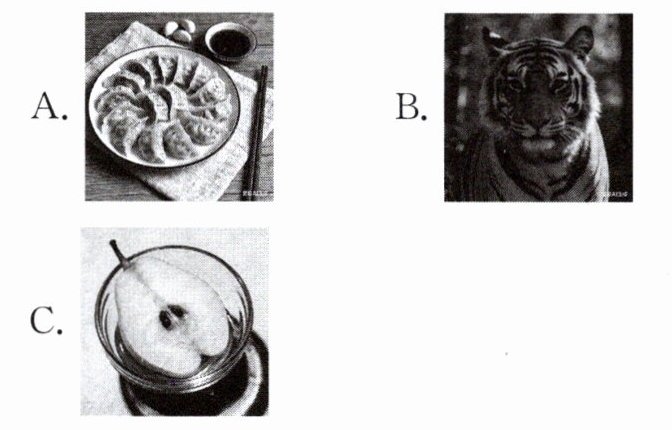
5. Which of the following describes jingzhe?
A. 寒寒树栖鸦,露露水中花。
B. 时雨及芒种,四野皆插秧。
C. 忽闻天公霹雳声,禽兽虫豸倒乾坤。
阅读短文,从每小题所给的 A、B、C 三个选项中选择最佳答案。
As spring comes, the weather warms up and the rain falls. The world comes back to life. Chinese people call this time of the year jingzhe, and it is one of the "solar terms"(节气) in China. Jingzhe usually comes on 5th March or 6th March.
It's time to get up and find food for some animals and insects. Farmers start the year's work. Lots of sunshine and rain are good for plants to grow. As the Chinese saying goes, "The whole year's work depends on a good start in spring." Everyone is busy preparing for the new year's work. What do we do around jingzhe?
Feed the "White Tiger"
In some old Chinese stories, a white tiger always hurts(伤害) people during jingzhe. So people draw it on paper and then "put some meat in its mouth". This way, the tiger is full and will not hurt people.
Beat the Drums
Some stories are about the god of thunder(雷神). He beats his drum to make spring thunder during jingzhe. To show their respect, people on the earth also beat the drums.
Eat Pears
It's getting warmer around jingzhe. Pears are sweet. People believe that eating pears can stop us from getting coughs(咳嗽).
1. Which day is jingzhe usually on?
A. 5th March or 6th March.
B. 5th May or 6th May.
C. 3rd May or 4th May.
2. What does the saying in Paragraph 2 mean?
A. People always get up early in spring.
B. Spring is the best time to be ready for the year's work.
C. It's important for people to work on a spring morning.
3. Why do people beat the drums around jingzhe?
A. To make spring thunder.
B. To stop getting coughs.
C. To show their respect for the god.
4. Which picture are not from jingzhe?
5. Which of the following describes jingzhe?
A. 寒寒树栖鸦,露露水中花。
B. 时雨及芒种,四野皆插秧。
C. 忽闻天公霹雳声,禽兽虫豸倒乾坤。
答案
1.A 2.B 3.C 4.A 5.C
解析
【分析】
本题为英语阅读理解题,需结合原文内容逐一分析各小题:
1. 第1题是细节理解题,定位原文中关于惊蛰时间的描述即可;
2. 第2题是句意理解题,结合谚语语境分析其含义;
3. 第3题是细节理解题,查找原文中打鼓的原因;
4. 第4题是信息匹配题,结合惊蛰习俗判断对应图片;
5. 第5题是诗句匹配题,结合惊蛰特点匹配对应诗句。
【解析】
1. 细节理解题:根据原文第一段最后一句“Jingzhe usually comes on 5th March or 6th March.”,可知惊蛰在3月5日或6日,对应选项A。
2. 句意理解题:第二段谚语“The whole year's work depends on a good start in spring.”意为“一年的工作取决于春天的良好开端”,即春天是为一年工作做准备的最佳时间,对应选项B。
3. 细节理解题:根据“Beat the Drums”部分“To show their respect, people on the earth also beat the drums.”,可知打鼓是为了表达对雷神的尊敬,对应选项C。
4. 信息匹配题:惊蛰习俗有“喂白虎”(对应图片B)、“吃梨”(对应图片C),图片A是饺子,不属于惊蛰习俗,因此选A。
5. 诗句匹配题:选项C描述了打雷场景,对应惊蛰时雷神打鼓、春雷响起的特点;选项A是寒露景象,选项B是芒种景象,因此选C。
【答案】
1.A 2.B 3.C 4.A 5.C
【知识点】
英语阅读理解、细节理解、节气常识
【点评】
本题结合英语阅读与中国节气知识,考查学生提取细节、理解句意及信息匹配的能力,整体难度适中,需学生仔细阅读原文并结合常识分析。
【难度系数】
0.6
本题为英语阅读理解题,需结合原文内容逐一分析各小题:
1. 第1题是细节理解题,定位原文中关于惊蛰时间的描述即可;
2. 第2题是句意理解题,结合谚语语境分析其含义;
3. 第3题是细节理解题,查找原文中打鼓的原因;
4. 第4题是信息匹配题,结合惊蛰习俗判断对应图片;
5. 第5题是诗句匹配题,结合惊蛰特点匹配对应诗句。
【解析】
1. 细节理解题:根据原文第一段最后一句“Jingzhe usually comes on 5th March or 6th March.”,可知惊蛰在3月5日或6日,对应选项A。
2. 句意理解题:第二段谚语“The whole year's work depends on a good start in spring.”意为“一年的工作取决于春天的良好开端”,即春天是为一年工作做准备的最佳时间,对应选项B。
3. 细节理解题:根据“Beat the Drums”部分“To show their respect, people on the earth also beat the drums.”,可知打鼓是为了表达对雷神的尊敬,对应选项C。
4. 信息匹配题:惊蛰习俗有“喂白虎”(对应图片B)、“吃梨”(对应图片C),图片A是饺子,不属于惊蛰习俗,因此选A。
5. 诗句匹配题:选项C描述了打雷场景,对应惊蛰时雷神打鼓、春雷响起的特点;选项A是寒露景象,选项B是芒种景象,因此选C。
【答案】
1.A 2.B 3.C 4.A 5.C
【知识点】
英语阅读理解、细节理解、节气常识
【点评】
本题结合英语阅读与中国节气知识,考查学生提取细节、理解句意及信息匹配的能力,整体难度适中,需学生仔细阅读原文并结合常识分析。
【难度系数】
0.6
