

 登录
登录
从方框中选择能填入对话相应空白处的最佳选项。(有两个为多余选项)
A: 1.
B: What? Flying cars? That's impossible!
A: 2.
B: Really? I know nothing about it.
A: 3.
B: Sounds great! What's it like?
A: It is nearly 6 meters long and seats two people. It has wings that fold. 4.
B: It is very expensive, isn't it?
A: Yes, around one million yuan.
B: Wow! 5.
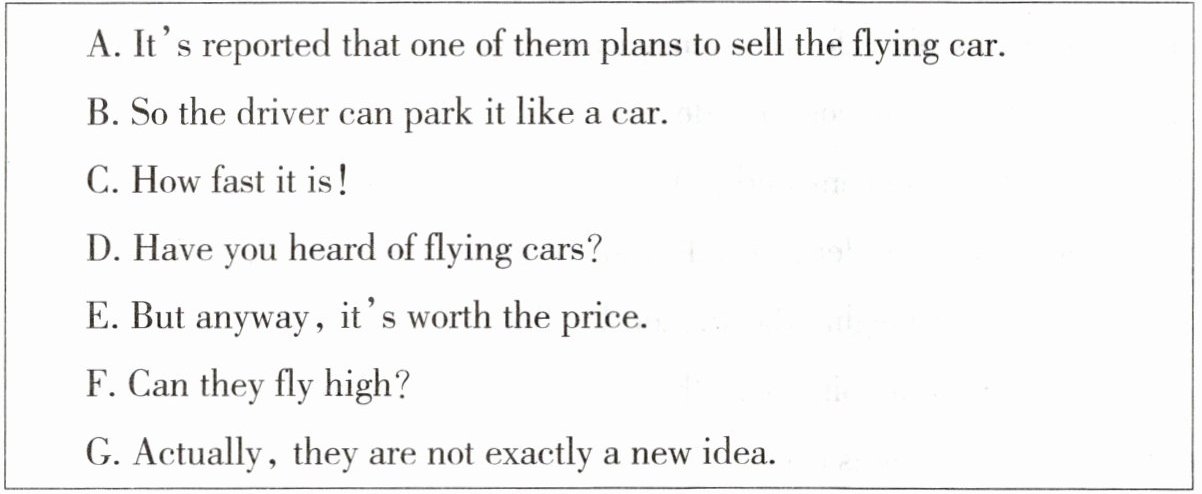
A. It's reported that one of them plans to sell the flying car.
B. So the driver can park it like a car.
C. How fast it is!
D. Have you heard of flying cars?
E. But anyway, it's worth the price.
F. Can they fly high?
G. Actually, they are not exactly a new idea.
A: 1.
D
B: What? Flying cars? That's impossible!
A: 2.
G
Many companies have been trying to make safe ones.B: Really? I know nothing about it.
A: 3.
A
B: Sounds great! What's it like?
A: It is nearly 6 meters long and seats two people. It has wings that fold. 4.
B
And it can turn into an airplane in just seconds.B: It is very expensive, isn't it?
A: Yes, around one million yuan.
B: Wow! 5.
E
A. It's reported that one of them plans to sell the flying car.
B. So the driver can park it like a car.
C. How fast it is!
D. Have you heard of flying cars?
E. But anyway, it's worth the price.
F. Can they fly high?
G. Actually, they are not exactly a new idea.
答案
1.D 2.G 3.A 4.B 5.E
解析
【分析】
解这类英语补全对话题,需先通读对话,明确上下文的话题衔接与逻辑关系,再匹配对应选项:
1. 第一空:B的回应是“Flying cars? That's impossible!”,说明A在引出“飞行汽车”话题,询问对方是否听说过,对应选项D。
2. 第二空:B认为飞行汽车不可能,A需解释其并非全新想法,很多公司在尝试研发,对应选项G。
3. 第三空:B表示自己对飞行汽车一无所知,A补充说明有公司计划售卖,对应选项A。
4. 第四空:前文提到飞行汽车“wings that fold(可折叠的翅膀)”,这一设计的作用是能像普通汽车一样停放,对应选项B。
5. 第五空:A提到飞行汽车价格昂贵,B感叹后表达其价值,对应选项E。
【解析】
1. 第一空:根据B的疑问回应,A是在开启关于飞行汽车的话题,询问对方是否听说过,故选D。
2. 第二空:B质疑飞行汽车的可能性,A需说明其并非新想法,很多公司在研发,故选G。
3. 第三空:B表示不了解飞行汽车,A进一步补充有公司计划售卖,故选A。
4. 第四空:前文提到翅膀可折叠,这一设计让飞行汽车能像普通汽车一样停放,故选B。
5. 第五空:A提到飞行汽车价格高,B感叹后表达其价值,故选E。
【答案】
1.D 2.G 3.A 4.B 5.E
【知识点】
英语补全对话、情景交际用语
【点评】
本题围绕“飞行汽车”的话题展开,考查学生对英语对话上下文逻辑的理解能力,属于基础情景补全题,只要理清问答衔接关系即可正确作答。
【难度系数】
0.7
解这类英语补全对话题,需先通读对话,明确上下文的话题衔接与逻辑关系,再匹配对应选项:
1. 第一空:B的回应是“Flying cars? That's impossible!”,说明A在引出“飞行汽车”话题,询问对方是否听说过,对应选项D。
2. 第二空:B认为飞行汽车不可能,A需解释其并非全新想法,很多公司在尝试研发,对应选项G。
3. 第三空:B表示自己对飞行汽车一无所知,A补充说明有公司计划售卖,对应选项A。
4. 第四空:前文提到飞行汽车“wings that fold(可折叠的翅膀)”,这一设计的作用是能像普通汽车一样停放,对应选项B。
5. 第五空:A提到飞行汽车价格昂贵,B感叹后表达其价值,对应选项E。
【解析】
1. 第一空:根据B的疑问回应,A是在开启关于飞行汽车的话题,询问对方是否听说过,故选D。
2. 第二空:B质疑飞行汽车的可能性,A需说明其并非新想法,很多公司在研发,故选G。
3. 第三空:B表示不了解飞行汽车,A进一步补充有公司计划售卖,故选A。
4. 第四空:前文提到翅膀可折叠,这一设计让飞行汽车能像普通汽车一样停放,故选B。
5. 第五空:A提到飞行汽车价格高,B感叹后表达其价值,故选E。
【答案】
1.D 2.G 3.A 4.B 5.E
【知识点】
英语补全对话、情景交际用语
【点评】
本题围绕“飞行汽车”的话题展开,考查学生对英语对话上下文逻辑的理解能力,属于基础情景补全题,只要理清问答衔接关系即可正确作答。
【难度系数】
0.7
从方框中选择能填入对话相应空白处的最佳选项。(有两个为多余选项)
Tom: Hi, Paul. I haven't seen you for years. 1.
Paul: Sorry. I don't know you. Who are you?
Tom: I'm Tom, your cousin. 2.
Paul: Let me see. Oh, you're Tom. I heard you were in Cambridge University.
Tom: Yes. But now I have finished the university.
Paul: 3.
Tom: Really? I used to have sweet food. I ate too much. So I was very fat.
Paul: 4.
Tom: Yes. I still wear glasses.
Paul: Where are you working now?
Tom: I'm in Fudan University. I have been a teacher of the university.
Paul: You are great. 5.
Tom: Thank you, but I have a meeting.
Paul: All right. See you next time.
Tom: See you.
A. You used to be short and heavy.
B. What do you feel like eating?
C. Don't you remember me?
D. You used to like sports, didn't you?
E. What happened to you?
F. OK, I'd like to.
G. Did you use to wear glasses?
Tom: Hi, Paul. I haven't seen you for years. 1.
E
Paul: Sorry. I don't know you. Who are you?
Tom: I'm Tom, your cousin. 2.
C
Paul: Let me see. Oh, you're Tom. I heard you were in Cambridge University.
Tom: Yes. But now I have finished the university.
Paul: 3.
A
But now you are thin and tall. So I couldn't...Tom: Really? I used to have sweet food. I ate too much. So I was very fat.
Paul: 4.
G
Tom: Yes. I still wear glasses.
Paul: Where are you working now?
Tom: I'm in Fudan University. I have been a teacher of the university.
Paul: You are great. 5.
B
I can treat you to dinner.Tom: Thank you, but I have a meeting.
Paul: All right. See you next time.
Tom: See you.
A. You used to be short and heavy.
B. What do you feel like eating?
C. Don't you remember me?
D. You used to like sports, didn't you?
E. What happened to you?
F. OK, I'd like to.
G. Did you use to wear glasses?
答案
1.E 2.C 3.A 4.G 5.B
解析
【分析】
本题为英语补全对话题,需结合对话上下文的语境、逻辑关系及日常交际用语解题。解题思路:先通读对话理解整体语境,再逐一分析每个空白处前后句的内容,匹配对应选项:第1空根据“好久不见”及Paul不认识Tom,选询问情况的选项;第2空根据Tom表明身份后,选询问是否被记得的选项;第3空根据Paul提到Tom现在的外貌,选对应过去外貌的选项;第4空根据Tom回答戴眼镜,选关于是否过去戴眼镜的选项;第5空根据Paul要请吃饭,选询问饮食的选项。
【解析】
1. 第1空:上文Tom说“好久不见”,下文Paul表示不认识Tom,因此Tom应询问对方为何不认识自己,对应选项E(What happened to you?);
2. 第2空:Tom表明自己是Paul的表弟后,接着询问Paul是否记得自己,对应选项C(Don't you remember me?);
3. 第3空:下文Paul提到“现在你又瘦又高”,此处需描述Tom过去的外貌,对应选项A(You used to be short and heavy.);
4. 第4空:下文Tom回答“是的,我现在还戴眼镜”,此处需询问Tom是否过去戴眼镜,对应选项G(Did you use to wear glasses?);
5. 第5空:下文Paul说“我可以请你吃饭”,此处需询问想吃什么,对应选项B(What do you feel like eating?)。
【答案】
1.E 2.C 3.A 4.G 5.B
【知识点】
补全对话、情景交际、一般过去时
【点评】
本题考查日常情景交际中的补全对话,重点考查学生对上下文语境和对话逻辑的理解,需结合前后句的呼应关系(如过去与现在的外貌对比)及日常交际用语解题,是初中英语常见题型,难度适中。
【难度系数】
0.7
本题为英语补全对话题,需结合对话上下文的语境、逻辑关系及日常交际用语解题。解题思路:先通读对话理解整体语境,再逐一分析每个空白处前后句的内容,匹配对应选项:第1空根据“好久不见”及Paul不认识Tom,选询问情况的选项;第2空根据Tom表明身份后,选询问是否被记得的选项;第3空根据Paul提到Tom现在的外貌,选对应过去外貌的选项;第4空根据Tom回答戴眼镜,选关于是否过去戴眼镜的选项;第5空根据Paul要请吃饭,选询问饮食的选项。
【解析】
1. 第1空:上文Tom说“好久不见”,下文Paul表示不认识Tom,因此Tom应询问对方为何不认识自己,对应选项E(What happened to you?);
2. 第2空:Tom表明自己是Paul的表弟后,接着询问Paul是否记得自己,对应选项C(Don't you remember me?);
3. 第3空:下文Paul提到“现在你又瘦又高”,此处需描述Tom过去的外貌,对应选项A(You used to be short and heavy.);
4. 第4空:下文Tom回答“是的,我现在还戴眼镜”,此处需询问Tom是否过去戴眼镜,对应选项G(Did you use to wear glasses?);
5. 第5空:下文Paul说“我可以请你吃饭”,此处需询问想吃什么,对应选项B(What do you feel like eating?)。
【答案】
1.E 2.C 3.A 4.G 5.B
【知识点】
补全对话、情景交际、一般过去时
【点评】
本题考查日常情景交际中的补全对话,重点考查学生对上下文语境和对话逻辑的理解,需结合前后句的呼应关系(如过去与现在的外貌对比)及日常交际用语解题,是初中英语常见题型,难度适中。
【难度系数】
0.7
