

 登录
登录
1. 如图,点$C$在$BD$上,$AB ⊥ BD$,$ED ⊥ BD$,$AC ⊥ CE$,$AB=CD$.
求证:$△ ABC ≌ △ CDE$.

求证:$△ ABC ≌ △ CDE$.
答案
1. 证明:$\because AB⊥BD,ED⊥BD,AC⊥CE$,
$\therefore ∠B=∠D=∠ACE=90^{\circ },$
$\therefore ∠DCE+∠DEC=90^{\circ },∠BCA+∠DCE=90^{\circ },$
$\therefore ∠BCA=∠DEC.$
在$△ ABC$和$△ CDE$中,$\begin{cases} ∠BCA=∠DEC,\\ ∠B=∠D,\\ AB=CD, \end{cases}$
$\therefore △ ABC≌△ CDE(\mathrm{AAS}).$
$\therefore ∠B=∠D=∠ACE=90^{\circ },$
$\therefore ∠DCE+∠DEC=90^{\circ },∠BCA+∠DCE=90^{\circ },$
$\therefore ∠BCA=∠DEC.$
在$△ ABC$和$△ CDE$中,$\begin{cases} ∠BCA=∠DEC,\\ ∠B=∠D,\\ AB=CD, \end{cases}$
$\therefore △ ABC≌△ CDE(\mathrm{AAS}).$
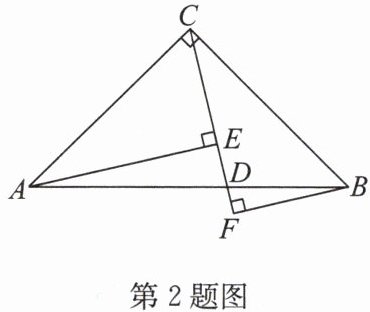
2. 如图,在$△ ABC$中,$∠ ACB=90^{ \circ }$,$AC=BC$,$D$是$AB$上一点,$AE ⊥ CD$于点$E$,$BF ⊥ CD$交$CD$的延长线于点$F$,求证:$AE=EF+BF$.
答案
2. 证明:$\because ∠ACB=90^{\circ },\therefore ∠ACE+∠BCF=90^{\circ }.$
$\because AE⊥CF,BF⊥CF,\therefore ∠AEC=∠BFC=90^{\circ },$
$∠ACE+∠CAE=90^{\circ },\therefore ∠CAE=∠BCF.$
在$△ AEC$和$△ CFB$中,$\begin{cases} ∠AEC=∠CFB,\\ ∠CAE=∠BCF,\\ AC=CB, \end{cases}$
$\therefore △ AEC≌△ CFB(\mathrm{AAS}),\therefore CE=BF,AE=CF.$
$\because CF=CE+EF=BF+EF,\therefore AE=EF+BF.$
$\because AE⊥CF,BF⊥CF,\therefore ∠AEC=∠BFC=90^{\circ },$
$∠ACE+∠CAE=90^{\circ },\therefore ∠CAE=∠BCF.$
在$△ AEC$和$△ CFB$中,$\begin{cases} ∠AEC=∠CFB,\\ ∠CAE=∠BCF,\\ AC=CB, \end{cases}$
$\therefore △ AEC≌△ CFB(\mathrm{AAS}),\therefore CE=BF,AE=CF.$
$\because CF=CE+EF=BF+EF,\therefore AE=EF+BF.$
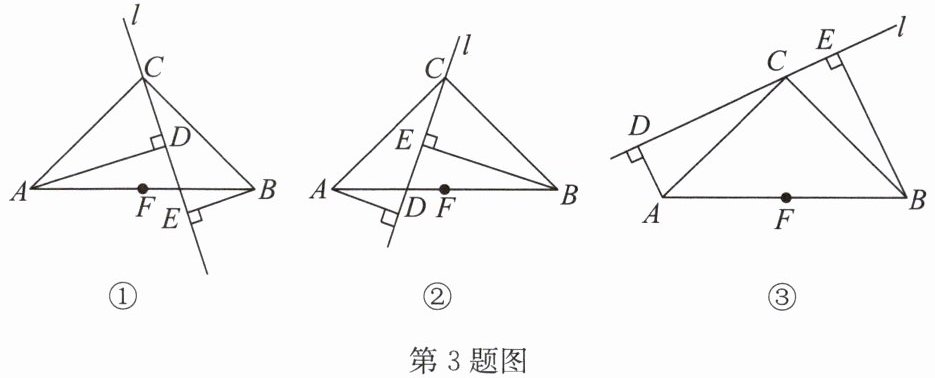
3. 如图,$△ ABC$ 是等腰直角三角形,$∠ ACB=90°$,$F$ 是 $AB$ 的中点,直线 $l$ 经过点 $C$,分别过点 $A$,$B$ 作 $l$ 的垂线,即 $AD⊥ CE, BE⊥ CE$.
(1) 如图①,当 $CE$ 位于点 $F$ 的右侧时,求证: $△ ADC≌△ CEB$;
(2) 如图②,当 $CE$ 位于点 $F$ 的左侧时,求证: $ED=BE-AD$;
(3) 如图③,当 $CE$ 在 $△ ABC$ 的外部时,试猜想 $ED,AD,BE$ 之间的数量关系,并证明你的猜想.
(1) 如图①,当 $CE$ 位于点 $F$ 的右侧时,求证: $△ ADC≌△ CEB$;
(2) 如图②,当 $CE$ 位于点 $F$ 的左侧时,求证: $ED=BE-AD$;
(3) 如图③,当 $CE$ 在 $△ ABC$ 的外部时,试猜想 $ED,AD,BE$ 之间的数量关系,并证明你的猜想.
答案
3. (1)证明:$\because AD⊥CE,BE⊥CE,\therefore ∠ADC=∠CEB=90^{\circ },$
$\therefore ∠CAD+∠ACD=90^{\circ }.$
$\because ∠ACD+∠ECB=90^{\circ },\therefore ∠CAD=∠BCE.$
$\because ∠ADC=∠CEB,AC=CB,\therefore △ ADC≌△ CEB(\mathrm{AAS}).$
(2)证明:$\because AD⊥CE,BE⊥CE,\therefore ∠ADC=∠CEB=90^{\circ },$
$\therefore ∠CAD+∠ACD=90^{\circ }.$
$\because ∠ACD+∠ECB=90^{\circ },\therefore ∠CAD=∠BCE.$
$\because ∠ADC=∠CEB,AC=CB,\therefore △ ADC≌△ CEB(\mathrm{AAS}),$
$\therefore DC=BE,AD=CE.$
$\because ED=CD-CE,\therefore ED=BE-AD.$
(3)解:$ED=AD+BE$. 证明如下:$\because AD⊥CE,BE⊥CE,$
$\therefore ∠ADC=∠CEB=90^{\circ },\therefore ∠CAD+∠ACD=90^{\circ }.$
$\because ∠ACB=90^{\circ },\therefore ∠ACD+∠BCE=90^{\circ },$
$\therefore ∠CAD=∠BCE.$
$\because ∠ADC=∠CEB,AC=CB,\therefore △ ADC≌△ CEB(\mathrm{AAS}),$
$\therefore DC=BE,AD=CE.$
$\because ED=CE+DC,\therefore ED=AD+BE.$
$\therefore ∠CAD+∠ACD=90^{\circ }.$
$\because ∠ACD+∠ECB=90^{\circ },\therefore ∠CAD=∠BCE.$
$\because ∠ADC=∠CEB,AC=CB,\therefore △ ADC≌△ CEB(\mathrm{AAS}).$
(2)证明:$\because AD⊥CE,BE⊥CE,\therefore ∠ADC=∠CEB=90^{\circ },$
$\therefore ∠CAD+∠ACD=90^{\circ }.$
$\because ∠ACD+∠ECB=90^{\circ },\therefore ∠CAD=∠BCE.$
$\because ∠ADC=∠CEB,AC=CB,\therefore △ ADC≌△ CEB(\mathrm{AAS}),$
$\therefore DC=BE,AD=CE.$
$\because ED=CD-CE,\therefore ED=BE-AD.$
(3)解:$ED=AD+BE$. 证明如下:$\because AD⊥CE,BE⊥CE,$
$\therefore ∠ADC=∠CEB=90^{\circ },\therefore ∠CAD+∠ACD=90^{\circ }.$
$\because ∠ACB=90^{\circ },\therefore ∠ACD+∠BCE=90^{\circ },$
$\therefore ∠CAD=∠BCE.$
$\because ∠ADC=∠CEB,AC=CB,\therefore △ ADC≌△ CEB(\mathrm{AAS}),$
$\therefore DC=BE,AD=CE.$
$\because ED=CE+DC,\therefore ED=AD+BE.$
