

 登录
登录
Ⅱ. 按要求改写句子,每空一词
6. Where is the beautiful picture? You bought it last week.(合并为一句)
Where is the beautiful picture you last week?
7. She was ill, but she still went on working.(改为同义句)
she was ill, she still went on working.
8. The mother told her son, “Don’t read in the bed.”(改为简单句)
The mother her son read in the bed.
9. I would rather stay at home than go to the cinema.(改为同义句)
I prefer at home to the cinema.
10. I don’t know the boy. The boy’s father is a doctor.(合并为一句)
I don’t know the boy father a doctor.
11. —Lucy didn’t come to school yesterday, did she?(作出回答)
—, , though she was not feeling very well.
12. I believe you can solve the problem easily.(改为否定句)
I you the problem easily.
6. Where is the beautiful picture? You bought it last week.(合并为一句)
Where is the beautiful picture you last week?
7. She was ill, but she still went on working.(改为同义句)
she was ill, she still went on working.
8. The mother told her son, “Don’t read in the bed.”(改为简单句)
The mother her son read in the bed.
9. I would rather stay at home than go to the cinema.(改为同义句)
I prefer at home to the cinema.
10. I don’t know the boy. The boy’s father is a doctor.(合并为一句)
I don’t know the boy father a doctor.
11. —Lucy didn’t come to school yesterday, did she?(作出回答)
—, , though she was not feeling very well.
12. I believe you can solve the problem easily.(改为否定句)
I you the problem easily.
答案
6. that/which;bought
7. Although/Though
8. told;not;to
9. to;stay;rather;than;go
10. whose;is
11. No;she;didn't
12. don't;believe;can;solve
7. Although/Though
8. told;not;to
9. to;stay;rather;than;go
10. whose;is
11. No;she;didn't
12. don't;believe;can;solve
解析
【分析】本题为英语句型转换类题目,涵盖定语从句、让步状语从句、固定搭配、反义疑问句回答、否定转移等知识点,解题需结合各语法规则和短语搭配,逐一分析每道题的结构转换要求,确定对应答案。
【解析】
6. 合并句子时,先行词the beautiful picture指物,需用关系代词that/which引导定语从句;原句中动词为buy的过去式bought,故填that/which;bought。
7. 原句用but表转折,同义句需用Although/Though引导让步状语从句表“虽然”,故填Although/Though。
8. 直接引语为否定祈使句,改为间接引语的简单句时,用tell sb not to do sth结构,原句为过去式,故填told;not;to。
9. would rather do than do的同义结构为prefer to do rather than do,故填to;stay;rather;than;go。
10. 先行词the boy与father为所属关系,用关系代词whose引导定语从句,从句主语father为单数,be动词用is,故填whose;is。
11. 反义疑问句回答需结合事实,后半句说明“虽不舒服但来了”,故用No, she didn't(翻译为“是的,她来了”)。
12. 主句为I believe时,否定需转移至主句,即I don’t believe,从句用陈述语序,故填don’t;believe;can;solve。
【答案】6. that/which;bought 7. Although/Though 8. told;not;to 9. to;stay;rather;than;go 10. whose;is 11. No;she;didn't 12. don't;believe;can;solve
【知识点】定语从句、固定搭配、句型转换
【点评】本题考查初中英语核心句型转换,涉及基础语法与短语搭配,是初中英语常考题型,需熟练掌握相关规则。
【难度系数】0.6
【解析】
6. 合并句子时,先行词the beautiful picture指物,需用关系代词that/which引导定语从句;原句中动词为buy的过去式bought,故填that/which;bought。
7. 原句用but表转折,同义句需用Although/Though引导让步状语从句表“虽然”,故填Although/Though。
8. 直接引语为否定祈使句,改为间接引语的简单句时,用tell sb not to do sth结构,原句为过去式,故填told;not;to。
9. would rather do than do的同义结构为prefer to do rather than do,故填to;stay;rather;than;go。
10. 先行词the boy与father为所属关系,用关系代词whose引导定语从句,从句主语father为单数,be动词用is,故填whose;is。
11. 反义疑问句回答需结合事实,后半句说明“虽不舒服但来了”,故用No, she didn't(翻译为“是的,她来了”)。
12. 主句为I believe时,否定需转移至主句,即I don’t believe,从句用陈述语序,故填don’t;believe;can;solve。
【答案】6. that/which;bought 7. Although/Though 8. told;not;to 9. to;stay;rather;than;go 10. whose;is 11. No;she;didn't 12. don't;believe;can;solve
【知识点】定语从句、固定搭配、句型转换
【点评】本题考查初中英语核心句型转换,涉及基础语法与短语搭配,是初中英语常考题型,需熟练掌握相关规则。
【难度系数】0.6
二、拓展阅读
Ⅲ.短文阅读
Chinese classical music has a history of more than 3,000 years. It uses traditional instruments like the guqin(a 7-string zither), erhu(2-string fiddle), and pipa(pear-shaped lute). The music often describes nature, such as flowing rivers or singing birds.
At a recent concert in Beijing, guzheng player Li Wei performed for 200 people. The audience included both elderly Chinese and young foreign students. Li played "High Mountains and Flowing Water," a famous piece about friendship. During the quiet parts, you could even hear a pin drop! After the show,Li answered some questions. A German teenager said, "I don't understand Chinese culture,but the music made me feel calm and happy."
Classical music fans enjoy it for different reasons. Older Chinese remember their childhood, while young people like the peaceful break from pop music. Tickets usually cost 50-100 yuan, with discounts(折扣) for students. Many concerts now offer English introductions to help foreigners understand.
13. Which instrument has 7 strings?
A. Erhu.
B. Guqin.
C. Pipa.
14. How did the German teenager feel about the show?
A. Calm.
B. Excited.
C. Bored.
15. Where can you find this information?
A. A science textbook.
B. A music magazine.
C. A sports website.
Ⅲ.短文阅读
Chinese classical music has a history of more than 3,000 years. It uses traditional instruments like the guqin(a 7-string zither), erhu(2-string fiddle), and pipa(pear-shaped lute). The music often describes nature, such as flowing rivers or singing birds.
At a recent concert in Beijing, guzheng player Li Wei performed for 200 people. The audience included both elderly Chinese and young foreign students. Li played "High Mountains and Flowing Water," a famous piece about friendship. During the quiet parts, you could even hear a pin drop! After the show,Li answered some questions. A German teenager said, "I don't understand Chinese culture,but the music made me feel calm and happy."
Classical music fans enjoy it for different reasons. Older Chinese remember their childhood, while young people like the peaceful break from pop music. Tickets usually cost 50-100 yuan, with discounts(折扣) for students. Many concerts now offer English introductions to help foreigners understand.
13. Which instrument has 7 strings?
A. Erhu.
B. Guqin.
C. Pipa.
14. How did the German teenager feel about the show?
A. Calm.
B. Excited.
C. Bored.
15. Where can you find this information?
A. A science textbook.
B. A music magazine.
C. A sports website.
答案
13.B 14.A 15.B
解析
【分析】
本题为英语阅读理解细节类题目,解题思路为:1. 第13题需定位原文中关于乐器弦数的描述,找到对应7弦的乐器;2. 第14题需定位德国青少年的表述,提取其对演出的感受;3. 第15题需根据文章主题判断信息来源,结合选项选出正确答案。
【解析】
13题:根据原文第一段“...the guqin(a 7-string zither)”可知,古琴(guqin)是7弦乐器,对应选项B,故答案为B。
14题:根据原文第二段最后一句“A German teenager said, '...the music made me feel calm and happy.'”可知,德国青少年觉得音乐让他平静,对应选项A,故答案为A。
15题:全文围绕中国古典音乐的乐器、音乐会、受众等音乐相关内容展开,应出自音乐杂志,对应选项B,故答案为B。
【答案】
13.B 14.A 15.B
【知识点】
英语阅读理解、细节信息查找
【点评】
本题为基础英语阅读理解题,主要考查学生对文章细节的定位与理解能力,题目难度较低,只要仔细阅读原文即可轻松选出正确答案。
【难度系数】
0.8
本题为英语阅读理解细节类题目,解题思路为:1. 第13题需定位原文中关于乐器弦数的描述,找到对应7弦的乐器;2. 第14题需定位德国青少年的表述,提取其对演出的感受;3. 第15题需根据文章主题判断信息来源,结合选项选出正确答案。
【解析】
13题:根据原文第一段“...the guqin(a 7-string zither)”可知,古琴(guqin)是7弦乐器,对应选项B,故答案为B。
14题:根据原文第二段最后一句“A German teenager said, '...the music made me feel calm and happy.'”可知,德国青少年觉得音乐让他平静,对应选项A,故答案为A。
15题:全文围绕中国古典音乐的乐器、音乐会、受众等音乐相关内容展开,应出自音乐杂志,对应选项B,故答案为B。
【答案】
13.B 14.A 15.B
【知识点】
英语阅读理解、细节信息查找
【点评】
本题为基础英语阅读理解题,主要考查学生对文章细节的定位与理解能力,题目难度较低,只要仔细阅读原文即可轻松选出正确答案。
【难度系数】
0.8
Ⅳ.阅读还原
Is there a connection between music and language? According to recent studies, the answer is yes. 16.
A recent study by researcher Kraus shows that playing a musical instrument can improve a person's hearing ability. 17.
Schlaug, a doctor at Harvard Medical School, works with stroke(中风) patients. Because of their illness, these people cannot say their names, addresses, or other information normally. However, they can still sing. 19.
Music improves concentration(注意力), memory, listening skills, and our overall language abilities. 20.
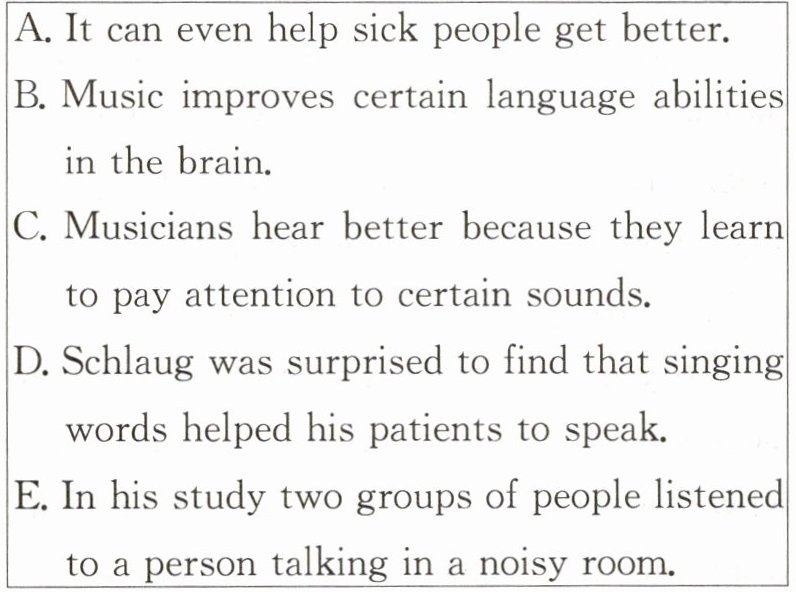
A. It can even help sick people get better.
B. Music improves certain language abilities in the brain.
C. Musicians hear better because they learn to pay attention to certain sounds.
D. Schlaug was surprised to find that singing words helped his patients to speak.
E. In his study two groups of people listened to a person talking in a noisy room.
Is there a connection between music and language? According to recent studies, the answer is yes. 16.
B
Here, we look at two examples.A recent study by researcher Kraus shows that playing a musical instrument can improve a person's hearing ability. 17.
E
The people in the first group were musicians, while those in the second group had no musical training. The musicians were able to hear the talking person more clearly. 18. C
Think about violinists in an orchestra(管弦乐团). When the violinists play with the group, they hear their own instrument and many others, too. But the violinists must listen closely to what they are playing, and pay no attention to the other sounds. In this way, musicians are able to focus on certain sounds, even in a room with lots of noise.Schlaug, a doctor at Harvard Medical School, works with stroke(中风) patients. Because of their illness, these people cannot say their names, addresses, or other information normally. However, they can still sing. 19.
D
Why does this work? Schlaug isn't sure. Music seems to make different parts of the brain work, including the damaged(损坏的) parts. This might help patients to use that part of the brain again.Music improves concentration(注意力), memory, listening skills, and our overall language abilities. 20.
A
Playing an instrument or singing can help us do better in school and keep our brain sharp(敏锐的) as we get older. Music is not only enjoyable, it's also good for us in many other ways.A. It can even help sick people get better.
B. Music improves certain language abilities in the brain.
C. Musicians hear better because they learn to pay attention to certain sounds.
D. Schlaug was surprised to find that singing words helped his patients to speak.
E. In his study two groups of people listened to a person talking in a noisy room.
答案
4. C 5. B 6. A 7. E 8. D
解析
【分析】
做阅读还原题时,需先通读全文把握主旨(音乐与语言存在关联),再结合空格前后的语境、句子间的逻辑关系(总起、举例、解释等)匹配选项。16题前文提出音乐和语言有联系,后文引出两个例子,需总述音乐对语言能力的作用;17题前文提到Kraus的听力研究,后文介绍两组人的对比,需说明研究的具体内容;18题前文说音乐家听力更好,后文举例说明音乐家的专注能力,需解释原因;19题前文提到Schlaug和中风病人的情况,后文问这种方式的作用,需填Schlaug的发现;20题前文说音乐提升多种能力,后文说帮助病人,需递进说明音乐的作用。
【解析】
1. 16题:前文提出音乐与语言有联系,后文引出两个例子,空格处需总述音乐对大脑语言能力的作用,B选项“Music improves certain language abilities in the brain.”符合总起语境,故选B。
2. 17题:前文提到Kraus的研究关于提升听力,后文介绍两组人的对比,空格处需说明研究的具体操作,E选项“In his study two groups of people listened to a person talking in a noisy room.”符合,故选E。
3. 18题:前文说音乐家能更清楚听,后文举例说明音乐家关注特定声音的能力,空格处需解释音乐家听力好的原因,C选项“Musicians hear better because they learn to pay attention to certain sounds.”符合,故选C。
4. 19题:前文提到Schlaug和中风病人(不能说话但能唱歌),后文问这种方式的作用,空格处需填Schlaug的发现,D选项“Schlaug was surprised to find that singing words helped his patients to speak.”符合,故选D。
5. 20题:前文说音乐提升多种能力,后文说帮助病人,空格处需递进说明音乐的作用,A选项“It can even help sick people get better.”符合,故选A。
【答案】
16.B 17.E 18.C 19.D 20.A
【知识点】
英语阅读还原、语篇逻辑理解
【点评】
本题考查学生对英语语篇上下文衔接、逻辑关系的理解能力,需结合段落主旨和句子间的呼应选择选项,难度适中。
【难度系数】
0.5
做阅读还原题时,需先通读全文把握主旨(音乐与语言存在关联),再结合空格前后的语境、句子间的逻辑关系(总起、举例、解释等)匹配选项。16题前文提出音乐和语言有联系,后文引出两个例子,需总述音乐对语言能力的作用;17题前文提到Kraus的听力研究,后文介绍两组人的对比,需说明研究的具体内容;18题前文说音乐家听力更好,后文举例说明音乐家的专注能力,需解释原因;19题前文提到Schlaug和中风病人的情况,后文问这种方式的作用,需填Schlaug的发现;20题前文说音乐提升多种能力,后文说帮助病人,需递进说明音乐的作用。
【解析】
1. 16题:前文提出音乐与语言有联系,后文引出两个例子,空格处需总述音乐对大脑语言能力的作用,B选项“Music improves certain language abilities in the brain.”符合总起语境,故选B。
2. 17题:前文提到Kraus的研究关于提升听力,后文介绍两组人的对比,空格处需说明研究的具体操作,E选项“In his study two groups of people listened to a person talking in a noisy room.”符合,故选E。
3. 18题:前文说音乐家能更清楚听,后文举例说明音乐家关注特定声音的能力,空格处需解释音乐家听力好的原因,C选项“Musicians hear better because they learn to pay attention to certain sounds.”符合,故选C。
4. 19题:前文提到Schlaug和中风病人(不能说话但能唱歌),后文问这种方式的作用,空格处需填Schlaug的发现,D选项“Schlaug was surprised to find that singing words helped his patients to speak.”符合,故选D。
5. 20题:前文说音乐提升多种能力,后文说帮助病人,空格处需递进说明音乐的作用,A选项“It can even help sick people get better.”符合,故选A。
【答案】
16.B 17.E 18.C 19.D 20.A
【知识点】
英语阅读还原、语篇逻辑理解
【点评】
本题考查学生对英语语篇上下文衔接、逻辑关系的理解能力,需结合段落主旨和句子间的呼应选择选项,难度适中。
【难度系数】
0.5
