

 登录
登录
一 Miss Li 邀请同学们展示小菜园的丰收成果。根据图片及首字母提示,写单词补全句子。
1. Those are carrots. We often eat the r
2. Mary pulls up the celery by the s
3. These are peas. We eat the s
4. There are some strawberries. We eat the f
5. That is a cabbage. We eat the l
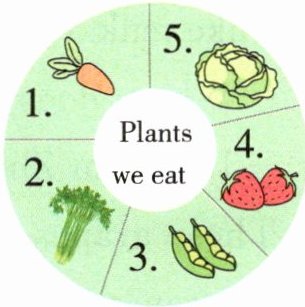
1. Those are carrots. We often eat the r
roots
.2. Mary pulls up the celery by the s
stems
and leaves.3. These are peas. We eat the s
seeds
.4. There are some strawberries. We eat the f
fruit
.5. That is a cabbage. We eat the l
leaves
.答案
1. roots 2. stems 3. seeds 4. fruit 5. leaves
解析
【分析】首先观察每个小题对应的图片确定植物种类,结合生活常识判断该植物的食用部位,再根据给出的首字母提示填写正确单词,同时注意名词的单复数形式。
【解析】1. 图中是胡萝卜,我们食用它的根,首字母为r,泛指用复数形式roots;2. 图中是芹菜,我们食用它的茎,首字母为s,泛指用复数形式stems;3. 图中是豌豆,我们食用它的种子,首字母为s,泛指用复数形式seeds;4. 图中是草莓,我们食用它的果实,首字母为f,用单数形式fruit;5. 图中是卷心菜,我们食用它的叶子,首字母为l,泛指用复数形式leaves。
【答案】1. roots 2. stems 3. seeds 4. fruit 5. leaves
【知识点】植物器官、英语名词单复数
【点评】本题结合图片考查常见植物的食用部位,属于基础词汇题,需掌握日常常见蔬果的食用部分,难度较低,适合巩固基础。
【难度系数】0.8
【解析】1. 图中是胡萝卜,我们食用它的根,首字母为r,泛指用复数形式roots;2. 图中是芹菜,我们食用它的茎,首字母为s,泛指用复数形式stems;3. 图中是豌豆,我们食用它的种子,首字母为s,泛指用复数形式seeds;4. 图中是草莓,我们食用它的果实,首字母为f,用单数形式fruit;5. 图中是卷心菜,我们食用它的叶子,首字母为l,泛指用复数形式leaves。
【答案】1. roots 2. stems 3. seeds 4. fruit 5. leaves
【知识点】植物器官、英语名词单复数
【点评】本题结合图片考查常见植物的食用部位,属于基础词汇题,需掌握日常常见蔬果的食用部分,难度较低,适合巩固基础。
【难度系数】0.8
二 同学们在讨论关于植物的话题。给下列句子选择正确的答语。
(
(
(
(
(
A. Yes,there are.
B. It's 5 yuan.
C. Strawberries.
D. No,it doesn't.
E. Because they're good for our eyes.
(
D
)1. Does every plant have a seed?(
C
)2. What's your favourite fruit?(
E
)3. Why do you like tomatoes?(
B
)4. How much is the celery?(
A
)5. Are there many coconuts in Hainan?A. Yes,there are.
B. It's 5 yuan.
C. Strawberries.
D. No,it doesn't.
E. Because they're good for our eyes.
答案
1-5 DCEBA
解析
【分析】
先明确每个小题的问句类型,结合答语的句式和内容进行匹配:1是Does开头的一般疑问句,答语需用does相关形式;2询问最喜欢的水果,答语应为水果名称;3用Why提问原因,答语需以Because引导;4询问价格,答语为具体金额;5是Are there开头的一般疑问句,答语需用there are相关形式,依次匹配对应选项。
【解析】
1. 问句是Does引导的一般疑问句,主语为单数,答语对应D(No,it doesn't);
2. 问句询问最喜欢的水果,答语对应C(Strawberries,草莓,是水果);
3. 问句用Why提问原因,答语对应E(以Because引导说明原因);
4. 问句询问芹菜的价格,答语对应B(It's 5 yuan,是金额);
5. 问句是Are there开头的一般疑问句,答语对应A(Yes,there are)。
因此匹配结果为1-D、2-C、3-E、4-B、5-A,即1-5 DCEBA。
【答案】
1-5 DCEBA
【知识点】
日常交际用语、选答语匹配
【点评】
本题考查日常交际中关于植物、食物话题的问答匹配,需掌握不同句式问句对应的答语特点,题型基础,适合小学阶段学生巩固交际用语知识。
【难度系数】
0.7
先明确每个小题的问句类型,结合答语的句式和内容进行匹配:1是Does开头的一般疑问句,答语需用does相关形式;2询问最喜欢的水果,答语应为水果名称;3用Why提问原因,答语需以Because引导;4询问价格,答语为具体金额;5是Are there开头的一般疑问句,答语需用there are相关形式,依次匹配对应选项。
【解析】
1. 问句是Does引导的一般疑问句,主语为单数,答语对应D(No,it doesn't);
2. 问句询问最喜欢的水果,答语对应C(Strawberries,草莓,是水果);
3. 问句用Why提问原因,答语对应E(以Because引导说明原因);
4. 问句询问芹菜的价格,答语对应B(It's 5 yuan,是金额);
5. 问句是Are there开头的一般疑问句,答语对应A(Yes,there are)。
因此匹配结果为1-D、2-C、3-E、4-B、5-A,即1-5 DCEBA。
【答案】
1-5 DCEBA
【知识点】
日常交际用语、选答语匹配
【点评】
本题考查日常交际中关于植物、食物话题的问答匹配,需掌握不同句式问句对应的答语特点,题型基础,适合小学阶段学生巩固交际用语知识。
【难度系数】
0.7
三 创新题 Anna 的好友 Lily 展示了小菜园桃树的生长日志。阅读短文,补全思维导图。
The life of the peach tree
Seeds need water and warm places to grow. The roots grow down into the ground(地面). The stems and leaves grow up towards the light. This peach tree will grow and grow.
This plant is a peach tree. Its leaves use light from the sun to make food. Its roots get water from the ground. The peach—the fruit has a seed inside.
The tree grows bigger and makes flowers. Flowers can make new plants. Many of these flowers will grow into peaches.
Peaches are healthy and sweet. People and animals eat the fresh peaches and leave the seeds behind. The seeds can grow into new peach trees.
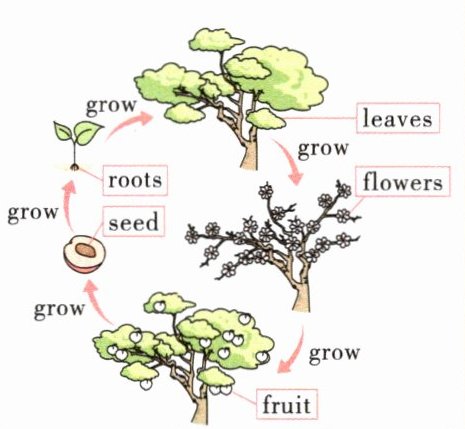
The life of the peach tree

seed
The 1.
young tree
The young tree has roots and 2.
tree with flowers
The tree grows bigger and makes 3.
tree with fruit
Many of these flowers will grow into 4.
The life of the peach tree
Seeds need water and warm places to grow. The roots grow down into the ground(地面). The stems and leaves grow up towards the light. This peach tree will grow and grow.
This plant is a peach tree. Its leaves use light from the sun to make food. Its roots get water from the ground. The peach—the fruit has a seed inside.
The tree grows bigger and makes flowers. Flowers can make new plants. Many of these flowers will grow into peaches.
Peaches are healthy and sweet. People and animals eat the fresh peaches and leave the seeds behind. The seeds can grow into new peach trees.
The life of the peach tree
seed
The 1.
roots
grow down into the ground.young tree
The young tree has roots and 2.
leaves
.tree with flowers
The tree grows bigger and makes 3.
flowers
.tree with fruit
Many of these flowers will grow into 4.
peaches
.答案
1. roots 2. leaves 3. flowers 4. peaches
解析
【分析】
本题为英语阅读理解补全题,解题思路是先通读短文,明确每个空对应的思维导图阶段,再在短文中定位与该阶段相关的关键句子,提取对应词汇填空。
【解析】
1. 空1:对应思维导图“seed”阶段,定位短文第一段第二句“The roots grow down into the ground”,提取核心词汇roots;
2. 空2:对应思维导图“young tree”阶段,结合短文第一段提到的“stems and leaves”及幼树结构,提取词汇leaves;
3. 空3:对应思维导图“tree with flowers”阶段,定位短文第三段第一句“The tree grows bigger and makes flowers”,提取核心词汇flowers;
4. 空4:对应思维导图“tree with fruit”阶段,定位短文第三段第二句“Many of these flowers will grow into peaches”,提取核心词汇peaches。
【答案】
1. roots 2. leaves 3. flowers 4. peaches
【知识点】
英语阅读理解,信息提取,词汇运用
【点评】
本题以植物生长主题的短文为载体,通过补全思维导图的形式考察英语阅读的信息定位与提取能力,题型新颖,难度较低,能帮助学生巩固相关词汇和阅读技巧。
【难度系数】
0.8
本题为英语阅读理解补全题,解题思路是先通读短文,明确每个空对应的思维导图阶段,再在短文中定位与该阶段相关的关键句子,提取对应词汇填空。
【解析】
1. 空1:对应思维导图“seed”阶段,定位短文第一段第二句“The roots grow down into the ground”,提取核心词汇roots;
2. 空2:对应思维导图“young tree”阶段,结合短文第一段提到的“stems and leaves”及幼树结构,提取词汇leaves;
3. 空3:对应思维导图“tree with flowers”阶段,定位短文第三段第一句“The tree grows bigger and makes flowers”,提取核心词汇flowers;
4. 空4:对应思维导图“tree with fruit”阶段,定位短文第三段第二句“Many of these flowers will grow into peaches”,提取核心词汇peaches。
【答案】
1. roots 2. leaves 3. flowers 4. peaches
【知识点】
英语阅读理解,信息提取,词汇运用
【点评】
本题以植物生长主题的短文为载体,通过补全思维导图的形式考察英语阅读的信息定位与提取能力,题型新颖,难度较低,能帮助学生巩固相关词汇和阅读技巧。
【难度系数】
0.8
