

 登录
四、阅读理解
Healthy Living Habits for Teenagers
Things
to do
Proper(恰
当的) time
Advantages
(优点)
More tips
Brushing
teeth
After get-
ting up
and before
going to
bed
To reduce
germs(细
菌)in the
mouth
Brush the
tongue(舌
头) while
brushing
teeth
Drinking
milk
During
breakfast
To keep
the body
strong and
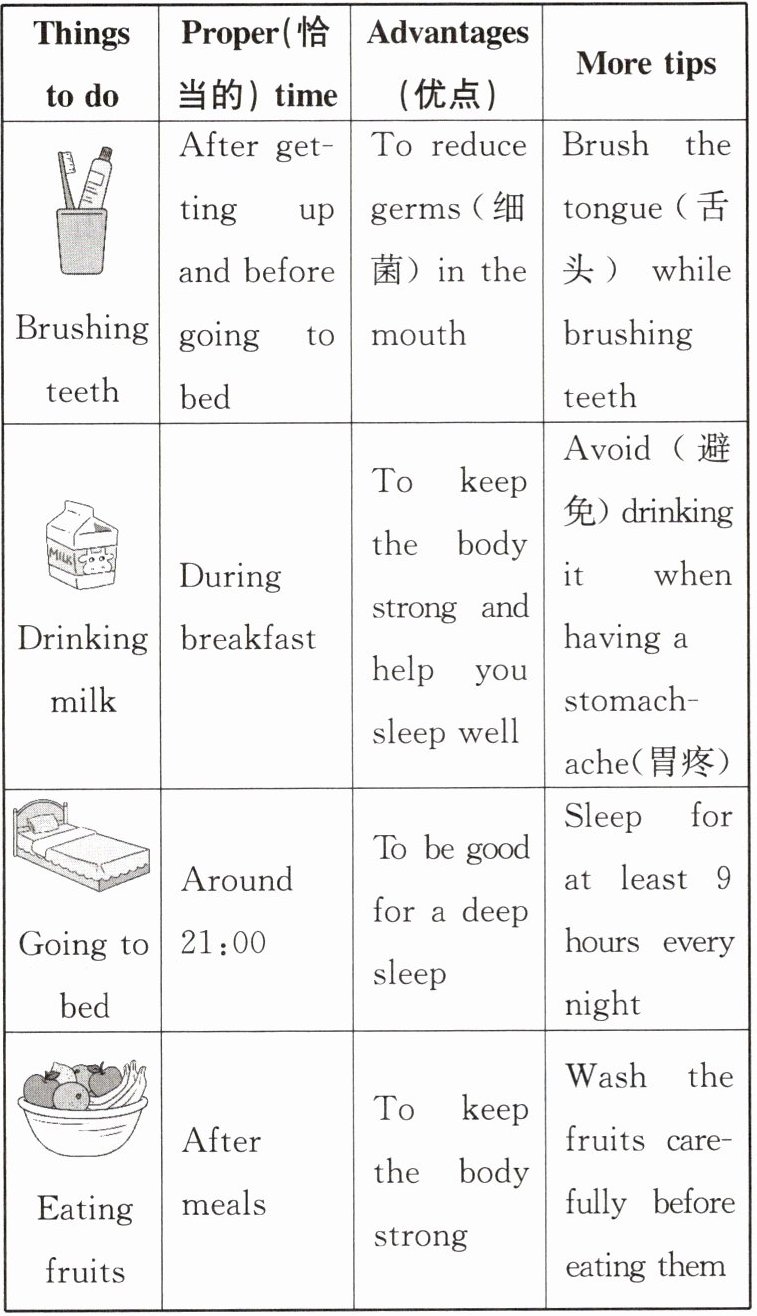 help
you sleep well
Avoid(避
免)drinking
it when
having a
stomach-
ache(胃疼)
Going to
bed
Around
21:00
To be good
for a deep
sleep
Sleep for
at least 9
hours every
night
Eating
fruits
After
meals
To keep
the body
strong
Wash the
fruits care-
fully fully before
eating them
1. What's the advantage of brushing teeth?
A. It helps you sleep well.
B. It helps you have a good voice.
C. It can keep the body strong.
D. It can reduce germs in the mouth.
2. What's the proper time for teenagers to drink milk?
A. Before going to bed.
B. During breakfast.
C. After getting up.
D. After meals.
3. What are helpful in keeping the body strong?
A. Drinking milk and eating fruits.
B. Going to bed early and brushing teeth.
C. Eating fruits and brushing teeth.
D. Drinking milk and going to bed early.
4. Where can we probably read the passage?
A. In a storybook.
B. In a novel.
C. In a dictionary.
D. In a magazine.
Healthy Living Habits for Teenagers
Things
to do
Proper(恰
当的) time
Advantages
(优点)
More tips
Brushing
teeth
After get-
ting up
and before
going to
bed
To reduce
germs(细
菌)in the
mouth
Brush the
tongue(舌
头) while
brushing
teeth
Drinking
milk
During
breakfast
To keep
the body
strong and
helpyou sleep well
Avoid(避
免)drinking
it when
having a
stomach-
ache(胃疼)
Going to
bed
Around
21:00
To be good
for a deep
sleep
Sleep for
at least 9
hours every
night
Eating
fruits
After
meals
To keep
the body
strong
Wash the
fruits care-
fully fully before
eating them
1. What's the advantage of brushing teeth?
A. It helps you sleep well.
B. It helps you have a good voice.
C. It can keep the body strong.
D. It can reduce germs in the mouth.
2. What's the proper time for teenagers to drink milk?
A. Before going to bed.
B. During breakfast.
C. After getting up.
D. After meals.
3. What are helpful in keeping the body strong?
A. Drinking milk and eating fruits.
B. Going to bed early and brushing teeth.
C. Eating fruits and brushing teeth.
D. Drinking milk and going to bed early.
4. Where can we probably read the passage?
A. In a storybook.
B. In a novel.
C. In a dictionary.
D. In a magazine.
答案
1. D 2. B 3. A 4. D
解析
【分析】
这是一篇关于青少年健康生活习惯的阅读理解题,需通过表格中的具体信息解答各小题:第1题需定位“刷牙”对应的优点;第2题查找“喝牛奶”的恰当时间;第3题找出对应“保持身体强壮”的行为;第4题结合文章主题判断出处,核心是快速定位表格细节信息。
【解析】
1. 定位表格中“Brushing teeth”的Advantages列,内容为“To reduce germs in the mouth”,与选项D一致,故选D。
2. 定位表格中“Drinking milk”的Proper time列,内容为“During breakfast”,与选项B一致,故选B。
3. 查看各行为的Advantages:Drinking milk的优点是“To keep the body strong”,Eating fruits的优点也是“To keep the body strong”,因此这两项有助于保持身体强壮,对应选项A,故选A。
4. 文章主题是青少年健康生活习惯,这类科普类内容通常出现在杂志中;故事书、小说以叙事为主,字典是工具书,均不符合,故选D。
【答案】
1. D 2. B 3. A 4. D
【知识点】
阅读理解、细节理解题
【点评】
本题以表格形式呈现信息,侧重考查学生快速定位细节的能力,题目难度较低,只要仔细对应表格内容即可得出答案。
【难度系数】
0.8
一、写出what、what time及when引导的特殊疑问句的结构
What/What time/When do/does+主语+动词原形+其他?
答案
What/What time/When do/does+主语+动词原形+其他?
解析
【分析】首先明确特殊疑问句的构成规则:当特殊疑问句的谓语是实义动词时,需借助助动词do或does,将助动词置于主语前,后续接动词原形及其他成分。题目要求写出what、what time、when引导的此类特殊疑问句的结构,因此结合规则,将对应疑问词、助动词、主语、动词原形等按顺序组合即可。
【解析】what、what time、when引导的特殊疑问句,当谓语为实义动词时,结构为:疑问词(What/What time/When)+ 助动词(do/does)+ 主语 + 动词原形 + 其他?
【答案】What/What time/When do/does+主语+动词原形+其他?
【知识点】特殊疑问句结构;助动词do/does的用法
【点评】本题考查英语特殊疑问句的基础结构,属于初中英语核心语法知识点,需掌握疑问词引导的实义动词作谓语的特殊疑问句构成规则。
【难度系数】0.6
【解析】what、what time、when引导的特殊疑问句,当谓语为实义动词时,结构为:疑问词(What/What time/When)+ 助动词(do/does)+ 主语 + 动词原形 + 其他?
【答案】What/What time/When do/does+主语+动词原形+其他?
【知识点】特殊疑问句结构;助动词do/does的用法
【点评】本题考查英语特殊疑问句的基础结构,属于初中英语核心语法知识点,需掌握疑问词引导的实义动词作谓语的特殊疑问句构成规则。
【难度系数】0.6
二、写出你所知道的频度副词及表示时间的常用介词
频度副词:usually, often, sometimes, always, never 等。
表示时间的常用介词:at,in,on,after,before
答案
频度副词:usually, often, sometimes, always, never 等。表示时间的常用介词:at,in,on,after,before
解析
【分析】首先明确题目要求,需写出两类词汇:一是表示动作发生频率的频度副词,二是用于引出时间的常用介词。回忆所学的基础英语词汇,筛选出符合要求的对应词汇即可完成作答。
【解析】1. 频度副词的作用是描述动作发生的频率,常见的频度副词有always、usually、often、sometimes、never等;2. 表示时间的常用介词用于关联时间相关的内容,常见的有at、in、on、after、before等,将上述符合要求的词汇整理后写出即可。
【答案】频度副词:usually, often, sometimes, always, never;表示时间的常用介词:at,in,on,after,before
【知识点】频度副词、时间介词
【点评】本题考查英语基础词汇的识记,属于英语学习中的核心基础内容,要求学生掌握常见的频度副词与时间介词,难度较低。
【难度系数】0.8
