

 登录
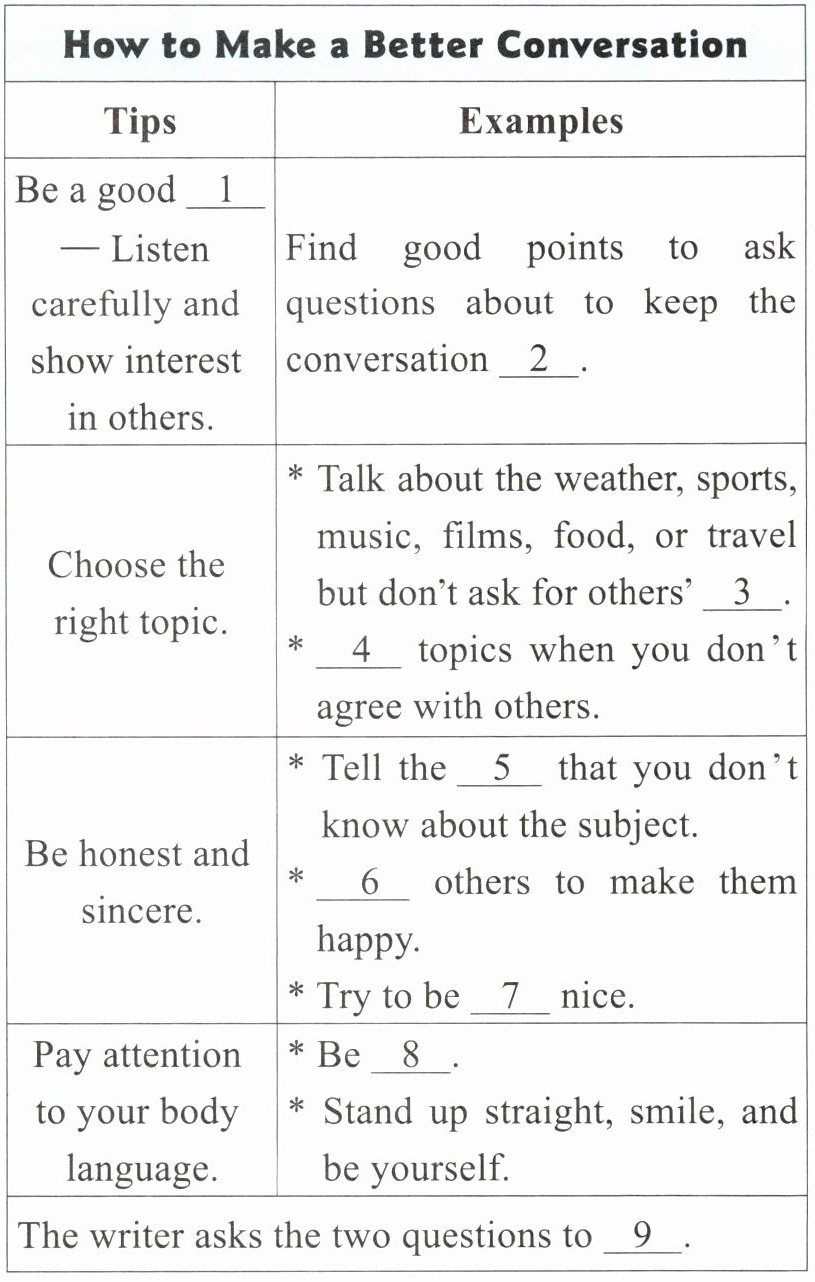
一、回归教材 阅读教材课文(P76),根据课文内容补全图表中所缺的信息。
答案
1. listener 2. going on 3. personal information 4. Change 5. truth 6. Praise 7. really 8. relaxed 9. draw readers’ attention / lead into the topic / create empathy
二、根据首字母及句意写出完整单词。
1. His s
2. She gives them t
3. Parents usually ask their kids not to speak to s
4. Fruit is free in this restaurant, so we don’t need to p
5. Simon talks about and shares everything with his parents. They are good l
6. When I feel n
7. Instead of giving all your a
8. It is i
1. His s
incere
wish to help others touched me a lot.2. She gives them t
ips
on how to keep fit.3. Parents usually ask their kids not to speak to s
trangers
.4. Fruit is free in this restaurant, so we don’t need to p
ay
for it.5. Simon talks about and shares everything with his parents. They are good l
isteners
.6. When I feel n
ervous
, I often take a deep breath to make myself calm down quickly.7. Instead of giving all your a
ttention
to what you are short of, look at how lucky you are already.8. It is i
mpolite
to read other people’s personal emails.答案
1. sincere 2. tips 3. strangers 4. pay 5. listeners 6. nervous 7. attention 8. impolite
三、阅读短文,从方框内的选项中选出可以填入空白处的最佳选项。

Communication is a problem for parents and children of all ages. If it’s hard for you to communicate with your parents, don’t worry about it. Here are some tips for you.
Don’t 1 your parents. Don’t try to talk about anything when you are angry. Go somewhere else to cool off first. If your parents seem upset, 2 another topic.
Respect your parents. First, listen to them carefully and look them in the eyes. Second, 3 their words by saying “yeah” or “I see” or nodding your head.
Try to understand your parents. Perhaps you 4 something. Put yourself in their shoes and you may find a better way. And 5 your parents’ facial (面部的) expressions and body language. That helps you understand them better.
1.
A
2. C
3. E
4. B
5. D
答案
1-5 ACEBD
四、根据短文内容选择最佳选项。
In old China, there was a man named Zhou Chu. He was very strong — stronger than any other man in the village. People were scared of him because he often bullied (欺负) villagers. At that time, a man-eating tiger and a water monster (水怪) lived near the village. They often made trouble. People called them along with Zhou the “three evils (祸害)”.
One day, some villagers asked Zhou to help them kill the tiger and the water monster. Zhou killed them after three days of fighting. The villagers thought he was dead, too. So they celebrated his death. When Zhou finally came back, seeing this, he knew how much people hated him and decided to change.
He visited a famous person named Lu Yun. Lu told him, “If one learns what is good in the morning, he can change his behavior (行为) in the evening. Just do what you think is right.”
From then on, Zhou became a good person and stopped bullying others. Later he became a great soldier and died saving his country.
In fact, it’s not easy for us to see our own mistakes. It was good that Zhou was able to look at himself and make changes. We all make mistakes. But it’s never too late to correct (改正) them.
(
A. Because he bullied villagers.
B. Because he lived in the village.
C. Because he fought with the tiger and the water monster.
(
A. Because they hoped to change him.
B. Because they hoped the three could kill each other.
C. Because they wanted to tell him how they hated him.
(
A. 朝如青丝暮成雪
B. 古人贵朝闻夕改
C. 朝闻道,夕死可矣
(
① He fought for his country.
② He learned to tell right or wrong.
③ He killed the tiger and the monster.
④ He became friendly to the villagers.
A. ①②③ B. ①②④ C. ②③④
(
A. A good beginning makes a good ending.
B. It’s never too late to correct our mistakes.
C. A strong man should die saving his country.
In old China, there was a man named Zhou Chu. He was very strong — stronger than any other man in the village. People were scared of him because he often bullied (欺负) villagers. At that time, a man-eating tiger and a water monster (水怪) lived near the village. They often made trouble. People called them along with Zhou the “three evils (祸害)”.
One day, some villagers asked Zhou to help them kill the tiger and the water monster. Zhou killed them after three days of fighting. The villagers thought he was dead, too. So they celebrated his death. When Zhou finally came back, seeing this, he knew how much people hated him and decided to change.
He visited a famous person named Lu Yun. Lu told him, “If one learns what is good in the morning, he can change his behavior (行为) in the evening. Just do what you think is right.”
From then on, Zhou became a good person and stopped bullying others. Later he became a great soldier and died saving his country.
In fact, it’s not easy for us to see our own mistakes. It was good that Zhou was able to look at himself and make changes. We all make mistakes. But it’s never too late to correct (改正) them.
(
A
) 1. Why did people call Zhou Chu one of the “three evils”?A. Because he bullied villagers.
B. Because he lived in the village.
C. Because he fought with the tiger and the water monster.
(
B
) 2. Why can we infer the villagers asked Zhou Chu to kill the tiger and the water monster?A. Because they hoped to change him.
B. Because they hoped the three could kill each other.
C. Because they wanted to tell him how they hated him.
(
B
) 3. What does the underlined sentence probably mean?A. 朝如青丝暮成雪
B. 古人贵朝闻夕改
C. 朝闻道,夕死可矣
(
B
) 4. What did Zhou Chu do after visiting Lu Yun?① He fought for his country.
② He learned to tell right or wrong.
③ He killed the tiger and the monster.
④ He became friendly to the villagers.
A. ①②③ B. ①②④ C. ②③④
(
B
) 5. What can we learn from the story?A. A good beginning makes a good ending.
B. It’s never too late to correct our mistakes.
C. A strong man should die saving his country.
答案
1-5 ABBBB
