

 登录
一、谚语配对
1. Money doesn't grow on trees. A. 俭以防匮。
2. Cash is king. B. 金钱不会凭空而来。
3. Waste not, want not. C. 现金为王。
4. A penny saved is a penny earned. D. 省钱就是赚钱。
答案
1. B 2. C 3. A 4. D
解析
【分析】解题时需先准确理解每个英文谚语的含义,再将其与给出的中文谚语意思进行匹配,逐一完成配对即可。具体步骤:先翻译每个英文谚语,再对应找意思相符的中文选项。
【解析】1. 英文谚语“Money doesn't grow on trees.”的含义是金钱不会凭空而来,对应选项B;2. “Cash is king.”的含义是现金为王,对应选项C;3. “Waste not, want not.”的含义是俭以防匮,对应选项A;4. “A penny saved is a penny earned.”的含义是省钱就是赚钱,对应选项D。
【答案】1. B 2. C 3. A 4. D
【知识点】英语谚语、英汉匹配
【点评】本题为英语谚语配对题,考察常见英语谚语的基本含义,属于基础题型,难度不大。
【难度系数】0.3
二、话题表述
请根据图片内容回答问题。
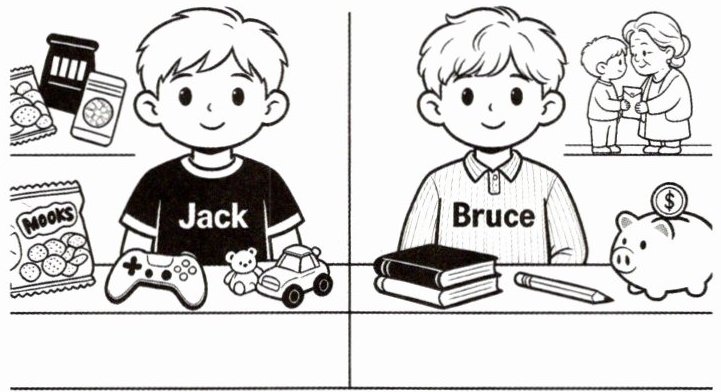
1. How do Jack and Bruce spend their pocket money?
2. Whose way do you prefer, Jack’s or Bruce’s? Why?
请根据图片内容回答问题。
1. How do Jack and Bruce spend their pocket money?
Jack spends his money on toys, games and snacks. Bruce spends his money on books, saves money in the bank and helps people with his money.
2. Whose way do you prefer, Jack’s or Bruce’s? Why?
I prefer Bruce's way because he spends money wisely.
答案
1. Jack spends his money on toys, games and snacks. Bruce spends his money on books, saves money in the bank and helps people with his money.
2. I prefer Bruce's way because he spends money wisely.
解析
【分析】首先仔细观察图片,找出Jack和Bruce的物品与行为:Jack周围有零食、游戏手柄、玩具车等,Bruce有书籍、存钱罐,还有给老奶奶钱的场景。针对第一个问题,结合这些物品和行为描述两人零花钱的用途;第二个问题选择更合理的方式,说明理由。
【解析】1. 从图片可知,Jack的物品包含零食、游戏设备、玩具,因此他将钱花在这些方面;Bruce有书籍,存在存钱行为,还有帮助他人的场景,对应描述即可。2. Bruce的做法更合理,因为他花钱有规划,还能帮助他人,所以选择他的方式。
【答案】1. Jack spends his money on toys, games and snacks. Bruce spends his money on books, saves money in the bank and helps people with his money.
2. I prefer Bruce's way because he spends money wisely.
【知识点】图片信息提取、话题表述
【点评】本题要求结合图片内容回答问题,需准确观察图片细节,对应问题组织语言,考查学生的观察能力和语言表达能力。
【难度系数】0.3
三、主题阅读
阅读短文,从A、B、C、D四个选项中选出最佳选项。
Good morning, everyone. Welcome to today’s Cool History for Teenagers.
What is money? When people pay for goods or services, they use some kinds of money. We can find money in museums all over the world. But do you know how money has developed over time?
Before people used money, they traded goods directly. For example, a person might trade a cow for five sheep. In this case, the cow was used as a form of “money”. People in ancient China invented shell money. Even today we can see the
symbol of “shell” in many Chinese characters about money or trade. During the Spring and Autumn Period(770 BCE—476 BCE), each state made their own money. Later, Qin Shi Huang brought together all the warring(交战的) states and created the Qin Dynasty. To make doing business easier across the country, he made the whole country use the same type of money—a round coin with a square hole in the center. With such a hole, people could put the money together with a rope and carry them around easily. Centuries later, when there was less metal for making money, the government of the Song Dynasty started to produce paper money—“jiaozi”.
This great invention later spread worldwide. Today, with the rise of digital money, visitors to China see people paying for almost everything via mobile phones.
What will money look like in the future? Will there still be paper money? We may not have answers to those questions. But money will surely continue to exist in some form.
(
A. They used round coins with holes.
B. They used shells to trade with others.
C. They used cows as the only valuable things.
D. They exchanged goods with each other directly.
(
A. Because he wanted to collect more metal for the country.
B. Because the old money was too heavy to carry around.
C. Because he hoped business could be done more easily nationwide.
D. Because other states refused to use their own money anymore.
(
A. The square holes.
B. The ropes.
C. The round coins.
D. Different states.
(
A. The use of Money
B. The History of Money
C. The Future of Money
D. The meaning of Money
阅读短文,从A、B、C、D四个选项中选出最佳选项。
Good morning, everyone. Welcome to today’s Cool History for Teenagers.
What is money? When people pay for goods or services, they use some kinds of money. We can find money in museums all over the world. But do you know how money has developed over time?
Before people used money, they traded goods directly. For example, a person might trade a cow for five sheep. In this case, the cow was used as a form of “money”. People in ancient China invented shell money. Even today we can see the
symbol of “shell” in many Chinese characters about money or trade. During the Spring and Autumn Period(770 BCE—476 BCE), each state made their own money. Later, Qin Shi Huang brought together all the warring(交战的) states and created the Qin Dynasty. To make doing business easier across the country, he made the whole country use the same type of money—a round coin with a square hole in the center. With such a hole, people could put the money together with a rope and carry them around easily. Centuries later, when there was less metal for making money, the government of the Song Dynasty started to produce paper money—“jiaozi”.
This great invention later spread worldwide. Today, with the rise of digital money, visitors to China see people paying for almost everything via mobile phones.
What will money look like in the future? Will there still be paper money? We may not have answers to those questions. But money will surely continue to exist in some form.
(
D
)1. What was the earliest way people exchanged things?A. They used round coins with holes.
B. They used shells to trade with others.
C. They used cows as the only valuable things.
D. They exchanged goods with each other directly.
(
C
)2. Why did Qin Shi Huang make the whole country use the same coin?A. Because he wanted to collect more metal for the country.
B. Because the old money was too heavy to carry around.
C. Because he hoped business could be done more easily nationwide.
D. Because other states refused to use their own money anymore.
(
C
)3. What does the underlined word “them” in Paragraph 3 refer to?A. The square holes.
B. The ropes.
C. The round coins.
D. Different states.
(
B
)4. What is the best title of this passage?A. The use of Money
B. The History of Money
C. The Future of Money
D. The meaning of Money
答案
1. D 2. C 3. C 4. B
解析
【分析】
本题为英语主题阅读题,需结合原文内容定位关键信息解题:第1题考查早期交换方式,需找原文对应描述;第2题考查秦始皇统一货币的原因,定位原文目的句;第3题考查代词指代,结合上下文找指代对象;第4题考查主旨,需概括全文核心内容。
【解析】
1. 细节理解题:根据原文第三段第一句“Before people used money, they traded goods directly.”可知,最早的交换方式是直接以物换物,对应选项D。
2. 细节理解题:根据原文第三段“To make doing business easier across the country, he made the whole country use the same type of money...”可知,秦始皇统一货币是为了让全国商业往来更便利,对应选项C。
3. 代词指代题:前文提到“a round coin with a square hole in the center... carry them around easily”,此处them指代前文的“round coins”,对应选项C。
4. 主旨大意题:全文围绕货币的发展历史展开,从早期物物交换、贝币、秦统一货币到宋代纸币、现代数字货币,核心是货币的历史,对应选项B。
【答案】
1.D 2.C 3.C 4.B
【知识点】
英语阅读理解、细节理解题、主旨大意题
【点评】
本题为英语主题阅读题,考查细节查找、代词指代及主旨概括能力,文本贴近生活,难度适中,学生通过定位原文关键信息即可解答。
【难度系数】
0.7
