

 登录
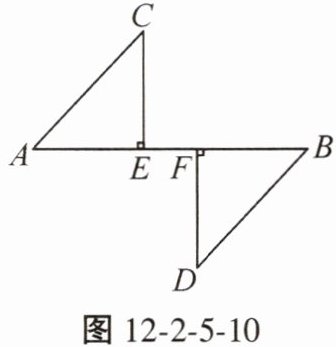
5. 如图12-2-5-10,已知$CE ⊥ AB$,$DF ⊥ AB$,$AC = BD$,$CE = DF$。求证:$AC // BD$。
答案
证明:$\because CE ⊥ AB,DF ⊥ AB$,
$\therefore ∠ CEA = ∠ DFB = 90°$。
又$\because AC = BD,CE = DF$,
$\therefore \mathrm{Rt}△ ACE ≌ \mathrm{Rt}△ BDF(\mathrm{HL})$,
$\therefore ∠ A = ∠ B$,
$\therefore AC // BD$。
$\therefore ∠ CEA = ∠ DFB = 90°$。
又$\because AC = BD,CE = DF$,
$\therefore \mathrm{Rt}△ ACE ≌ \mathrm{Rt}△ BDF(\mathrm{HL})$,
$\therefore ∠ A = ∠ B$,
$\therefore AC // BD$。
6. 如图12-2-5-11,点C是路段AB的中点,两人同时从C出发,以相同的速度分别沿两条直线行走,并同时到达D,E两地,DA⊥AB,EB⊥AB,D,E两点到路段AB的距离相等吗?为什么?
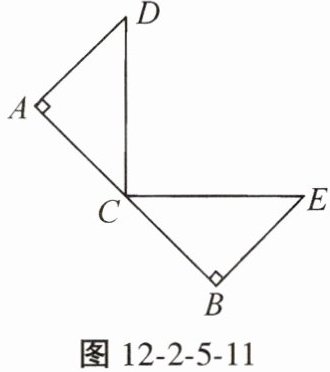
图12-2-5-11
图12-2-5-11
答案
解:D,E两点到路段AB的距离相等。
理由如下:
$\because$ 点 $C$ 是路段 $AB$ 的中点,
$\therefore AC = CB$。
$\because$ 两人同时从 $C$ 出发,以相同的速度分别沿两条直线行走,
$\therefore DC = EC$。
$\because DA ⊥ AB,EB ⊥ AB$,
$\therefore ∠ A = ∠ B = 90°$。
在 $\mathrm{Rt}△ ACD$ 和 $\mathrm{Rt}△ BCE$ 中,
$\because AC = CB,CD = CE$ ,
$\therefore \mathrm{Rt}△ ACD ≌ \mathrm{Rt}△ BCE(\mathrm{HL})$,
$\therefore AD = BE$。
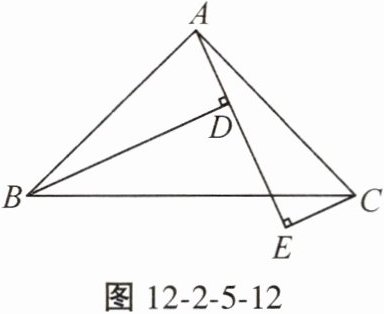
7. 如图12-2-5-12,在△ABC中,AB=AC,AE是经过点A的一条直线,且B,C在AE的两侧,BD⊥AE于点D,CE⊥AE于点E,AD=CE,则∠BAC的度数是 (
A.45°
B.60°
C.90°
D.120°
C
)A.45°
B.60°
C.90°
D.120°
答案
7. C
8. (教材P85练习T3变式)如图12-2-5-13,有两个长度相等的滑梯(BC=EF),左边滑梯的高度AC与右边滑梯水平方向上的长度DF相等,若∠ABC=32°,则∠DFE的度数为 (

A.$32°$
B.$28°$
C.$58°$
D.$45°$
C
)A.$32°$
B.$28°$
C.$58°$
D.$45°$
答案
8. C
