

 登录
登录
任务四:根据短文内容填空。
1. Foxes were very
2. A giraffe has a
3. The writer's cousin was
4. The sheep are
5. There are three elephants here, but you can also see a
1. Foxes were very
clever
and moved quietly.2. A giraffe has a
long
neck and unique
spots on its body.3. The writer's cousin was
afraid
of snakes because of their smooth skin.4. The sheep are
gentle
animals that feed on grass all day.5. There are three elephants here, but you can also see a
baby
elephant over there.答案
1. clever
2. long; unique
3. afraid
4. gentle
5. baby
2. long; unique
3. afraid
4. gentle
5. baby
B. 语音规则。
A Day at the Zoo
Last weekend, I visited the zoo with my family. We saw many animals! First, we went to the shark area. The big sharks swam fast in the water, and their teeth looked scary but cool.
Next, we watched the lions. They were sleeping under the trees, but one stood up and roared(吼叫) loudly. My little sister was afraid and hid behind me!
Near the lions, there were boxes of food for the animals. The zookeeper put fresh meat in one box for the tigers.
In the bird area, colourful birds sang sweet songs. A giraffe walked by, bending its long neck to eat leaves. It was so tall!
Then, we saw the monkeys. They jumped from tree to tree and stole(偷) a banana from a visitor’s bag.
Behind the trees, we saw two foxes. They were small and clever, running around their home.
Finally, we met the elephants. They sprayed(喷洒) water with their trunks and played with big balls. Even the little toads(蟾蜍) in the pond made us smile.
It was really a fun day full of amazing animals!
任务一:请朗读短文,注意可数名词复数形式的读音。
任务二:梳理读音规则。请将上文中重点标注的单词进行分类,根据读音规则,将其填入表格中。
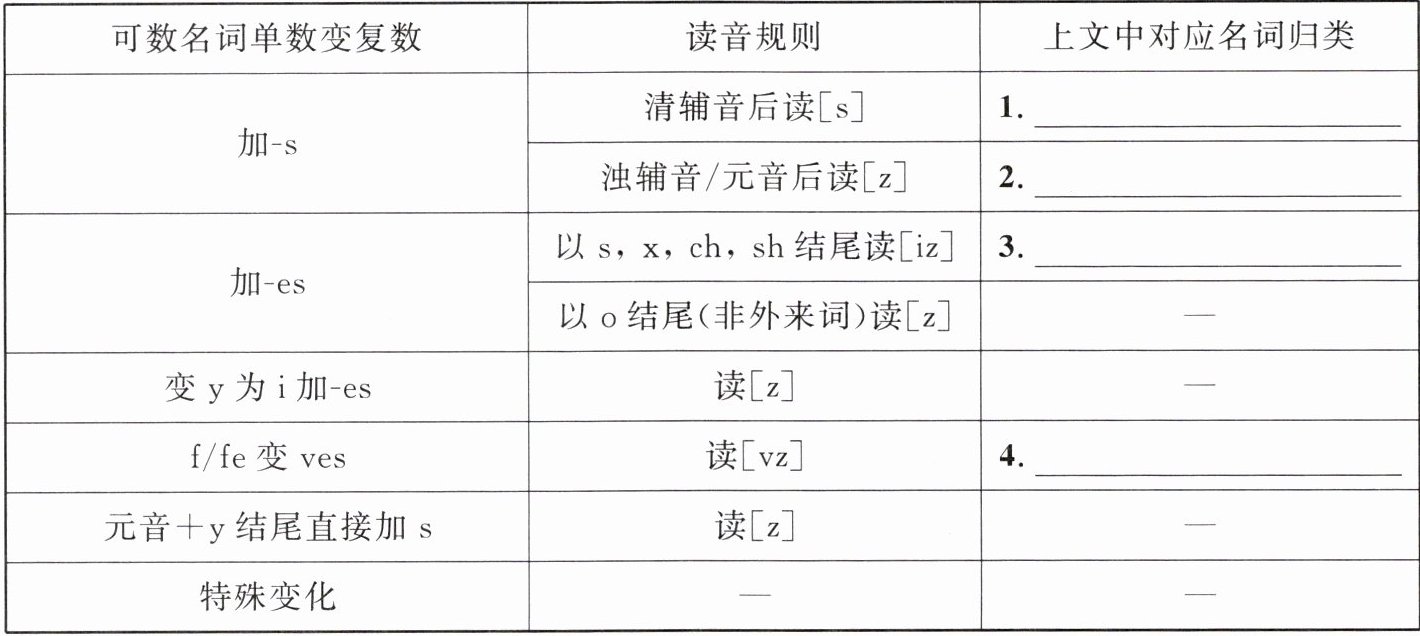
| 可数名词单数变复数 | 读音规则 | 上文中对应名词归类 |
| --- | --- | --- |
| 加-s | 清辅音后读[s] | 1.
| | 浊辅音/元音后读[z] | 2.
| 加-es | 以s, x, ch, sh结尾读[iz] | 3.
| | 以o结尾(非外来词)读[z] | — |
| 变y为i加-es | 读[z] | — |
| f/fe变ves | 读[vz] | 4.
| 元音+y结尾直接加s | 读[z] | — |
| 特殊变化 | — | — |
【实践篇】
根据对话内容,完成下列任务。
Sam: Hi, Lily! Do you have a favourite animal?
Lily: Yes! I love red-crowned cranes, also called “丹顶鹤” in Chinese. They're one of the most beautiful birds in the world! Their bodies are pure white, and their necks are black. The best part is their red spot on the head—it looks like a crown(王冠)!
Sam: That's amazing! Where do they live?
Lily: They mainly live in wetlands in Northeast China, like Heilongjiang and Jilin provinces. In summer, they fly to Russia to lay eggs and raise their babies. Then, in winter, they return to China.
Sam: That's a long trip! Do they have special meanings or stories?
Lily: Yes! In Chinese culture, cranes symbolize(象征) long life, happiness, and good luck. Many old paintings show them with pine trees(松树), meaning harmony(和谐). There's a famous story about a man who saved a hurt crane, and it became his lifelong friend.
Sam: That's sweet! How do they behave?
Lily: They're very graceful(优雅的). They dance to attract mates, jumping and spreading their wings. Their calls sound like music—some say it brings peace. Parents teach their babies to fly and find food.
Sam: Are they safe now?
Lily: Sadly, they're in danger. Wetlands are disappearing because of farming and building. But people are helping! Nature reserves(自然保护区) protect them, and scientists work hard to save their homes.
Sam: That's good news! I want to visit a reserve and see them dance.
Lily: Me too! Let's learn more about these gentle birds and help protect them. They're treasures(宝物) of nature.
任务一:根据对话内容,选择正确的答案。
(
A. Their sounds are very loud and can be heard from far away.
B. They have beautiful white feathers and a red spot on their head that looks like a crown.
C. They can fly faster than any other bird in China.
(
A. They go to Japan to find warmer weather.
B. They stay in China because it's safer.
C. They fly to Russia to lay eggs and raise their babies.
(
A. Strength and power.
B. Loneliness and silence.
C. Long life, happiness, and good luck.
(
A. Wetlands are getting smaller because of farming and building.
B. People hunt them for their feathers to make hats.
C. They can't find enough fish to eat because of pollution.
(
A. To teach us how to draw a crane.
B. To explain why cranes are dangerous animals.
C. To share facts about cranes and encourage people to protect them.
(
A. Cranes are afraid of humans.
B. Humans and cranes can form trusting, lasting bonds.
C. Cranes are better off living alone without human help.
A Day at the Zoo
Last weekend, I visited the zoo with my family. We saw many animals! First, we went to the shark area. The big sharks swam fast in the water, and their teeth looked scary but cool.
Next, we watched the lions. They were sleeping under the trees, but one stood up and roared(吼叫) loudly. My little sister was afraid and hid behind me!
Near the lions, there were boxes of food for the animals. The zookeeper put fresh meat in one box for the tigers.
In the bird area, colourful birds sang sweet songs. A giraffe walked by, bending its long neck to eat leaves. It was so tall!
Then, we saw the monkeys. They jumped from tree to tree and stole(偷) a banana from a visitor’s bag.
Behind the trees, we saw two foxes. They were small and clever, running around their home.
Finally, we met the elephants. They sprayed(喷洒) water with their trunks and played with big balls. Even the little toads(蟾蜍) in the pond made us smile.
It was really a fun day full of amazing animals!
任务一:请朗读短文,注意可数名词复数形式的读音。
任务二:梳理读音规则。请将上文中重点标注的单词进行分类,根据读音规则,将其填入表格中。
| 可数名词单数变复数 | 读音规则 | 上文中对应名词归类 |
| --- | --- | --- |
| 加-s | 清辅音后读[s] | 1.
sharks;elephants; trunks
|| | 浊辅音/元音后读[z] | 2.
animals; lions; trees; tigers; birds; monkeys; songs; balls; toads
|| 加-es | 以s, x, ch, sh结尾读[iz] | 3.
boxes; foxes
|| | 以o结尾(非外来词)读[z] | — |
| 变y为i加-es | 读[z] | — |
| f/fe变ves | 读[vz] | 4.
leaves
|| 元音+y结尾直接加s | 读[z] | — |
| 特殊变化 | — | — |
【实践篇】
根据对话内容,完成下列任务。
Sam: Hi, Lily! Do you have a favourite animal?
Lily: Yes! I love red-crowned cranes, also called “丹顶鹤” in Chinese. They're one of the most beautiful birds in the world! Their bodies are pure white, and their necks are black. The best part is their red spot on the head—it looks like a crown(王冠)!
Sam: That's amazing! Where do they live?
Lily: They mainly live in wetlands in Northeast China, like Heilongjiang and Jilin provinces. In summer, they fly to Russia to lay eggs and raise their babies. Then, in winter, they return to China.
Sam: That's a long trip! Do they have special meanings or stories?
Lily: Yes! In Chinese culture, cranes symbolize(象征) long life, happiness, and good luck. Many old paintings show them with pine trees(松树), meaning harmony(和谐). There's a famous story about a man who saved a hurt crane, and it became his lifelong friend.
Sam: That's sweet! How do they behave?
Lily: They're very graceful(优雅的). They dance to attract mates, jumping and spreading their wings. Their calls sound like music—some say it brings peace. Parents teach their babies to fly and find food.
Sam: Are they safe now?
Lily: Sadly, they're in danger. Wetlands are disappearing because of farming and building. But people are helping! Nature reserves(自然保护区) protect them, and scientists work hard to save their homes.
Sam: That's good news! I want to visit a reserve and see them dance.
Lily: Me too! Let's learn more about these gentle birds and help protect them. They're treasures(宝物) of nature.
任务一:根据对话内容,选择正确的答案。
(
B
)1. What is the main reason Lily loves red-crowned cranes?A. Their sounds are very loud and can be heard from far away.
B. They have beautiful white feathers and a red spot on their head that looks like a crown.
C. They can fly faster than any other bird in China.
(
C
)2. Where do red-crowned cranes go in summer, and why?A. They go to Japan to find warmer weather.
B. They stay in China because it's safer.
C. They fly to Russia to lay eggs and raise their babies.
(
C
)3. What do cranes symbolize in Chinese culture?A. Strength and power.
B. Loneliness and silence.
C. Long life, happiness, and good luck.
(
A
)4. Why are red-crowned cranes in danger?A. Wetlands are getting smaller because of farming and building.
B. People hunt them for their feathers to make hats.
C. They can't find enough fish to eat because of pollution.
(
C
)5. What is the main purpose of this conversation?A. To teach us how to draw a crane.
B. To explain why cranes are dangerous animals.
C. To share facts about cranes and encourage people to protect them.
(
B
)6. What can you learn from the story about the man who saved the crane?A. Cranes are afraid of humans.
B. Humans and cranes can form trusting, lasting bonds.
C. Cranes are better off living alone without human help.
答案
任务一:按要求完成即可。
任务二:
1. sharks;elephants; trunks
2. animals; lions; trees; tigers; birds; monkeys; songs; balls; toads
3. boxes; foxes
4. leaves
任务一:
1.B 2.C 3.C 4.A 5.C 6.B
任务二:
1. sharks;elephants; trunks
2. animals; lions; trees; tigers; birds; monkeys; songs; balls; toads
3. boxes; foxes
4. leaves
任务一:
1.B 2.C 3.C 4.A 5.C 6.B
