

 登录
一、词汇运用
A. 根据括号中的中文提示,写出句中所缺单词。
1. In summer, the sun shines brightly and brings strong
2. The sweet
3. The doctor asked me to check my body
4. We were all shocked by a
5. The beauty of the mountain scenery is far
A. 根据括号中的中文提示,写出句中所缺单词。
1. In summer, the sun shines brightly and brings strong
heat
(热量)that makes us sweat a lot.2. The sweet
smell
(气味)of flowers fills the air when spring comes and nature wakes up again.3. The doctor asked me to check my body
temperature
(温度)twice a day during the illness.4. We were all shocked by a
sudden
(突然的)loud noise outside the window last night.5. The beauty of the mountain scenery is far
beyond
(超出)what simple words can describe.答案
1. heat 2. smell 3. temperature 4. sudden 5. beyond
解析
【分析】本题为词汇运用题,需根据括号内的中文提示,结合句子的语境、词性及固定搭配填写正确英文单词。解题时先明确空缺处所需词性,再匹配对应核心词汇,同时注意固定短语的用法。
【解析】1. 括号内“热量”为名词,对应英文heat,符合语境;2. “气味”为名词,对应smell,sweet smell(甜香)是常用搭配;3. “温度”为名词,对应temperature,body temperature(体温)是固定短语;4. “突然的”为形容词,修饰名词noise,对应sudden;5. “超出”为介词,对应beyond,far beyond(远超出)是固定表达,符合句意。
【答案】1. heat 2. smell 3. temperature 4. sudden 5. beyond
【知识点】词汇运用、单词拼写、固定搭配
【点评】本题考查基础核心词汇的中英文对应及词性运用,结合语境和固定搭配即可解答,属于基础题型。
【难度系数】0.8
B. 阅读下面短文,在空白处填入一个适当的单词或括号内单词的正确形式。
The White Dew(白露) is one of the 24 Solar Terms. The days (6) (turn) cooler as the White Dew arrives. The farmers, once busy in the fields, grow lazier now. They wait (7) (harvest) the golden rice.
In the early morning, dewdrops cling to(附着 spider webs like tiny pearls. By noon, they start to drop one (8) one, sparkling in the sunlight.
Xiaomei walked through the village and (9) (feel) the cool air. “Grandpa, (10) is it called the White Dew?” she asked. “Because the temperature drops (11) (slow) and vapours蒸气 in the air turn into white dew on the grass and trees at night,” he explained.
Soon, (12) ______ (leaf) will turn yellow. And autumn will begin fully. But for now, the world is (13) ______ (peace), filled with the last songs of summer insects.
As the season (14) (change), Xiaomei collects fallen leaves in her book, saving these quiet (15) (memory) before winter comes.
答案
6. are turning 7. to harvest 8. by 9. felt 10. why 11. slowly 12. leaves
13. peaceful 14. changes 15. memories
解析
【分析】
本题为语篇型语法填空题,围绕中国传统节气“白露”展开,需结合语境、语法规则、固定搭配及词性变化完成填空。解题思路:先通读全文把握大意,再逐个分析空格:1. 结合上下文时态确定动词形式;2. 依据固定搭配或短语填单词;3. 根据句子成分确定词性(如修饰动词用副词、作表语用形容词);4. 结合名词的数(单复数)及疑问词的用法完成填空。
【解析】
6. 此处描述白露到来时天气逐渐变化的动作,用现在进行时,主语days为复数,故填are turning。
7. 固定搭配wait to do sth意为“等待做某事”,故填to harvest。
8. 固定短语one by one意为“一个接一个”,故填by。
9. 前文walked为过去式,and连接并列谓语,故feel用过去式felt。
10. 下文答语用because说明原因,此处需用疑问词why提问,故填why。
11. 此处修饰动词drops,需用副词,slow的副词形式为slowly,故填slowly。
12. leaf为可数名词,此处泛指树叶,需用复数形式leaves,故填leaves。
13. 此处作表语,需用形容词,peace的形容词形式为peaceful,故填peaceful。
14. as引导时间状语从句,主句用一般将来时,从句用一般现在时表将来,主语season为第三人称单数,故填changes。
15. memory为可数名词,前面有these修饰,需用复数形式memories,故填memories。
【答案】
6. are turning 7. to harvest 8. by 9. felt 10. why 11. slowly 12. leaves 13. peaceful 14. changes 15. memories
【知识点】
动词时态运用、固定搭配、词性转换
【点评】
本题以中国传统节气为话题,考查学生在语篇语境中运用英语语法和词汇的能力,考点基础,贴近文化常识,难度适中。
【难度系数】
0.6
二、阅读理解
On a sunny day, you may see clouds forming, changing shape, and moving across the sky. A cloud is a group of tiny water drops floating in the air.
How do clouds form?
Clouds form in four clear steps. First, water from oceans, lakes, rivers and plants rises into the air as water vapour. Then, the
air containing water vapour is warmed by the sun. Next, the warm air rises into the sky where the air is colder. Finally, when the warm air reaches the cold air, some water vapour changes back into water drops or tiny bits of ice. A cloud is born.
You can see the same process of condensation at home. For example, when you breathe on a cold mirror or take a hot shower—though these are not real clouds.
Types of clouds
There are three main types of clouds. The clouds that look like sheets across the sky are called stratus clouds. The fluffy clouds that look like balls of cotton wool are called cumulus clouds. The thin, wispy clouds high in the sky are called cirrus clouds. Some clouds look white because the sun makes all the tiny water drops shine. Some look black because they are made of so many water drops that the sunlight cannot shine through them. Black clouds usually mean rain is coming.
From clouds to precipitation(降水): rain, snow, and hail
When water drops inside a cloud bump into each other and stick together, they become bigger and heavier. Eventually, they fall down as rain. When the air is very cold, water vapour turns directly into tiny icy snowflakes. If the snowflakes don't melt on the way down, snow falls instead of rain. This is why higher mountains often get snowfalls. Hailstones form when strong winds carry water drops high into the cold sky. The drops freeze into small ice balls. As more water freezes onto them, they grow larger. When they become too heavy, they fall to the ground as hail.
Now you know: the simple sky is never just a sky.
(
A. the ways clouds form and change
B. the formation of rain, snow and hail
C. the basic knowledge about clouds
D. the types of clouds and their shapes
(
A. The way clouds move across the sky.
B. The process of vapour turning into water.
C. The way sunlight shines through clouds.
D. The process of water turning into vapour.
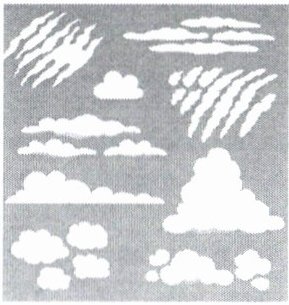
(
A. to describe the size of different clouds in the sky
B. to explain how clouds turn into rain, snow and hail
C. to introduce the beauty of clouds in different seasons
D. to show characteristics of different types of clouds clearly
(
A. We cannot tell the weather by the types of clouds.
B. Every cloud will finally produce some precipitation.
C. The more water drops a cloud has, the darker it may be.
D. Cold weather makes it impossible for new clouds to form.
On a sunny day, you may see clouds forming, changing shape, and moving across the sky. A cloud is a group of tiny water drops floating in the air.
How do clouds form?
Clouds form in four clear steps. First, water from oceans, lakes, rivers and plants rises into the air as water vapour. Then, the
air containing water vapour is warmed by the sun. Next, the warm air rises into the sky where the air is colder. Finally, when the warm air reaches the cold air, some water vapour changes back into water drops or tiny bits of ice. A cloud is born.
You can see the same process of condensation at home. For example, when you breathe on a cold mirror or take a hot shower—though these are not real clouds.
Types of clouds
There are three main types of clouds. The clouds that look like sheets across the sky are called stratus clouds. The fluffy clouds that look like balls of cotton wool are called cumulus clouds. The thin, wispy clouds high in the sky are called cirrus clouds. Some clouds look white because the sun makes all the tiny water drops shine. Some look black because they are made of so many water drops that the sunlight cannot shine through them. Black clouds usually mean rain is coming.
From clouds to precipitation(降水): rain, snow, and hail
When water drops inside a cloud bump into each other and stick together, they become bigger and heavier. Eventually, they fall down as rain. When the air is very cold, water vapour turns directly into tiny icy snowflakes. If the snowflakes don't melt on the way down, snow falls instead of rain. This is why higher mountains often get snowfalls. Hailstones form when strong winds carry water drops high into the cold sky. The drops freeze into small ice balls. As more water freezes onto them, they grow larger. When they become too heavy, they fall to the ground as hail.
Now you know: the simple sky is never just a sky.
(
C
)1. The passage is mainly about C
.A. the ways clouds form and change
B. the formation of rain, snow and hail
C. the basic knowledge about clouds
D. the types of clouds and their shapes
(
B
)2. What does the underlined word "condensation" in paragraph 3 probably mean?A. The way clouds move across the sky.
B. The process of vapour turning into water.
C. The way sunlight shines through clouds.
D. The process of water turning into vapour.
(
D
)3. The writer uses the picture D
.A. to describe the size of different clouds in the sky
B. to explain how clouds turn into rain, snow and hail
C. to introduce the beauty of clouds in different seasons
D. to show characteristics of different types of clouds clearly
(
C
)4. What can we infer from the passage?A. We cannot tell the weather by the types of clouds.
B. Every cloud will finally produce some precipitation.
C. The more water drops a cloud has, the darker it may be.
D. Cold weather makes it impossible for new clouds to form.
答案
1. C 2. B 3. D 4. C
解析
【分析】
1. 第1题为主旨大意题,需梳理全文内容,判断选项的全面性;第2题为词义猜测题,结合上下文语境推测词义;第3题为图片作用题,观察图片形态对应文中云的类型特征;第4题为推理判断题,定位原文细节分析选项匹配度。
【解析】
1. 通读全文,文章围绕云的形成过程、类型、与降水的关系等展开,是关于云的基础知识的内容。A选项仅涉及形成和变化,B选项仅涉及降水,D选项仅涉及类型,均不全面,故选C。
2. 第三段提到云形成的最后一步是水汽变成水滴,后文举例“哈气到冷镜子”时水汽变为水,可知“condensation”指水汽变成水的过程,故选B。
3. 图片展示了不同形态的云,对应文中对层状云、积云、卷云等不同类型云的特征描述,因此作者用图片是为了清晰展示不同类型云的特点,故选D。
4. 原文提到“Some look black because they are made of so many water drops that the sunlight cannot shine through them”,可推断出云里水滴越多,颜色可能越暗,C正确;A选项错误,云的类型可反映天气;B选项错误,并非所有云都产生降水;D选项错误,冷空气中可形成云,故选C。
【答案】
1.C 2.B 3.D 4.C
【知识点】
英语阅读理解主旨大意题、词义猜测题、推理判断题
【点评】
本题围绕云的科普知识展开,涵盖英语阅读常见题型,考查学生对文章内容的理解与信息提取能力,难度适中,仔细阅读原文即可正确解答。
【难度系数】
0.6
