

 登录
登录
主题解读
本单元话题以“日常生活作息”展开,情境属于2022新课标“人与自我”主题范畴中的“生活与学习”这一主题群,涉及子主题“丰富、充实、积极向上的生活”和“自我认识,自我管理,自我提升”。该话题要求同学们能够使用描绘日常活动的词汇、句型及时间表达法,按照时间顺序对自己或他人的学校以及日常生活进行描述。
任务情境
假如你是李华,你校英文报正在开展以“My Daily Life”为题的征文活动,请你写一篇短文参加此次活动。
内容包括:1.时间安排;2.主要事件;3.你的感受。
要求:1.词数60左右;
2.字迹工整,内容完整连贯,语言准确规范;
3.包括所给信息,可适当增加细节,以使行文连贯。
My Daily Life
思路点拨
逐步突破——三步训练法
(一)短语翻译——根据写作要点翻译短语。
1. 穿衣服
2. 刷牙
3. 起床
4. 去上学
5. 做作业
6. 日常生活
7. 为……把某物准备好
(二)句子翻译——结合(一)中短语和括号内的提示完成句子。
1. 我通常每天六点起床。(get up)
2. 早餐后,我该骑自行车去上学了。(it’s time for sb to do)
3. 晚饭后,我准备好第二天上学用的书包。(prepare)
(三)篇章展示——运用(二)中句子组成语段。
My Daily Life
本单元话题以“日常生活作息”展开,情境属于2022新课标“人与自我”主题范畴中的“生活与学习”这一主题群,涉及子主题“丰富、充实、积极向上的生活”和“自我认识,自我管理,自我提升”。该话题要求同学们能够使用描绘日常活动的词汇、句型及时间表达法,按照时间顺序对自己或他人的学校以及日常生活进行描述。
任务情境
假如你是李华,你校英文报正在开展以“My Daily Life”为题的征文活动,请你写一篇短文参加此次活动。
内容包括:1.时间安排;2.主要事件;3.你的感受。
要求:1.词数60左右;
2.字迹工整,内容完整连贯,语言准确规范;
3.包括所给信息,可适当增加细节,以使行文连贯。
My Daily Life
思路点拨
逐步突破——三步训练法
(一)短语翻译——根据写作要点翻译短语。
1. 穿衣服
get dressed
2. 刷牙
brush teeth
3. 起床
get up
4. 去上学
go to school
5. 做作业
do homework
6. 日常生活
daily life/routine
7. 为……把某物准备好
prepare sth for
(二)句子翻译——结合(一)中短语和括号内的提示完成句子。
1. 我通常每天六点起床。(get up)
I usually get up at six every day.
2. 早餐后,我该骑自行车去上学了。(it’s time for sb to do)
After breakfast, it's time for me to go to school by bike.
3. 晚饭后,我准备好第二天上学用的书包。(prepare)
After dinner, I prepare my schoolbag for the next day.
(三)篇章展示——运用(二)中句子组成语段。
My Daily Life
I'm Li Hua. Let me tell you about my daily life.
I usually get up at six every day. Then I get dressed, wash my face and brush my teeth. After breakfast, it's time for me to go to school by bike.
I have four lessons in the morning and three in the afternoon. I study hard and always help my classmates. School finishes at five. I often play basketball with my friends after school.
After dinner, I prepare my schoolbag for the next day. I go to bed at nine o'clock.
In a word, my daily life is busy but colourful.
答案
(一)
1. get dressed 2. brush teeth 3. get up
4. go to school 5. do homework 6. daily life/routine
7. prepare sth for
(二)
1. I usually get up at six every day. 2. After breakfast, it's time for me to go to school by bike. 3. After dinner, I prepare my schoolbag for the next day.
(三)
My Daily Life
I'm Li Hua. Let me tell you about my daily life.
I usually get up at six every day. Then I get dressed, wash my face and brush my teeth. After breakfast, it's time for me to go to school by bike.
I have four lessons in the morning and three in the afternoon. I study hard and always help my classmates. School finishes at five. I often play basketball with my friends after school.
After dinner, I prepare my schoolbag for the next day. I go to bed at nine o'clock.
In a word, my daily life is busy but colourful.
1. get dressed 2. brush teeth 3. get up
4. go to school 5. do homework 6. daily life/routine
7. prepare sth for
(二)
1. I usually get up at six every day. 2. After breakfast, it's time for me to go to school by bike. 3. After dinner, I prepare my schoolbag for the next day.
(三)
My Daily Life
I'm Li Hua. Let me tell you about my daily life.
I usually get up at six every day. Then I get dressed, wash my face and brush my teeth. After breakfast, it's time for me to go to school by bike.
I have four lessons in the morning and three in the afternoon. I study hard and always help my classmates. School finishes at five. I often play basketball with my friends after school.
After dinner, I prepare my schoolbag for the next day. I go to bed at nine o'clock.
In a word, my daily life is busy but colourful.
解析
【分析】
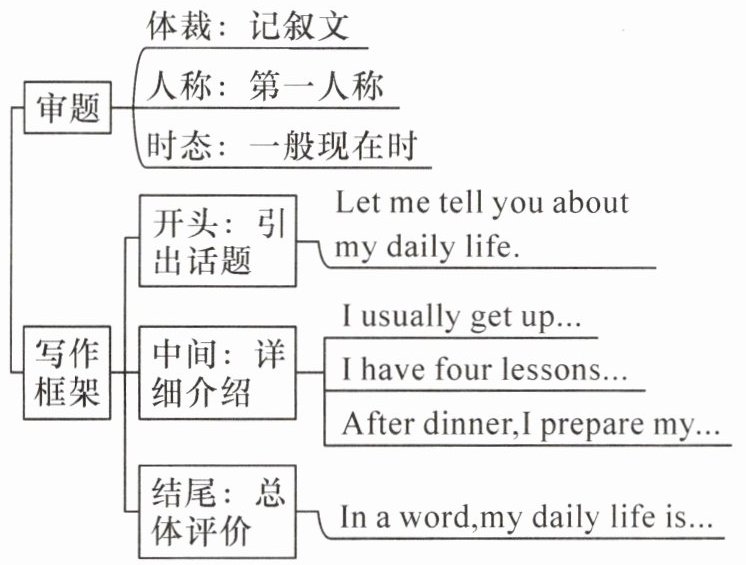
首先审题确定写作要求:体裁为记叙文,第一人称,一般现在时,主题是“My Daily Life”,需包含时间安排、主要事件、个人感受,词数约60,需结合给定的写作框架(开头引出话题、中间详细描述日常、结尾评价)。解题思路:第一步翻译日常活动相关短语,确保词汇准确;第二步将短语组合成符合语法(一般现在时、第一人称)的句子;第三步将句子按时间顺序连贯成篇,适当补充细节,覆盖要求的内容点,保证行文连贯。
【解析】
1. 审题:明确人称用第一人称I,时态用一般现在时,体裁为记叙文,需包含时间安排、主要事件、个人感受,词数控制在60左右。
2. 短语翻译:根据要求翻译日常活动短语,如“穿衣服”译为get dressed,“刷牙”译为brush teeth等。
3. 句子翻译:结合短语和提示完成句子,如“我通常每天六点起床”译为I usually get up at six every day,“晚饭后,我准备好第二天上学用的书包”译为After dinner, I prepare my schoolbag for the next day。
4. 篇章组织:将句子按时间顺序排列,开头用“Let me tell you about my daily life”引出话题,中间详细描述起床、上学、上课、课后活动、准备书包等内容,结尾用“In a word, my daily life is busy but colourful”总结感受,确保行文连贯,符合要求。
【答案】
My Daily Life
I'm Li Hua. Let me tell you about my daily life.
I usually get up at six every day. Then I get dressed, wash my face and brush my teeth. After breakfast, it's time for me to go to school by bike.
I have four lessons in the morning and three in the afternoon. I study hard and always help my classmates. School finishes at five. I often play basketball with my friends after school.
After dinner, I prepare my schoolbag for the next day. I go to bed at nine o'clock.
In a word, my daily life is busy but colourful.
【知识点】
英语记叙文写作;一般现在时;日常活动词汇
【点评】
本题围绕学生熟悉的日常生活展开写作,要求明确,考察学生对日常话题词汇、句型的掌握及篇章组织能力,符合新课标“人与自我”主题的教学要求,难度适中,适合学生巩固相关知识。
【难度系数】
0.5
首先审题确定写作要求:体裁为记叙文,第一人称,一般现在时,主题是“My Daily Life”,需包含时间安排、主要事件、个人感受,词数约60,需结合给定的写作框架(开头引出话题、中间详细描述日常、结尾评价)。解题思路:第一步翻译日常活动相关短语,确保词汇准确;第二步将短语组合成符合语法(一般现在时、第一人称)的句子;第三步将句子按时间顺序连贯成篇,适当补充细节,覆盖要求的内容点,保证行文连贯。
【解析】
1. 审题:明确人称用第一人称I,时态用一般现在时,体裁为记叙文,需包含时间安排、主要事件、个人感受,词数控制在60左右。
2. 短语翻译:根据要求翻译日常活动短语,如“穿衣服”译为get dressed,“刷牙”译为brush teeth等。
3. 句子翻译:结合短语和提示完成句子,如“我通常每天六点起床”译为I usually get up at six every day,“晚饭后,我准备好第二天上学用的书包”译为After dinner, I prepare my schoolbag for the next day。
4. 篇章组织:将句子按时间顺序排列,开头用“Let me tell you about my daily life”引出话题,中间详细描述起床、上学、上课、课后活动、准备书包等内容,结尾用“In a word, my daily life is busy but colourful”总结感受,确保行文连贯,符合要求。
【答案】
My Daily Life
I'm Li Hua. Let me tell you about my daily life.
I usually get up at six every day. Then I get dressed, wash my face and brush my teeth. After breakfast, it's time for me to go to school by bike.
I have four lessons in the morning and three in the afternoon. I study hard and always help my classmates. School finishes at five. I often play basketball with my friends after school.
After dinner, I prepare my schoolbag for the next day. I go to bed at nine o'clock.
In a word, my daily life is busy but colourful.
【知识点】
英语记叙文写作;一般现在时;日常活动词汇
【点评】
本题围绕学生熟悉的日常生活展开写作,要求明确,考察学生对日常话题词汇、句型的掌握及篇章组织能力,符合新课标“人与自我”主题的教学要求,难度适中,适合学生巩固相关知识。
【难度系数】
0.5
