

 登录
阅读下面四篇语言材料,然后按文后要求做题。
A
Li Bing
Li Bing was a great ancient official and expert in water control. In ancient times, frequent floods destroyed farmland and harmed local people's lives. To solve the problem, he led local workers to build the famous Dujiangyan Irrigation System. This great project controlled floods and watered large areas of farmland. It helped local people live a stable life and greatly improved agricultural development. Even today, the old project still works well and benefits people.
Cai Lun
Cai Lun was a famous inventor in ancient China. Before his time, people wrote on heavy or expensive materials, which made study and record-keeping very hard. After long-term practice and countless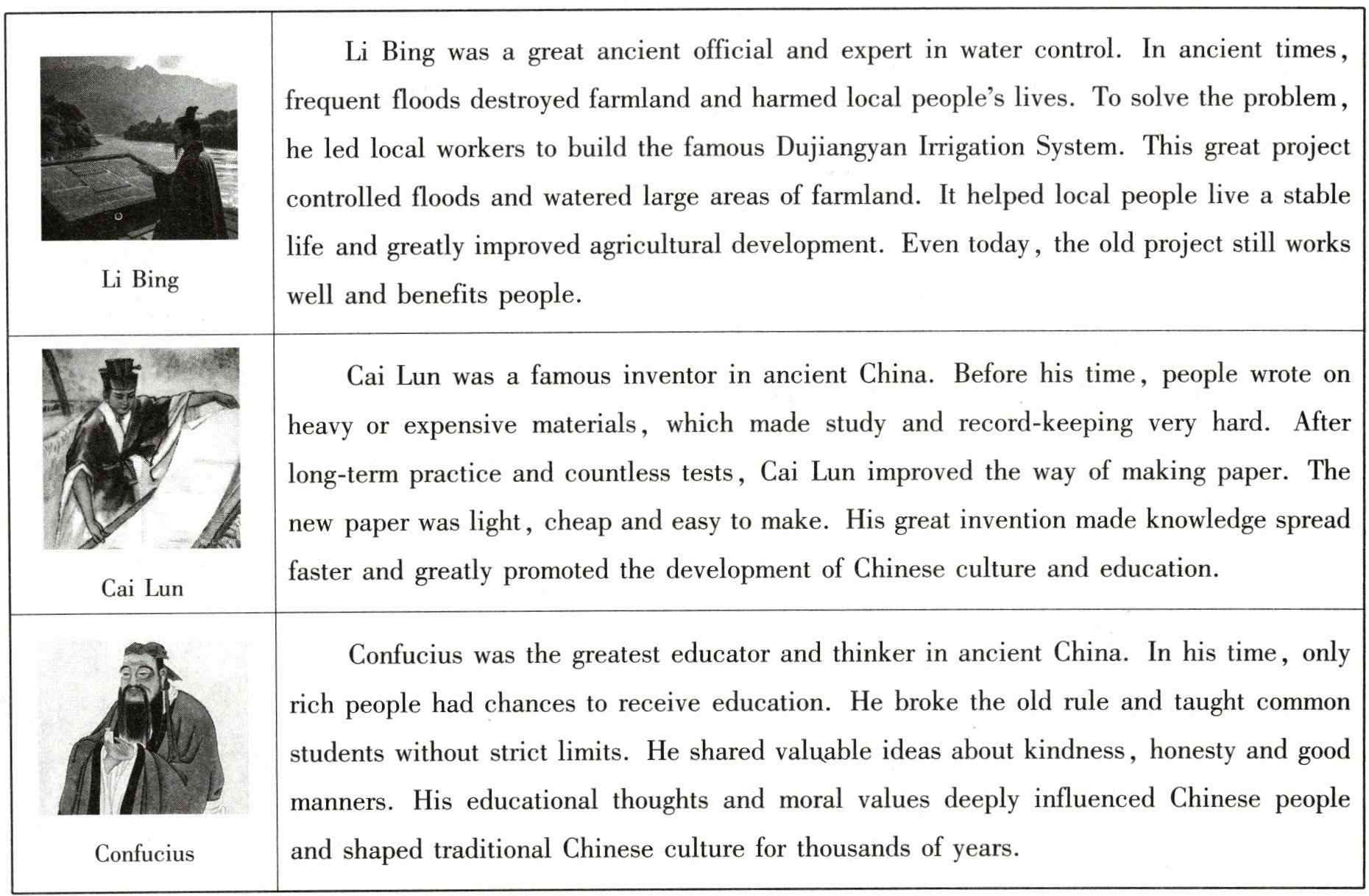 tests, Cai Lun improved the way of making paper. The new paper was light, cheap and easy to make. His great invention made knowledge spread faster and greatly promoted the development of Chinese culture and education.
Confucius
Confucius was the greatest educator and thinker in ancient China. In his time, only rich people had chances to receive education. He broke the old rule and taught common students without strict limits. He shared valuable ideas about kindness, honesty and good manners. His educational thoughts and moral values deeply influenced Chinese people and shaped traditional Chinese culture for thousands of years.
根据材料内容选择最佳答案。
(
A. Water pool.
B. Dujiangyan.
C. New farmland.
D. Warning towers.
(
A. Old paper spread fast.
B. Old materials were poor.
C. Rich people needed paper.
D. He wanted to develop farming.
(
A. Building water projects.
B. Teaching only rich students.
C. Teaching common people.
D. Making cheap writing tools.
(
A. Dujiangyan stops working now.
B. Cai Lun's paper slowed culture.
C. Confucius' ideas last thousands of years.
D. Floods help farm development in ways.
(
A. Old writing inventions.
B. Ancient flood projects.
C. Old education special rules.
D. Great ancient Chinese people.
A
Li Bing
Li Bing was a great ancient official and expert in water control. In ancient times, frequent floods destroyed farmland and harmed local people's lives. To solve the problem, he led local workers to build the famous Dujiangyan Irrigation System. This great project controlled floods and watered large areas of farmland. It helped local people live a stable life and greatly improved agricultural development. Even today, the old project still works well and benefits people.
Cai Lun
Cai Lun was a famous inventor in ancient China. Before his time, people wrote on heavy or expensive materials, which made study and record-keeping very hard. After long-term practice and countless
tests, Cai Lun improved the way of making paper. The new paper was light, cheap and easy to make. His great invention made knowledge spread faster and greatly promoted the development of Chinese culture and education.Confucius
Confucius was the greatest educator and thinker in ancient China. In his time, only rich people had chances to receive education. He broke the old rule and taught common students without strict limits. He shared valuable ideas about kindness, honesty and good manners. His educational thoughts and moral values deeply influenced Chinese people and shaped traditional Chinese culture for thousands of years.
根据材料内容选择最佳答案。
(
B
)21. What did Li Bing build?A. Water pool.
B. Dujiangyan.
C. New farmland.
D. Warning towers.
(
B
)22. Why did Cai Lun change papermaking?A. Old paper spread fast.
B. Old materials were poor.
C. Rich people needed paper.
D. He wanted to develop farming.
(
C
)23. What kind of special act did Confucius do?A. Building water projects.
B. Teaching only rich students.
C. Teaching common people.
D. Making cheap writing tools.
(
C
)24. What can we infer from the text?A. Dujiangyan stops working now.
B. Cai Lun's paper slowed culture.
C. Confucius' ideas last thousands of years.
D. Floods help farm development in ways.
(
D
)25. What is the main idea of the whole text?A. Old writing inventions.
B. Ancient flood projects.
C. Old education special rules.
D. Great ancient Chinese people.
答案
21. B 22. B 23. C 24. C 25. D
B
Jiang Xiaona, a 96-born college graduate, gave up a well-paid white-collar job in Shanghai and returned to
her hometown in Heilongjiang Province three years ago. Back then, most young people in her village had left to work in cities, leaving vast farmland uncultivated (未耕种的). “The land feeds us, but no one wants to farm it anymore. I wanted to change that,” she said.
At first, villagers doubted her choice. “A girl who just graduated from college knows nothing about farming. How can she drive a tractor (拖拉机)?” they whispered. But Jiang proved them wrong. She spent three months learning to operate rice transplanters and harvesters, and taught herself advanced agricultural technologies. She even introduced a new high-yield (高产量的) rice variety suitable for the local climate.
Last year, the rice yield in her village increased by 20% compared to the previous year. Jiang didn’t keep the technology to herself—she opened free training classes to teach other villagers how to grow the new rice variety and use modern farm machines. Now she is known as the “post-95 farming pioneer” in the region, and was awarded the title of “National Outstanding Youth for Rural Revitalization”.
“Many people think success means working in big cities and earning lots of money. But I believe the land never fails those who work hard on it,” Jiang said. Her story has inspired hundreds of young people in her county to return home and start businesses.
根据材料内容选择最佳答案。
(
A. She couldn’t find a job in Shanghai.
B. She wanted to help solve the problem of uncultivated farmland.
C. She had a strong interest in driving farm machines.
D. She aimed to win the national honor from the beginning.
(
A. 先锋 B. 游客 C. 学生 D. 工人
(
A. They supported her actively. B. They doubted her ability to farm.
C. They were uninterested in her decision. D. They were angry about her giving up the city job.
(
A. She helped increase the rice yield by 20%.
B. She built a new primary school for local children.
C. She repaired the main road connecting the village to the city.
D. She opened a supermarket selling daily necessities.
(
A. White-collar jobs in big cities offer better salaries.
B. Young people should return to their hometowns to work.
C. Hard work on the land pays off, and ordinary people can be role models.
D. Operating farm machines is much easier than office work.
C
Jiang Xiaona, a 96-born college graduate, gave up a well-paid white-collar job in Shanghai and returned to
her hometown in Heilongjiang Province three years ago. Back then, most young people in her village had left to work in cities, leaving vast farmland uncultivated (未耕种的). “The land feeds us, but no one wants to farm it anymore. I wanted to change that,” she said.
At first, villagers doubted her choice. “A girl who just graduated from college knows nothing about farming. How can she drive a tractor (拖拉机)?” they whispered. But Jiang proved them wrong. She spent three months learning to operate rice transplanters and harvesters, and taught herself advanced agricultural technologies. She even introduced a new high-yield (高产量的) rice variety suitable for the local climate.
Last year, the rice yield in her village increased by 20% compared to the previous year. Jiang didn’t keep the technology to herself—she opened free training classes to teach other villagers how to grow the new rice variety and use modern farm machines. Now she is known as the “post-95 farming pioneer” in the region, and was awarded the title of “National Outstanding Youth for Rural Revitalization”.
“Many people think success means working in big cities and earning lots of money. But I believe the land never fails those who work hard on it,” Jiang said. Her story has inspired hundreds of young people in her county to return home and start businesses.
根据材料内容选择最佳答案。
(
B
)26. Why did Jiang Xiaona decide to return to her hometown?A. She couldn’t find a job in Shanghai.
B. She wanted to help solve the problem of uncultivated farmland.
C. She had a strong interest in driving farm machines.
D. She aimed to win the national honor from the beginning.
(
A
)27. What does the underlined word “pioneer” in Paragraph 3 probably mean?A. 先锋 B. 游客 C. 学生 D. 工人
(
B
)28. How did villagers react to Jiang's choice at first?A. They supported her actively. B. They doubted her ability to farm.
C. They were uninterested in her decision. D. They were angry about her giving up the city job.
(
A
)29. What contribution did Jiang make to her village?A. She helped increase the rice yield by 20%.
B. She built a new primary school for local children.
C. She repaired the main road connecting the village to the city.
D. She opened a supermarket selling daily necessities.
(
C
)30. What is the main idea of the text?A. White-collar jobs in big cities offer better salaries.
B. Young people should return to their hometowns to work.
C. Hard work on the land pays off, and ordinary people can be role models.
D. Operating farm machines is much easier than office work.
C
答案
26. B 27. A 28. B 29. A 30. C
