

 登录
登录
任务二:如果你想在不同的文化里表现得得体大方,你应该怎么做? 根据对话内容,完成培养良好礼仪的任务。
My Action
How I'll Do
Practice proper greetings.
• Learn greeting ways of different cultures.
• 1.
Follow table manners.
• Use chopsticks correctly.
• 2.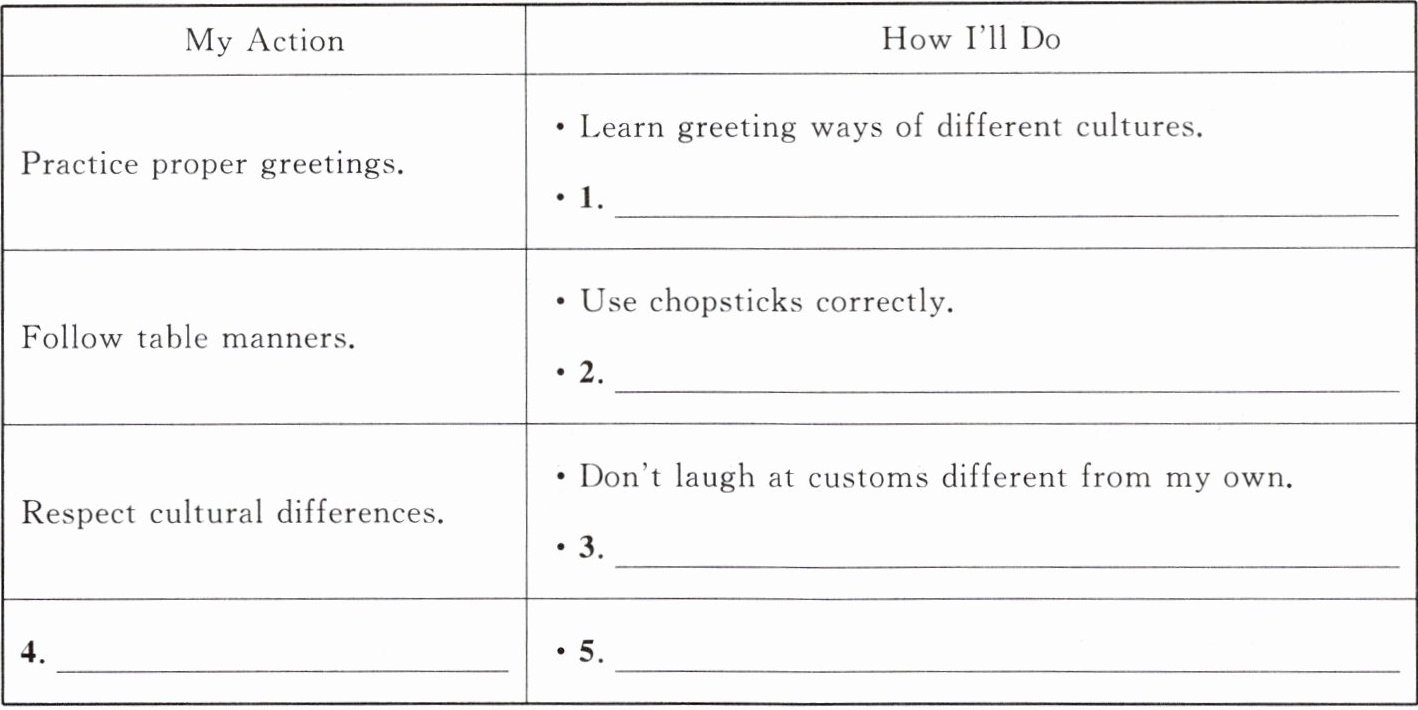
Respect cultural differences.
• Don't laugh at customs different from my own.
• 3.
4.
• 5.
My Action
How I'll Do
Practice proper greetings.
• Learn greeting ways of different cultures.
• 1.
Follow table manners.
• Use chopsticks correctly.
• 2.
Respect cultural differences.
• Don't laugh at customs different from my own.
• 3.
4.
• 5.
答案
任务二:答案不唯一,合理即可。
第一节 完形填空
阅读下面的短文,理解其大意,并从 A、B、C 三个选项中选出一个能填入空白处的最佳选项。
When was the last time you gave or received a hug? Do your parents often hug you 1 you leave for school? In many Western countries, it is quite common to 2 close friends or relatives with a warm hug. It's a simple way to show care and happiness to people around you.
If a friend is feeling 3, a warm hug can easily cheer them up and make them feel supported. After not seeing each other for a long time, good friends often hug tightly when they 4 again to show how much they miss each other. When you win a basketball game, you might hug your 5 excitedly to share the joy and pride together. A hug can also calm someone down when they feel nervous about a big exam or a new challenge.
However, different cultures have very different ideas about hugging. In China, it is seen as a 6 act that usually only happens between very close people. Even people who are good friends may feel shy to hug in public places. We usually greet each other 7 a friendly smile or a polite handshake instead.
A "hugging party" in Shanghai once invited strangers to hug each other. At first, the Chinese participants felt quite 8. But by the end of the activity, many changed their minds. They found that hugging can be a nice and gentle way to connect with others.
Next time you see your parents, try 9 them a warm hug. It might feel a little strange at first, but you will soon find 10 warm and sweet it makes you both feel!
(
(
(
(
(
(
(
(
(
(
阅读下面的短文,理解其大意,并从 A、B、C 三个选项中选出一个能填入空白处的最佳选项。
When was the last time you gave or received a hug? Do your parents often hug you 1 you leave for school? In many Western countries, it is quite common to 2 close friends or relatives with a warm hug. It's a simple way to show care and happiness to people around you.
If a friend is feeling 3, a warm hug can easily cheer them up and make them feel supported. After not seeing each other for a long time, good friends often hug tightly when they 4 again to show how much they miss each other. When you win a basketball game, you might hug your 5 excitedly to share the joy and pride together. A hug can also calm someone down when they feel nervous about a big exam or a new challenge.
However, different cultures have very different ideas about hugging. In China, it is seen as a 6 act that usually only happens between very close people. Even people who are good friends may feel shy to hug in public places. We usually greet each other 7 a friendly smile or a polite handshake instead.
A "hugging party" in Shanghai once invited strangers to hug each other. At first, the Chinese participants felt quite 8. But by the end of the activity, many changed their minds. They found that hugging can be a nice and gentle way to connect with others.
Next time you see your parents, try 9 them a warm hug. It might feel a little strange at first, but you will soon find 10 warm and sweet it makes you both feel!
(
A
)1. A. before B. after C. while(
B
)2. A. help B. greet C. visit(
C
)3. A. shocked B. angry C. upset(
A
)4. A. meet B. fight C. leave(
B
)5. A. volunteers B. teammates C. fans(
A
)6. A. formal B. simple C. common(
C
)7. A. to B. for C. with(
A
)8. A. uncomfortable B. excited C. relaxed(
B
)9. A. sending B. offering C. lending(
C
)10. A. what B. why C. how答案
1. A
2. B
3. C
4. A
5. B
6. A
7. C
8. A
9. B
10. C
2. B
3. C
4. A
5. B
6. A
7. C
8. A
9. B
10. C
