

 登录
登录
一、给下列句子选择合适的图片。
B. 元 旦 快 乐
C.
(
(
(
(
(
B. 元 旦 快 乐
C.
(
E
)1. At this festival, people always get together. They eat mooncakes.(
C
)2. We often wear new clothes. We always get red packets.(
A
)3. People always eat zongzi at this festival. They commemorate Qu Yuan.(
D
)4. This festival is for old people. They usually go climbing and eat Chongyang cakes.(
B
)5. This is the first day of the new year. It's an important festival in the UK.答案
1. E 2. C 3. A 4. D 5. B
解析
【分析】先理解每个英语句子描述的节日特征,再逐一匹配对应图片:1. 提到吃月饼,对应有月亮、月饼的E图;2. 提到穿新衣、拿红包,对应春节场景的C图;3. 提到吃粽子纪念屈原,对应粽子图A;4. 提到为老人的节日,对应给老人送花的D图;5. 提到新年第一天(元旦),对应写有“元旦快乐”的B图。
【解析】1. 句子描述的节日习俗是吃月饼,对应E图(中秋节,家人团圆吃月饼);2. 句子提到穿新衣、拿红包,对应C图(春节拜年场景);3. 句子说吃粽子纪念屈原,对应A图(粽子);4. 句子说明是老人的节日,对应D图(重阳节相关,给老人送花);5. 句子指新年第一天(元旦),对应B图(元旦快乐)。
【答案】1.E 2.C 3.A 4.D 5.B
【知识点】节日习俗、图片匹配、英语句子理解
【点评】本题考查常见节日的英语表达与对应习俗,结合图片信息进行匹配,是小学阶段基础的英语应用题目,需要学生掌握基础节日知识。
【难度系数】0.5
【解析】1. 句子描述的节日习俗是吃月饼,对应E图(中秋节,家人团圆吃月饼);2. 句子提到穿新衣、拿红包,对应C图(春节拜年场景);3. 句子说吃粽子纪念屈原,对应A图(粽子);4. 句子说明是老人的节日,对应D图(重阳节相关,给老人送花);5. 句子指新年第一天(元旦),对应B图(元旦快乐)。
【答案】1.E 2.C 3.A 4.D 5.B
【知识点】节日习俗、图片匹配、英语句子理解
【点评】本题考查常见节日的英语表达与对应习俗,结合图片信息进行匹配,是小学阶段基础的英语应用题目,需要学生掌握基础节日知识。
【难度系数】0.5
二、完形填空。
The Lantern Festival(元宵节) is a popular festival in China. It's usually in January or February, fourteen days 1 the Spring Festival. People usually go to 2 lanterns on the street or in the park. There 3 many lanterns. Children often hold little lanterns in their hands. They're very excited. Sometimes we can watch fireworks(烟花) at 4. They are so beautiful. At the festival, people eat tangyuan. In China, people 5 call it yuanxiao. This food means the family reunion(团聚) and happiness.
(
(
(
(
(
The Lantern Festival(元宵节) is a popular festival in China. It's usually in January or February, fourteen days 1 the Spring Festival. People usually go to 2 lanterns on the street or in the park. There 3 many lanterns. Children often hold little lanterns in their hands. They're very excited. Sometimes we can watch fireworks(烟花) at 4. They are so beautiful. At the festival, people eat tangyuan. In China, people 5 call it yuanxiao. This food means the family reunion(团聚) and happiness.
(
A
)1. A. after B. before C. in(
B
)2. A. look B. watch C. play(
A
)3. A. are B. is C. aren't(
C
)4. A. evening B. weekends C. night(
B
)5. A. both B. also C. too答案
1. A 解析:春节是大年初一,元宵节是正月十五,所以是春节的14天后。 2. B 3. A 4. C 5. B
解析
【分析】
本文介绍了中国元宵节的相关内容,解题时需先通读全文把握主旨,再结合文化常识、语法知识及固定搭配逐一分析每个空:第1空需明确元宵节与春节的时间先后关系;第2空辨析表示“观看”的动词用法;第3空运用there be句型的就近原则;第4空考查时间相关的固定搭配;第5空辨析句中表“也”的副词用法。
【解析】
1. 元宵节在正月十五,春节在正月初一,因此元宵节在春节之后,选A(after)。
2. 表示“观看灯笼”用watch,look为不及物动词需加at,play不符合语境,选B(watch)。
3. there be句型遵循就近原则,主语many lanterns是复数,be动词用are,选A(are)。
4. “在晚上”的固定搭配是at night,evening通常与in搭配,weekends需加the,选C(night)。
5. also用于句中,too用于句末,此处位于动词call前,选B(also)。
【答案】
1.A 2.B 3.A 4.C 5.B
【知识点】
文化常识、动词辨析、there be句型
【点评】
本题结合元宵节文化常识和基础语法知识,难度适中,侧重考查学生的语言运用能力和文化常识积累,适合初中低年级学生巩固相关知识点。
【难度系数】
0.6
本文介绍了中国元宵节的相关内容,解题时需先通读全文把握主旨,再结合文化常识、语法知识及固定搭配逐一分析每个空:第1空需明确元宵节与春节的时间先后关系;第2空辨析表示“观看”的动词用法;第3空运用there be句型的就近原则;第4空考查时间相关的固定搭配;第5空辨析句中表“也”的副词用法。
【解析】
1. 元宵节在正月十五,春节在正月初一,因此元宵节在春节之后,选A(after)。
2. 表示“观看灯笼”用watch,look为不及物动词需加at,play不符合语境,选B(watch)。
3. there be句型遵循就近原则,主语many lanterns是复数,be动词用are,选A(are)。
4. “在晚上”的固定搭配是at night,evening通常与in搭配,weekends需加the,选C(night)。
5. also用于句中,too用于句末,此处位于动词call前,选B(also)。
【答案】
1.A 2.B 3.A 4.C 5.B
【知识点】
文化常识、动词辨析、there be句型
【点评】
本题结合元宵节文化常识和基础语法知识,难度适中,侧重考查学生的语言运用能力和文化常识积累,适合初中低年级学生巩固相关知识点。
【难度系数】
0.6
三、新素材 阅读绘本,判断正(T)误(F)。
It is Christmas Eve. The house is full of lights, music, and laughter.
Suddenly, the bell rings. “ Come in!” everyone shouts loudly.
A man opens the front door and comes in. Nobody knows him, but the host(主人) goes to meet him and takes him to the table to have a drink.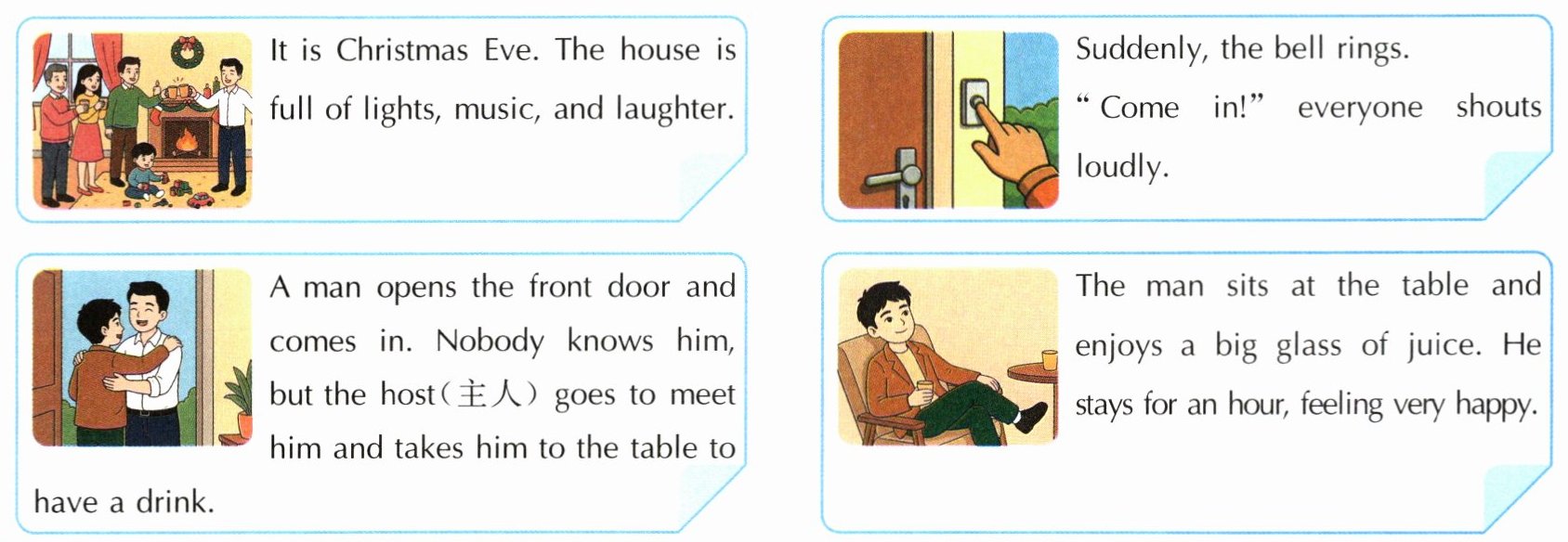
The man sits at the table and enjoys a big glass of juice. He stays for an hour, feeling very happy.
 Then the man says, “Do you know nobody invites(邀请) me to this party? I don't know you and your guests(客人). My wife and I want to get into our car, but one of your guests' cars is in front of our gate(门), so I come here to find him.
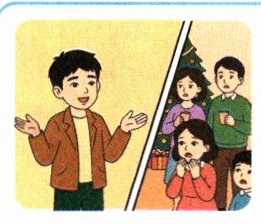
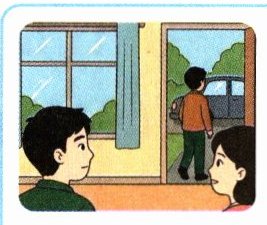 “My wife is waiting in the car outside. But thanks for the drink!” He waves and walks back into his car.
(
(
(
(
(
It is Christmas Eve. The house is full of lights, music, and laughter.
Suddenly, the bell rings. “ Come in!” everyone shouts loudly.
A man opens the front door and comes in. Nobody knows him, but the host(主人) goes to meet him and takes him to the table to have a drink.
The man sits at the table and enjoys a big glass of juice. He stays for an hour, feeling very happy.
Then the man says, “Do you know nobody invites(邀请) me to this party? I don't know you and your guests(客人). My wife and I want to get into our car, but one of your guests' cars is in front of our gate(门), so I come here to find him. “My wife is waiting in the car outside. But thanks for the drink!” He waves and walks back into his car.(
T
)1. It is the 24th of December.(
F
)2. The host knows why the man comes when he comes in.(
T
)3. The man doesn't know any people in the house.(
F
)4. The man goes to the party to have a drink.(
T
)5. Perhaps the man's wife is angry(生气的) because she waits for a long time.答案
1. T 2. F 3. T 4. F 5. T
解析
【分析】做此类判断正误题,需先通读全文把握故事脉络,再针对每个小题的表述,定位原文对应语句,对比题干与原文内容是否一致,逐一推导判断。
【解析】1. 题干意为“这是12月24日”,原文第一句“It is Christmas Eve.”(平安夜即12月24日),表述一致,故判断为T。
2. 题干意为“男人进来时主人就知道他来的原因”,原文提到主人不知道他,带他去喝酒,男人后续才说明来意,主人一开始并不知晓,表述不符,故判断为F。
3. 题干意为“这个男人不认识房子里的任何人”,原文男人明确说“I don't know you and your guests.”,表述一致,故判断为T。
4. 题干意为“这个男人去派对是为了喝饮料”,原文男人是因他人车辆挡住自家车门,来找车主,喝饮料只是临时行为,并非赴派对的目的,表述不符,故判断为F。
5. 题干意为“他的妻子可能生气因为等了很久”,原文提到妻子在车里等,男人停留了一小时,推测妻子可能因等待时间长生气,表述合理,故判断为T。
【答案】1.T 2.F 3.T 4.F 5.T
【知识点】英语阅读理解、细节判断
【点评】本题为英语阅读理解的细节判断类题目,要求学生精准定位原文信息,对比题干与原文内容完成判断,难度适中,侧重考查学生的语篇理解与信息匹配能力。
【难度系数】0.6
【解析】1. 题干意为“这是12月24日”,原文第一句“It is Christmas Eve.”(平安夜即12月24日),表述一致,故判断为T。
2. 题干意为“男人进来时主人就知道他来的原因”,原文提到主人不知道他,带他去喝酒,男人后续才说明来意,主人一开始并不知晓,表述不符,故判断为F。
3. 题干意为“这个男人不认识房子里的任何人”,原文男人明确说“I don't know you and your guests.”,表述一致,故判断为T。
4. 题干意为“这个男人去派对是为了喝饮料”,原文男人是因他人车辆挡住自家车门,来找车主,喝饮料只是临时行为,并非赴派对的目的,表述不符,故判断为F。
5. 题干意为“他的妻子可能生气因为等了很久”,原文提到妻子在车里等,男人停留了一小时,推测妻子可能因等待时间长生气,表述合理,故判断为T。
【答案】1.T 2.F 3.T 4.F 5.T
【知识点】英语阅读理解、细节判断
【点评】本题为英语阅读理解的细节判断类题目,要求学生精准定位原文信息,对比题干与原文内容完成判断,难度适中,侧重考查学生的语篇理解与信息匹配能力。
【难度系数】0.6
