

 登录
登录
[2026 浙江衢州调研]
Lightning Safety
Each year, thunderstorms(雷暴)produce millions of flashes of lightning. Here is what you need to know to stay safe. Seek shelter. No place outside is safe.
WHEN YOU HEAR THUNDER
√Move to a building or a car with windows closed.
√Stay indoors for at least 30 minutes after the last sound of thunder.
√Don’t use telephones, computers and radios.
√Stay away from windows and doors.
WHEN YOU ARE CAUGHT OUTSIDE
Crouch down(蹲下)as low as possible. Avoid being the tallest object in the area.
Cover your ears with your hands to protect your hearing.
Keep your heels(脚后跟)touching each other. Your heels shouldn’t touch the ground. This helps ground electricity go through one foot and out of the other. Only the front part of your feet should touch the ground.
(
A. Telephones. B. Books.
C. Computers. D. Radios.
(
A. Stand up tall.
B. Lie on the ground.
C. Cover your ears.
D. Keep your heels on the ground.
(
A. In a travel magazine.
B. In a museum guidebook.
C. On a weather website.
D. In a news report.
Lightning Safety
Each year, thunderstorms(雷暴)produce millions of flashes of lightning. Here is what you need to know to stay safe. Seek shelter. No place outside is safe.
WHEN YOU HEAR THUNDER
√Move to a building or a car with windows closed.
√Stay indoors for at least 30 minutes after the last sound of thunder.
√Don’t use telephones, computers and radios.
√Stay away from windows and doors.
WHEN YOU ARE CAUGHT OUTSIDE
Crouch down(蹲下)as low as possible. Avoid being the tallest object in the area.
Cover your ears with your hands to protect your hearing.
Keep your heels(脚后跟)touching each other. Your heels shouldn’t touch the ground. This helps ground electricity go through one foot and out of the other. Only the front part of your feet should touch the ground.
(
B
)1. What is safe to use during a thunderstorm?A. Telephones. B. Books.
C. Computers. D. Radios.
(
C
)2. What should you do when caught outside during a thunderstorm?A. Stand up tall.
B. Lie on the ground.
C. Cover your ears.
D. Keep your heels on the ground.
(
C
)3. 新考法文章出处 Where might you read this text?A. In a travel magazine.
B. In a museum guidebook.
C. On a weather website.
D. In a news report.
答案
1. B 细节理解题。根据"Don't use telephones, computers and radios."可知选B项。
2. C 细节理解题。根据"Cover your ears with your hands to protect your hearing."可知应捂住耳朵。故选C项。
3. C 推理判断题。文章主要介绍雷雨天气的安全知识,最可能在天气网站上读到。故选C项。
2. C 细节理解题。根据"Cover your ears with your hands to protect your hearing."可知应捂住耳朵。故选C项。
3. C 推理判断题。文章主要介绍雷雨天气的安全知识,最可能在天气网站上读到。故选C项。
解析
【分析】
本题为英语阅读理解题,包含3道选择题,分别考查细节理解和推理判断能力。解题思路:1. 第1题需定位雷暴时禁止使用的物品,通过排除不符合的选项得出答案;2. 第2题定位户外遇雷暴的正确做法,匹配对应选项;3. 第3题根据文章核心主题(雷雨安全知识),结合选项推断最可能的文章出处。
【解析】
1. 细节理解题:根据原文“Don't use telephones, computers and radios.”可知,雷暴时不能使用电话、电脑、收音机,因此排除A、C、D,选B。
2. 细节理解题:根据原文“Cover your ears with your hands to protect your hearing.”可知,户外遇雷暴时应捂住耳朵,选C。
3. 推理判断题:文章主要介绍雷雨天气的安全防护知识,这类内容最可能出现在天气相关的网站上,结合选项,选C。
【答案】
1.B 2.C 3.C
【知识点】
英语阅读理解、细节理解题、推理判断题
【点评】
本题围绕雷雨安全主题设题,考查学生快速定位原文细节信息及根据主题推断文章出处的能力,题目难度不大,需学生仔细阅读原文,准确提取关键信息。
【难度系数】
0.7
本题为英语阅读理解题,包含3道选择题,分别考查细节理解和推理判断能力。解题思路:1. 第1题需定位雷暴时禁止使用的物品,通过排除不符合的选项得出答案;2. 第2题定位户外遇雷暴的正确做法,匹配对应选项;3. 第3题根据文章核心主题(雷雨安全知识),结合选项推断最可能的文章出处。
【解析】
1. 细节理解题:根据原文“Don't use telephones, computers and radios.”可知,雷暴时不能使用电话、电脑、收音机,因此排除A、C、D,选B。
2. 细节理解题:根据原文“Cover your ears with your hands to protect your hearing.”可知,户外遇雷暴时应捂住耳朵,选C。
3. 推理判断题:文章主要介绍雷雨天气的安全防护知识,这类内容最可能出现在天气相关的网站上,结合选项,选C。
【答案】
1.B 2.C 3.C
【知识点】
英语阅读理解、细节理解题、推理判断题
【点评】
本题围绕雷雨安全主题设题,考查学生快速定位原文细节信息及根据主题推断文章出处的能力,题目难度不大,需学生仔细阅读原文,准确提取关键信息。
【难度系数】
0.7
答案 4—8
[2026 江苏盐城期末]There are lots of natural disasters every year. 4
Typhoons are some of the worst storms, usually around the Pacific Ocean (太平洋). Most happen in July, August and September.
How does a typhoon happen? When lots of sea water gets hot in the summer sun, it evaporates (蒸发) into the air. This makes the air hotter. ______ 5 ______ Then cooler air around it rushes in. It fills the space that is left. After the air gets warmer, it starts to move quickly, making wind. The wind goes in circles and it keeps moving higher in the sky. The warmer the air gets, the quicker the wind moves. And when wind moves faster than 30 metres a second, a typhoon begins.
A typhoon has two parts. One is called the "eye". 6 The other part is the wall of clouds around the eye. Here are the strongest winds and hardest rain.
Typhoons are very dangerous. In November in 2013, a typhoon killed many people in Philippines. 7
What should we do when a typhoon hits?
• Stay inside. 8
• Try to bring all of your things inside. Strong winds could even blow away your bikes!
• Listen to the radio or TV or search on the internet for important information.
• If you're told to go to a safer place, do it right now.
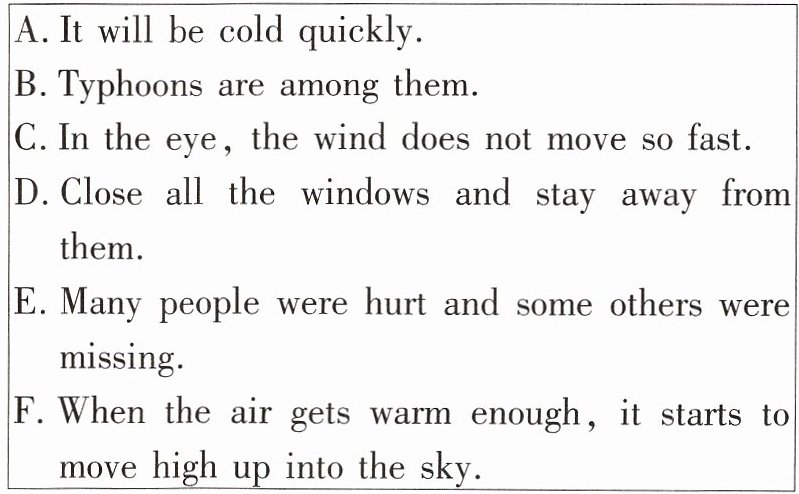
[2026 江苏盐城期末]There are lots of natural disasters every year. 4
Typhoons are some of the worst storms, usually around the Pacific Ocean (太平洋). Most happen in July, August and September.
How does a typhoon happen? When lots of sea water gets hot in the summer sun, it evaporates (蒸发) into the air. This makes the air hotter. ______ 5 ______ Then cooler air around it rushes in. It fills the space that is left. After the air gets warmer, it starts to move quickly, making wind. The wind goes in circles and it keeps moving higher in the sky. The warmer the air gets, the quicker the wind moves. And when wind moves faster than 30 metres a second, a typhoon begins.
A typhoon has two parts. One is called the "eye". 6 The other part is the wall of clouds around the eye. Here are the strongest winds and hardest rain.
Typhoons are very dangerous. In November in 2013, a typhoon killed many people in Philippines. 7
What should we do when a typhoon hits?
• Stay inside. 8
• Try to bring all of your things inside. Strong winds could even blow away your bikes!
• Listen to the radio or TV or search on the internet for important information.
• If you're told to go to a safer place, do it right now.
答案
4. B 根据"There are lots of natural disasters every year."和下文可知,此处介绍台风属于自然灾害。B项符合语境。
5. F 这里介绍台风是如何形成的且与空气流动有关,F项符合语境。
6. C 根据"A typhoon has two parts. One is called the 'eye'."可知,此处介绍的是台风的"风眼"。C项符合语境。
7. E 根据上文可知,此处介绍台风的危害,E项符合语境。
8. D 根据"What should we do when a typhoon hits?"可知,这里介绍的是台风来临时应该如何做。D项符合语境,故选D项。
5. F 这里介绍台风是如何形成的且与空气流动有关,F项符合语境。
6. C 根据"A typhoon has two parts. One is called the 'eye'."可知,此处介绍的是台风的"风眼"。C项符合语境。
7. E 根据上文可知,此处介绍台风的危害,E项符合语境。
8. D 根据"What should we do when a typhoon hits?"可知,这里介绍的是台风来临时应该如何做。D项符合语境,故选D项。
解析
【分析】
本题为英语七选五题型,需结合上下文语境、逻辑关系及话题一致性解题。先通读全文明确话题为台风相关的自然灾害,再逐个分析空格前后内容匹配选项:第4题前讲多种自然灾害,后引出台风,对应B;第5题讲台风形成的空气变化,对应F;第6题讲台风的“风眼”,对应C;第7题讲台风的危害,对应E;第8题讲台风应对措施,对应D。
【解析】
4. 空格前提到“每年有很多自然灾害”,空格后开始介绍台风,B项“Typhoons are among them.”(台风属于其中之一)承接上文,引出下文对台风的介绍,符合语境。
5. 空格前讲台风形成时海水蒸发使空气变热,空格后讲周围冷空气涌入,F项“When the air gets warm enough, it starts to move high up into the sky.”(当空气足够暖时,开始上升到高空)符合台风形成中空气流动的逻辑,衔接前后内容。
6. 空格前提到台风的两部分之一是“eye”(风眼),C项“In the eye, the wind does not move so fast.”(在风眼里,风移动得没那么快)对应风眼的特点,符合语境。
7. 空格前讲2013年菲律宾台风造成很多人死亡,E项“Many people were hurt and some others were missing.”(很多人受伤,还有一些人失踪)补充说明台风的危害,承接上文。
8. 空格前讲台风来临时的应对措施,前一条是“Stay inside.”(待在室内),D项“Close all the windows and stay away from them.”(关上所有窗户,远离它们)是待在室内的具体做法,符合应对措施的语境。
【答案】
4.B 5.F 6.C 7.E 8.D
【知识点】
英语七选五、语境推理、台风常识
【点评】
本题是初中英语期末的七选五题型,围绕台风相关知识展开,考查学生的上下文逻辑理解和信息匹配能力,难度适中,需结合话题与语境准确选择。
【难度系数】
0.6
本题为英语七选五题型,需结合上下文语境、逻辑关系及话题一致性解题。先通读全文明确话题为台风相关的自然灾害,再逐个分析空格前后内容匹配选项:第4题前讲多种自然灾害,后引出台风,对应B;第5题讲台风形成的空气变化,对应F;第6题讲台风的“风眼”,对应C;第7题讲台风的危害,对应E;第8题讲台风应对措施,对应D。
【解析】
4. 空格前提到“每年有很多自然灾害”,空格后开始介绍台风,B项“Typhoons are among them.”(台风属于其中之一)承接上文,引出下文对台风的介绍,符合语境。
5. 空格前讲台风形成时海水蒸发使空气变热,空格后讲周围冷空气涌入,F项“When the air gets warm enough, it starts to move high up into the sky.”(当空气足够暖时,开始上升到高空)符合台风形成中空气流动的逻辑,衔接前后内容。
6. 空格前提到台风的两部分之一是“eye”(风眼),C项“In the eye, the wind does not move so fast.”(在风眼里,风移动得没那么快)对应风眼的特点,符合语境。
7. 空格前讲2013年菲律宾台风造成很多人死亡,E项“Many people were hurt and some others were missing.”(很多人受伤,还有一些人失踪)补充说明台风的危害,承接上文。
8. 空格前讲台风来临时的应对措施,前一条是“Stay inside.”(待在室内),D项“Close all the windows and stay away from them.”(关上所有窗户,远离它们)是待在室内的具体做法,符合应对措施的语境。
【答案】
4.B 5.F 6.C 7.E 8.D
【知识点】
英语七选五、语境推理、台风常识
【点评】
本题是初中英语期末的七选五题型,围绕台风相关知识展开,考查学生的上下文逻辑理解和信息匹配能力,难度适中,需结合话题与语境准确选择。
【难度系数】
0.6
