

 登录
登录
五、阅读下面短文,从短文后的选项中选出可以填入空白处的最佳选项。选项中有一项为多余选项。
When you open a map on your phone, you might assume(认为)it is guided by the Global Positioning System(GPS)without giving it a second thought. 1
China started to build the BDS 30 years ago. Back in 1978, the US already started providing navigation services with its GPS. However, depending on a navigation system from another country is not safe.
2 Named after the Big Dipper constellation(北斗七星星座),which has guided people for centuries,the mission(任务)of the BDS was to make sure China could navigate the future on its own terms. In 2020,after over 20 years of hard work,Beidou completed its global network. The BDS became the fourth global navigation system after the GPS of the United States,Galileo of the European Union and GLONASS of Russia.
The BDS is the first navigation satellite system to provide a global short message communication service. 3 For example,in February 2023,a hiker got lost in heavy snow in Inner Mongolia. He sent a text message using the BDS-powered chip in his phone and got rescued in time.
Moreover,the Beidou system plays an important role in disaster prevention and response. Rescuers(救援人员)can communicate through the BDS quickly and clearly. 4
5 As of 2023,it had provided service for over 120 countries and regions(地区). “By 2035,China will build a positioning,navigation and timing(定位、导航和授时)system with the BDS at its core(核心)to provide more smart services,” Ran Chengqi,director general of the China Satellite Navigation Office,said at a news meeting in 2018.
A. It is also helpful in agriculture(农业),letting farmers plant their crops(庄稼)better.
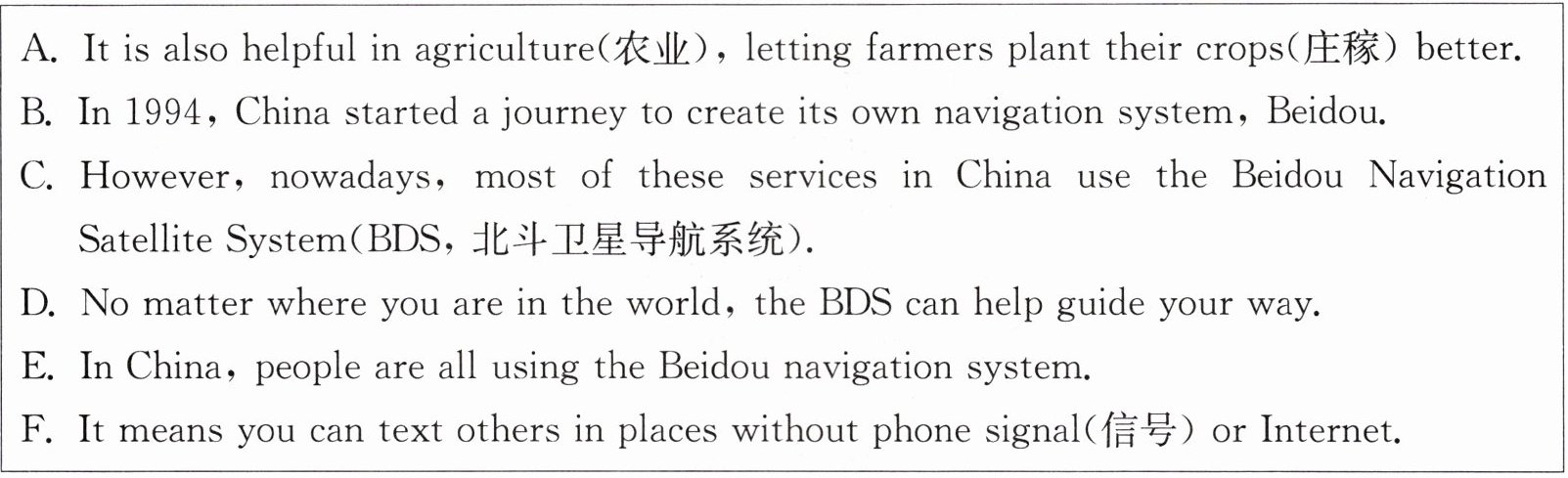
B. In 1994,China started a journey to create its own navigation system,Beidou.
C. However,nowadays,most of these services in China use the Beidou Navigation Satellite System(BDS,北斗卫星导航系统).
D. No matter where you are in the world,the BDS can help guide your way.
E. In China,people are all using the Beidou navigation system.
F. It means you can text others in places without phone signal(信号)or Internet.
1.
When you open a map on your phone, you might assume(认为)it is guided by the Global Positioning System(GPS)without giving it a second thought. 1
China started to build the BDS 30 years ago. Back in 1978, the US already started providing navigation services with its GPS. However, depending on a navigation system from another country is not safe.
2 Named after the Big Dipper constellation(北斗七星星座),which has guided people for centuries,the mission(任务)of the BDS was to make sure China could navigate the future on its own terms. In 2020,after over 20 years of hard work,Beidou completed its global network. The BDS became the fourth global navigation system after the GPS of the United States,Galileo of the European Union and GLONASS of Russia.
The BDS is the first navigation satellite system to provide a global short message communication service. 3 For example,in February 2023,a hiker got lost in heavy snow in Inner Mongolia. He sent a text message using the BDS-powered chip in his phone and got rescued in time.
Moreover,the Beidou system plays an important role in disaster prevention and response. Rescuers(救援人员)can communicate through the BDS quickly and clearly. 4
5 As of 2023,it had provided service for over 120 countries and regions(地区). “By 2035,China will build a positioning,navigation and timing(定位、导航和授时)system with the BDS at its core(核心)to provide more smart services,” Ran Chengqi,director general of the China Satellite Navigation Office,said at a news meeting in 2018.
A. It is also helpful in agriculture(农业),letting farmers plant their crops(庄稼)better.
B. In 1994,China started a journey to create its own navigation system,Beidou.
C. However,nowadays,most of these services in China use the Beidou Navigation Satellite System(BDS,北斗卫星导航系统).
D. No matter where you are in the world,the BDS can help guide your way.
E. In China,people are all using the Beidou navigation system.
F. It means you can text others in places without phone signal(信号)or Internet.
1.
C
2. B
3. F
4. A
5. D
答案
1.C 2.B 3.F 4.A 5.D
解析
【分析】
这是一篇说明文类的阅读还原题,核心是介绍北斗卫星导航系统的发展历程、特色功能与应用场景。解题时首先通读全文,理清文章整体行文脉络:先引出北斗替代GPS的现状,再讲北斗的研发背景与发展历程,接着介绍北斗的特色功能、多领域应用,最后说明北斗的全球服务布局。之后逐空结合上下文的逻辑线索匹配选项:
1. 第一空前文提到人们默认手机地图用GPS导航,需要一个转折句引出北斗的普及现状,对应带转折词however的C选项;
2. 第二空前文提到依赖别国导航系统不安全,后文介绍北斗的命名和自研定位,需要填入中国正式启动自研北斗项目的内容,对应B选项;
3. 第三空前文提到北斗独有全球短报文通信服务,后文举了徒步者无信号时发消息获救的例子,需要解释短报文服务的含义,对应F选项;
4. 第四空前文介绍北斗在防灾减灾领域的作用,需要补充北斗在其他领域的应用,对应A选项的农业领域应用;
5. 第五空后文提到北斗已经为全球120多个国家和地区提供服务,需要填入北斗全球导航属性的总起句,对应D选项;最后验证多余的E选项表述过于绝对,全文没有对应支撑内容,属于干扰项。
【解析】
1. 第一空:前文描述大众默认手机地图由GPS导航的固有印象,C选项用However转折,引出如今中国绝大多数导航相关服务都使用北斗系统的事实,逻辑衔接自然。
2. 第二空:前文指出依赖他国导航系统存在安全隐患,B选项说明1994年中国正式启动自研北斗导航系统的项目,承接前文的安全顾虑,引出后文北斗的研发定位。
3. 第三空:前文点明北斗是首个提供全球短报文通信服务的导航卫星系统,F选项对该服务的功能做出解释:没有手机信号和互联网的区域也可以向外发送消息,和后文徒步者靠北斗短报文获救的例子完全呼应。
4. 第四空:前文介绍北斗在防灾减灾领域的重要作用,A选项递进补充北斗在农业领域的实用价值,都是北斗落地应用的场景介绍,行文逻辑通顺。
5. 第五空:后文介绍北斗已经向全球超120个国家和地区提供服务,D选项总述无论身处世界何地,北斗都可以为你导航,引出北斗的全球服务属性,和后文内容匹配。
【答案】
1.C 2.B 3.F 4.A 5.D
【知识点】
语篇逻辑衔接,阅读还原,北斗导航常识
【点评】
本题属于典型的说明文类阅读还原题型,既考查学生对上下文转折、顺承、举例等逻辑关系的判断能力,也融入了我国北斗导航系统的相关科技常识,引导学生了解我国前沿科技成就,干扰项E选项表述绝对,很容易被排除,整体难度适中。
【难度系数】
0.7
这是一篇说明文类的阅读还原题,核心是介绍北斗卫星导航系统的发展历程、特色功能与应用场景。解题时首先通读全文,理清文章整体行文脉络:先引出北斗替代GPS的现状,再讲北斗的研发背景与发展历程,接着介绍北斗的特色功能、多领域应用,最后说明北斗的全球服务布局。之后逐空结合上下文的逻辑线索匹配选项:
1. 第一空前文提到人们默认手机地图用GPS导航,需要一个转折句引出北斗的普及现状,对应带转折词however的C选项;
2. 第二空前文提到依赖别国导航系统不安全,后文介绍北斗的命名和自研定位,需要填入中国正式启动自研北斗项目的内容,对应B选项;
3. 第三空前文提到北斗独有全球短报文通信服务,后文举了徒步者无信号时发消息获救的例子,需要解释短报文服务的含义,对应F选项;
4. 第四空前文介绍北斗在防灾减灾领域的作用,需要补充北斗在其他领域的应用,对应A选项的农业领域应用;
5. 第五空后文提到北斗已经为全球120多个国家和地区提供服务,需要填入北斗全球导航属性的总起句,对应D选项;最后验证多余的E选项表述过于绝对,全文没有对应支撑内容,属于干扰项。
【解析】
1. 第一空:前文描述大众默认手机地图由GPS导航的固有印象,C选项用However转折,引出如今中国绝大多数导航相关服务都使用北斗系统的事实,逻辑衔接自然。
2. 第二空:前文指出依赖他国导航系统存在安全隐患,B选项说明1994年中国正式启动自研北斗导航系统的项目,承接前文的安全顾虑,引出后文北斗的研发定位。
3. 第三空:前文点明北斗是首个提供全球短报文通信服务的导航卫星系统,F选项对该服务的功能做出解释:没有手机信号和互联网的区域也可以向外发送消息,和后文徒步者靠北斗短报文获救的例子完全呼应。
4. 第四空:前文介绍北斗在防灾减灾领域的重要作用,A选项递进补充北斗在农业领域的实用价值,都是北斗落地应用的场景介绍,行文逻辑通顺。
5. 第五空:后文介绍北斗已经向全球超120个国家和地区提供服务,D选项总述无论身处世界何地,北斗都可以为你导航,引出北斗的全球服务属性,和后文内容匹配。
【答案】
1.C 2.B 3.F 4.A 5.D
【知识点】
语篇逻辑衔接,阅读还原,北斗导航常识
【点评】
本题属于典型的说明文类阅读还原题型,既考查学生对上下文转折、顺承、举例等逻辑关系的判断能力,也融入了我国北斗导航系统的相关科技常识,引导学生了解我国前沿科技成就,干扰项E选项表述绝对,很容易被排除,整体难度适中。
【难度系数】
0.7
六、阅读理解。
Lots of people go travelling during holidays. As travellers look for more personalized(个人特制的)experiences,many choose AI to be their online tour guides.
During the May Day holiday,Wu Hongbo,a visitor from Dalian,travelled to Shanxi. It was his first visit to Shanxi. Wu didn't want to join a tour group because he would have to spend a lot of money and he couldn't explore freely. There were so many places of interest in Shanxi and he was not familiar with the travel routes(路线),so he turned to AI for help.
Wu used AI to plan a fantastic tour of Shanxi. He input the places he wanted to visit,his travel dates,budget and personal interests into an AI app. Soon,he got a personalized week-long travel plan. It showed him the ways to get around,places to visit,and hotels to stay in. Wu is interested in ancient buildings and tasty food,so the AI app also listed several not-so-famous but culturally rich places and delicious dishes.
“This AI-planned tour truly gave me great surprises,” Wu said. “The places and routes perfectly matched my taste,helping me understand Shanxi better. ”
Some people believe 2026 will be the breakout year for AI tour guides. They think AI can meet tourists' needs for personalized travel. During a personalized trip,AI can serve tourists in real time. Through modern technologies,an AI tour guide can act like a personal guide,explaining the historical stories and cultural meanings behind the tourist areas.
In the future,AI tour guides will help human guides and together they can bring a more personalized experience to make travel more exciting.
(
A. How long Wu stayed in Shanxi.
B. Why Wu turned to the AI app for help.
C. What information the AI app gave Wu.
D. Which places Wu wanted to visit in Shanxi.
(
A. Safe and interesting.
B. Wonderful and meaningful.
C. Cheap and amazing.
D. Special and comfortable.
(
A. Human guides will lose their jobs in the future.
B. Human guides and AI guides will work together.
C. AI guides have difficulty meeting tourists' needs.
D. AI guides are poor at explaining cultural meanings.
(
A. AI Tour Guides:the Future of Travel
B. Advice on Using AI for Trip Planning
C. Personalized Travel:a New Way of Travelling
D. Modern Technologies Used by AI Tour Guides
Lots of people go travelling during holidays. As travellers look for more personalized(个人特制的)experiences,many choose AI to be their online tour guides.
During the May Day holiday,Wu Hongbo,a visitor from Dalian,travelled to Shanxi. It was his first visit to Shanxi. Wu didn't want to join a tour group because he would have to spend a lot of money and he couldn't explore freely. There were so many places of interest in Shanxi and he was not familiar with the travel routes(路线),so he turned to AI for help.
Wu used AI to plan a fantastic tour of Shanxi. He input the places he wanted to visit,his travel dates,budget and personal interests into an AI app. Soon,he got a personalized week-long travel plan. It showed him the ways to get around,places to visit,and hotels to stay in. Wu is interested in ancient buildings and tasty food,so the AI app also listed several not-so-famous but culturally rich places and delicious dishes.
“This AI-planned tour truly gave me great surprises,” Wu said. “The places and routes perfectly matched my taste,helping me understand Shanxi better. ”
Some people believe 2026 will be the breakout year for AI tour guides. They think AI can meet tourists' needs for personalized travel. During a personalized trip,AI can serve tourists in real time. Through modern technologies,an AI tour guide can act like a personal guide,explaining the historical stories and cultural meanings behind the tourist areas.
In the future,AI tour guides will help human guides and together they can bring a more personalized experience to make travel more exciting.
(
C
)1. What does Paragraph 3 mainly talk about?A. How long Wu stayed in Shanxi.
B. Why Wu turned to the AI app for help.
C. What information the AI app gave Wu.
D. Which places Wu wanted to visit in Shanxi.
(
B
)2. What did Wu think of the AI-planned tour?A. Safe and interesting.
B. Wonderful and meaningful.
C. Cheap and amazing.
D. Special and comfortable.
(
B
)3. What can we learn from the text?A. Human guides will lose their jobs in the future.
B. Human guides and AI guides will work together.
C. AI guides have difficulty meeting tourists' needs.
D. AI guides are poor at explaining cultural meanings.
(
A
)4. Which is the best title for the text?A. AI Tour Guides:the Future of Travel
B. Advice on Using AI for Trip Planning
C. Personalized Travel:a New Way of Travelling
D. Modern Technologies Used by AI Tour Guides
答案
1.C 2.B 3.B 4.A
解析
【分析】
这是一篇说明文类阅读理解,解题思路如下:首先先通读4道题干,明确每道题的考点,带着问题回原文定位对应段落:第1题问第三段主旨,直接锁定第三段梳理核心内容;第2题定位人物Wu的评价语句,匹配选项;第3题逐个核对选项和原文细节,排除表述错误的干扰项;第4题梳理全文核心论述对象,排除以偏概全的选项选出最佳标题,全程要注意区分局部细节和段落/全文核心,避免被片面选项误导。
【解析】
1. 第1题:第三段先讲吴宏波向AI app输入自己的出行相关信息,之后AI给他输出了包含出行路线、景点、酒店、小众文化点位、特色美食在内的完整个性化旅行方案,核心是说明AI app给吴提供了哪些信息。A选项只提到停留时长是局部细节,B选项是第二段的内容,D选项只是吴输入的部分信息,都不是第三段核心,因此选C。
2. 第2题:根据吴的原话“This AI-planned tour truly gave me great surprises”以及“The places and routes perfectly matched my taste,helping me understand Shanxi better”,能看出他认为AI规划的旅行体验很棒,还能帮助自己深入了解山西文化,对应“很棒且有意义”的描述,文中没有提及安全、低价、舒适相关表述,排除其余选项,选B。
3. 第3题:根据原文最后一段“In the future,AI tour guides will help human guides and together they can bring a more personalized experience”,可知人类导游和AI导游未来会协同工作。A选项“人类导游会失业”无中生有,C选项“AI导游很难满足游客需求”和原文表述相反,D选项“AI导游不擅长讲解文化含义”和原文“AI tour guide can act like a personal guide,explaining the historical stories and cultural meanings behind the tourist areas”矛盾,因此选B。
4. 第4题:全文围绕AI线上导游展开,从当下的实际应用案例,讲到行业对AI导游发展的预判,以及未来AI导游和人类导游协作的发展方向,核心主题是AI导游和旅行的未来。其余选项都没有抓住核心论述对象“AI导游”,存在以偏概全的问题,因此选A。
【答案】
1.C 2.B 3.B 4.A
【知识点】
细节信息查找,段落主旨概括,语篇标题判断
【点评】
本题属于中等难度的日常科普类阅读理解,既考察学生快速定位原文细节的能力,也考察学生区分局部细节和核心主旨的能力,容易出错的点是做主旨类、标题类题时误把局部信息当成全文核心,解题时要优先抓住全文反复出现的核心论述对象,就能快速排除干扰项。
【难度系数】
0.7
这是一篇说明文类阅读理解,解题思路如下:首先先通读4道题干,明确每道题的考点,带着问题回原文定位对应段落:第1题问第三段主旨,直接锁定第三段梳理核心内容;第2题定位人物Wu的评价语句,匹配选项;第3题逐个核对选项和原文细节,排除表述错误的干扰项;第4题梳理全文核心论述对象,排除以偏概全的选项选出最佳标题,全程要注意区分局部细节和段落/全文核心,避免被片面选项误导。
【解析】
1. 第1题:第三段先讲吴宏波向AI app输入自己的出行相关信息,之后AI给他输出了包含出行路线、景点、酒店、小众文化点位、特色美食在内的完整个性化旅行方案,核心是说明AI app给吴提供了哪些信息。A选项只提到停留时长是局部细节,B选项是第二段的内容,D选项只是吴输入的部分信息,都不是第三段核心,因此选C。
2. 第2题:根据吴的原话“This AI-planned tour truly gave me great surprises”以及“The places and routes perfectly matched my taste,helping me understand Shanxi better”,能看出他认为AI规划的旅行体验很棒,还能帮助自己深入了解山西文化,对应“很棒且有意义”的描述,文中没有提及安全、低价、舒适相关表述,排除其余选项,选B。
3. 第3题:根据原文最后一段“In the future,AI tour guides will help human guides and together they can bring a more personalized experience”,可知人类导游和AI导游未来会协同工作。A选项“人类导游会失业”无中生有,C选项“AI导游很难满足游客需求”和原文表述相反,D选项“AI导游不擅长讲解文化含义”和原文“AI tour guide can act like a personal guide,explaining the historical stories and cultural meanings behind the tourist areas”矛盾,因此选B。
4. 第4题:全文围绕AI线上导游展开,从当下的实际应用案例,讲到行业对AI导游发展的预判,以及未来AI导游和人类导游协作的发展方向,核心主题是AI导游和旅行的未来。其余选项都没有抓住核心论述对象“AI导游”,存在以偏概全的问题,因此选A。
【答案】
1.C 2.B 3.B 4.A
【知识点】
细节信息查找,段落主旨概括,语篇标题判断
【点评】
本题属于中等难度的日常科普类阅读理解,既考察学生快速定位原文细节的能力,也考察学生区分局部细节和核心主旨的能力,容易出错的点是做主旨类、标题类题时误把局部信息当成全文核心,解题时要优先抓住全文反复出现的核心论述对象,就能快速排除干扰项。
【难度系数】
0.7
