

 登录
登录
四、文化追踪员:传统手工艺是中华文化的重要组成部分,制作风筝是我国流传已久的民间技艺。请你给下列制作风筝的步骤重新排序,使其成为一段通顺、完整的说明文字。
()Next(接下来), put glue on the frame and carefully stick(粘贴) the paper over it.
()You can draw(画) a beautiful picture on the paper to make your kite look nice.
()First(首先), prepare two bamboo strips(竹条), some thin paper, glue(胶水), and a long piece of string(线).
()Finally(最后), tie(系上) the string to the frame and your kite is ready to fly!
()Then, stick the bamboo strips together to make a frame(框架) for your kite.
()And then, cut(裁剪) the paper to match the shape(形状) of the frame and leave some extra paper around the edges(边缘).
()Next(接下来), put glue on the frame and carefully stick(粘贴) the paper over it.
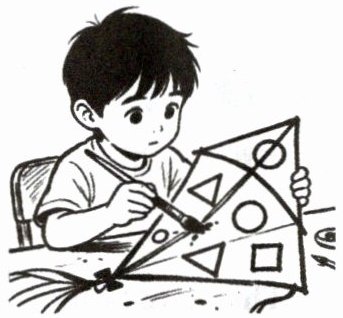
()You can draw(画) a beautiful picture on the paper to make your kite look nice.
()First(首先), prepare two bamboo strips(竹条), some thin paper, glue(胶水), and a long piece of string(线).
()Finally(最后), tie(系上) the string to the frame and your kite is ready to fly!
()Then, stick the bamboo strips together to make a frame(框架) for your kite.
()And then, cut(裁剪) the paper to match the shape(形状) of the frame and leave some extra paper around the edges(边缘).
答案
从第一句到第六句的排序数字依次为:4、5、1、6、2、3
解析
这是制作风筝的步骤排序题,我们可以按照提示词的逻辑顺序和手工制作的先后流程梳理:
1. 首先以"First(首先)"开头的句子是第一步,先准备竹条、纸、胶水、线这些制作材料。
2. 准备好材料后,以"Then(然后)"开头的句子是第二步,把竹条拼接粘好,做出风筝的框架。
3. 做好框架后,以"And then(接着)"开头的句子是第三步,裁剪纸张,让纸的形状和框架匹配,边缘留出多余的纸。
4. 裁好纸后,以"Next(接下来)"开头的句子是第四步,在框架上涂胶水,小心把纸粘贴到框架上。
5. 粘好纸张后,就可以在纸上绘制好看的图案来装饰风筝,这是第五步。
6. 最后以"Finally(最后)"开头的句子是第六步,把线系到框架上,风筝就制作完成,可以放飞了。
1. 首先以"First(首先)"开头的句子是第一步,先准备竹条、纸、胶水、线这些制作材料。
2. 准备好材料后,以"Then(然后)"开头的句子是第二步,把竹条拼接粘好,做出风筝的框架。
3. 做好框架后,以"And then(接着)"开头的句子是第三步,裁剪纸张,让纸的形状和框架匹配,边缘留出多余的纸。
4. 裁好纸后,以"Next(接下来)"开头的句子是第四步,在框架上涂胶水,小心把纸粘贴到框架上。
5. 粘好纸张后,就可以在纸上绘制好看的图案来装饰风筝,这是第五步。
6. 最后以"Finally(最后)"开头的句子是第六步,把线系到框架上,风筝就制作完成,可以放飞了。
