

 登录
■ C. Read and classify. 读一读,根据发音给画线单词分类。
I have a pet.
desk:
She is a pretty cat.
we:
She makes me happy.
delicious:
She likes to sleep in my bed.
I have a pet.
desk:
She is a pretty cat.
we:
She makes me happy.
delicious:
She likes to sleep in my bed.
答案
desk: pet, bed
we: me
delicious: pretty
we: me
delicious: pretty
解析
首先明确三个参考词中画线字母e的发音:①desk中e发音为/e/,②we中e发音为/iː/,③delicious中e发音为/ɪ/。逐一核对题干里画线单词的发音:pet的e发/e/,pretty的e发/ɪ/,me的e发/iː/,bed的e发/e/,按照发音对应分类即可。
■ D. Read and write. 读一读,用所给单词的正确形式填空。
1. At Christmas, people usually (put) lights on a Christmas tree.
2. Santa (bring) gifts to children on Christmas Eve every year.
3. My family and I (have) a big dinner together last Christmas.
4. Lily (make) beautiful Christmas cards for her friends yesterday.
5. We (sing) Christmas songs happily at the party now.
答案
1. put 2. brings 3. had 4. made 5. are singing
解析
我们可以根据每句的时间标志词判断对应时态,再对所给动词做正确变形:
1. 句中有频度副词usually(通常),描述经常性习惯性的动作,用一般现在时,主语people是复数,谓语动词用原形put。
2. 句中有时间标志every year(每年),用一般现在时,主语Santa是第三人称单数,谓语动词变为第三人称单数形式brings。
3. 句中有时间标志last Christmas(去年圣诞节),描述过去发生的事,用一般过去时,动词have变为过去式had。
4. 句中有时间标志yesterday(昨天),描述过去发生的事,用一般过去时,动词make变为过去式made。
5. 句中有时间标志now(现在),描述正在发生的动作,用现在进行时,结构为"be动词+动词现在分词",主语是we,对应be动词用are,sing的现在分词是singing,所以填are singing。
■ E. Read, guess and write. 读一读,根据谜底把谜语补充完整。
1. It's a in December. People decorate trees and get gifts.
2. He wears clothes and brings gifts to children on Christmas Eve.
3. People put on it during Christmas.
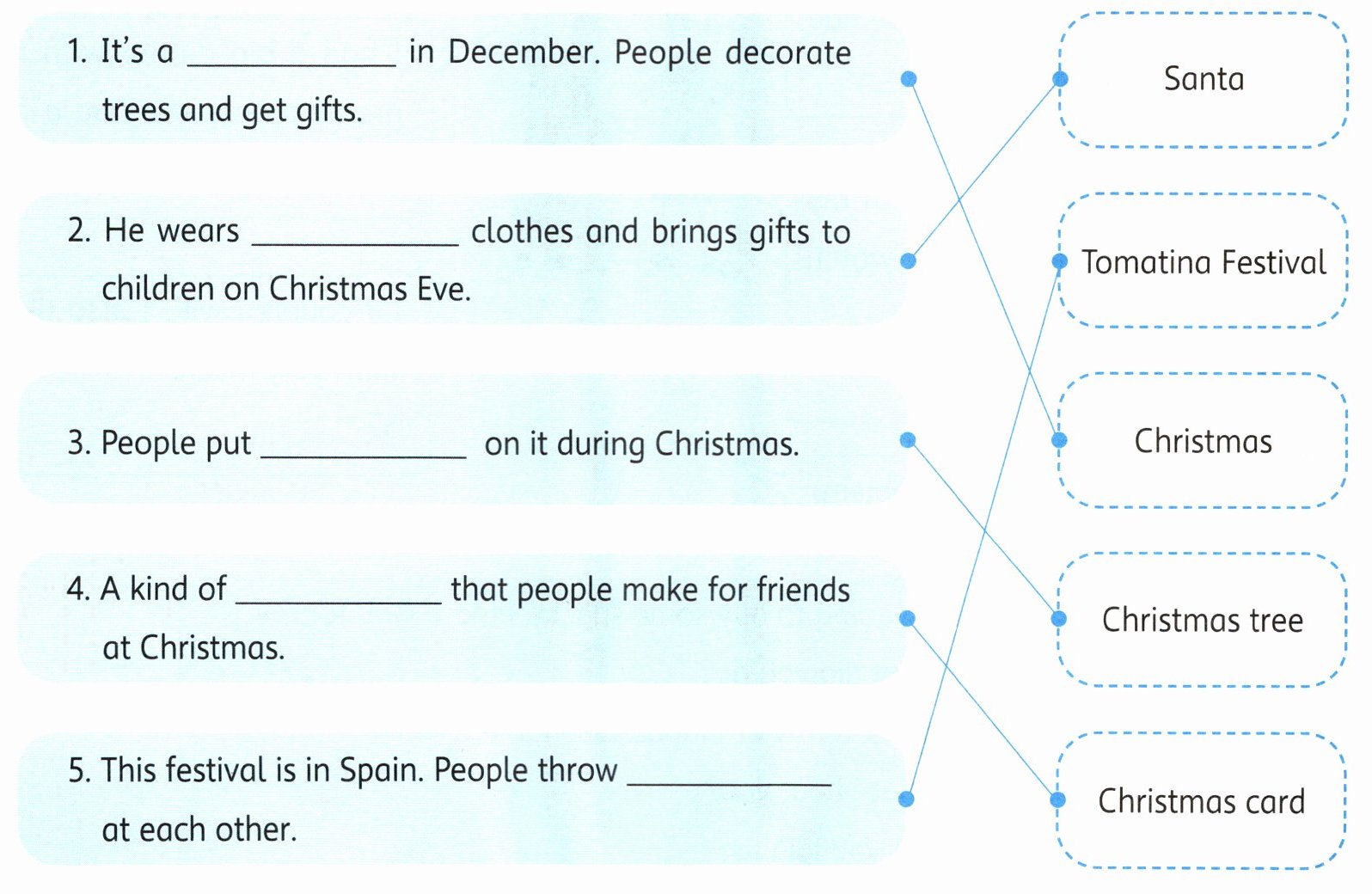
4. A kind of that people make for friends at Christmas.
5. This festival is in Spain. People throw at each other.
Santa
Tomatina Festival
Christmas
Christmas tree
Christmas card
1. It's a in December. People decorate trees and get gifts.
2. He wears clothes and brings gifts to children on Christmas Eve.
3. People put on it during Christmas.
4. A kind of that people make for friends at Christmas.
5. This festival is in Spain. People throw at each other.
Santa
Tomatina Festival
Christmas
Christmas tree
Christmas card
答案
1. holiday
2. red
3. lights
4. card
5. tomatoes
2. red
3. lights
4. card
5. tomatoes
解析
我们先将每个句子和右侧对应的谜底匹配,结合单元所学知识和常识补全句子:
1. 描述12月举办、人们装饰树木、互赠礼物的节日,对应谜底Christmas,空处填单元核心词汇holiday符合语境。
2. 句中He对应谜底Santa(圣诞老人),圣诞老人的标志性特征是穿红色的衣服,空处填red。
3. 句中it对应谜底Christmas tree(圣诞树),圣诞节人们通常会在圣诞树上挂彩灯,空处填lights。
4. 描述圣诞节人们为朋友制作的物品,对应谜底Christmas card(圣诞贺卡),空处填card。
5. 描述西班牙的节日,对应谜底Tomatina Festival(番茄节),这个节日的习俗是人们互相扔西红柿,空处填tomatoes。
1. 描述12月举办、人们装饰树木、互赠礼物的节日,对应谜底Christmas,空处填单元核心词汇holiday符合语境。
2. 句中He对应谜底Santa(圣诞老人),圣诞老人的标志性特征是穿红色的衣服,空处填red。
3. 句中it对应谜底Christmas tree(圣诞树),圣诞节人们通常会在圣诞树上挂彩灯,空处填lights。
4. 描述圣诞节人们为朋友制作的物品,对应谜底Christmas card(圣诞贺卡),空处填card。
5. 描述西班牙的节日,对应谜底Tomatina Festival(番茄节),这个节日的习俗是人们互相扔西红柿,空处填tomatoes。
