

 登录
Ⅰ.重点单词填一填
1.
2.
3.
4.
1.
nicely
/'naɪsli/ adv.漂亮地;令人愉快地2.
blouse
/blaʊz/ n.(女式)衬衫或短上衣3.
private
/'praɪvət/ adj.不喜欢谈论私事的;私人的4.
married
/'mærid/ adj.已婚的;婚姻的答案
1. nicely
2. blouse
3. private
4. married
2. blouse
3. private
4. married
解析
【分析】本题要求根据音标、词性及词义写出对应的英语单词,解题思路是:结合所学英语词汇,依据给出的音标、词义和词性,匹配出正确的单词。
【解析】1. 音标/'naɪsli/,词性为副词,词义是漂亮地、令人愉快地,对应单词nicely;2. 音标/blaʊz/,词性为名词,词义是(女式)衬衫或短上衣,对应单词blouse;3. 音标/'praɪvət/,词性为形容词,词义是私人的,对应单词private;4. 音标/'mærid/,词性为形容词,词义是已婚的,对应单词married。
【答案】1. nicely 2. blouse 3. private 4. married
【知识点】根据音标写单词、英语基础词汇
【点评】本题是基础英语词汇题,考察学生对音标与单词对应关系的掌握,属于英语学习的基础题型,难度较低。
【难度系数】0.8
Ⅱ.核心短语连一连
1. arrival time
2. hear from
3. share... with...
4. get along
5. personal questions
6. go a long way
A. 得到……消息
B. 与……分享……
C. 帮助很大
D. 相处融洽;进展
E. 个人问题
F. 到达时间
1. arrival time
2. hear from
3. share... with...
4. get along
5. personal questions
6. go a long way
A. 得到……消息
B. 与……分享……
C. 帮助很大
D. 相处融洽;进展
E. 个人问题
F. 到达时间
答案
1~6 FABDEC
解析
【分析】本题考查常见英语短语的汉语释义匹配,需先明确每个英语短语的含义,再对应匹配选项,最后按序号整理结果。
【解析】逐一匹配短语与选项:1.arrival time意为“到达时间”,对应F;2.hear from意为“得到……消息”,对应A;3.share...with...意为“与……分享……”,对应B;4.get along意为“相处融洽;进展”,对应D;5.personal questions意为“个人问题”,对应E;6.go a long way意为“帮助很大”,对应C。因此1~6的对应顺序为FABDEC。
【答案】FABDEC
【知识点】英语短语匹配
【点评】本题为基础英语短语匹配题,考查核心短语的常用释义,只要掌握基础短语含义即可轻松作答。
【难度系数】0.9
【解析】逐一匹配短语与选项:1.arrival time意为“到达时间”,对应F;2.hear from意为“得到……消息”,对应A;3.share...with...意为“与……分享……”,对应B;4.get along意为“相处融洽;进展”,对应D;5.personal questions意为“个人问题”,对应E;6.go a long way意为“帮助很大”,对应C。因此1~6的对应顺序为FABDEC。
【答案】FABDEC
【知识点】英语短语匹配
【点评】本题为基础英语短语匹配题,考查核心短语的常用释义,只要掌握基础短语含义即可轻松作答。
【难度系数】0.9
Ⅲ. 经典句式悟一悟
1. It's so great to hear from you. (It's+adj.+动词不定式)
译文:
2. He was still getting everything ready. (get sth ready“准备某物”)
译文:
3. At that party it was surprising to see how nicely everyone was dressed. (It's+adj.+动词不定式)
译文:
4. But everyone else was dressed so well that I felt silly. (so... that... “如此……以至于……”)
译文:
5. It's best not to ask personal questions unless you know the person quite well.
(unless“除非,如果不”,引导条件状语从句)
译文:
6. They don't like it when others ask them about their age, their family, whether they are married, or how much money they make. (whether... or... “无论……还是……”)
译文:
1. It's so great to hear from you. (It's+adj.+动词不定式)
译文:
收到你的来信真是太好了。
2. He was still getting everything ready. (get sth ready“准备某物”)
译文:
他还在准备一切。
3. At that party it was surprising to see how nicely everyone was dressed. (It's+adj.+动词不定式)
译文:
在那个聚会上,看到每个人穿着都很得体,真是令人惊讶。
4. But everyone else was dressed so well that I felt silly. (so... that... “如此……以至于……”)
译文:
但其他人都穿得很好,我觉得自己很傻。
5. It's best not to ask personal questions unless you know the person quite well.
(unless“除非,如果不”,引导条件状语从句)
译文:
除非你很了解对方,否则最好不要问私人问题。
6. They don't like it when others ask them about their age, their family, whether they are married, or how much money they make. (whether... or... “无论……还是……”)
译文:
他们不喜欢别人问他们的年龄、家庭、是否结婚或收入多少等问题。
答案
1. 收到你的来信真是太好了。
2. 他还在准备一切。
3. 在那个聚会上,看到每个人穿着都很得体,真是令人惊讶。
4. 但其他人都穿得很好,我觉得自己很傻。
5. 除非你很了解对方,否则最好不要问私人问题。
6. 他们不喜欢别人问他们的年龄、家庭、是否结婚或收入多少等问题。
2. 他还在准备一切。
3. 在那个聚会上,看到每个人穿着都很得体,真是令人惊讶。
4. 但其他人都穿得很好,我觉得自己很傻。
5. 除非你很了解对方,否则最好不要问私人问题。
6. 他们不喜欢别人问他们的年龄、家庭、是否结婚或收入多少等问题。
解析
【分析】本题考查英语经典句式及固定短语的汉译,需结合每个句子标注的结构(如It's+adj.+动词不定式、get sth ready、so...that等),准确对应英语词汇与短语的中文含义,调整为符合中文表达习惯的通顺译文。
【解析】根据各句标注的句式及短语含义,逐句翻译:
1. It's so great to hear from you. 中hear from意为“收到……的来信”,It's+adj.+to do结构译为“做某事是……的”,故译为“收到你的来信真是太好了。”
2. He was still getting everything ready. 中get sth ready意为“准备某物”,过去进行时体现动作正在进行,故译为“他还在准备一切。”
3. At that party it was surprising to see how nicely everyone was dressed. It's+adj.+to do结构中surprising意为“令人惊讶的”,how nicely everyone was dressed意为“每个人穿着都很得体”,故译为“在那个聚会上,看到每个人穿着都很得体,真是令人惊讶。”
4. But everyone else was dressed so well that I felt silly. so...that...意为“如此……以至于……”,dressed well意为“穿得好”,felt silly意为“觉得自己很傻”,故译为“但其他人都穿得很好,我觉得自己很傻。”
5. It's best not to ask personal questions unless you know the person quite well. unless意为“除非,如果不”,personal questions意为“私人问题”,故译为“除非你很了解对方,否则最好不要问私人问题。”
6. They don't like it when others ask them about their age, their family, whether they are married, or how much money they make. whether...or...意为“无论……还是……”,ask about意为“询问关于……”,故译为“他们不喜欢别人问他们的年龄、家庭、是否结婚或收入多少等问题。”
【答案】1. 收到你的来信真是太好了。
2. 他还在准备一切。
3. 在那个聚会上,看到每个人穿着都很得体,真是令人惊讶。
4. 但其他人都穿得很好,我觉得自己很傻。
5. 除非你很了解对方,否则最好不要问私人问题。
6. 他们不喜欢别人问他们的年龄、家庭、是否结婚或收入多少等问题。
【知识点】经典句式翻译、固定短语翻译、状语从句翻译
【点评】本题考查英语基础经典句式及短语的汉译,要求学生掌握核心固定搭配与句式结构,将英语准确转换为通顺的中文,属于基础语言应用题型。
【难度系数】0.4
文本研读·理脉络
Step 1 Lead-in
Free talk. Look at the email on Pages 66~67 and answer.
What is Nancy's email mainly about?
Step 2 While-reading
Task 1 Understand the main idea.
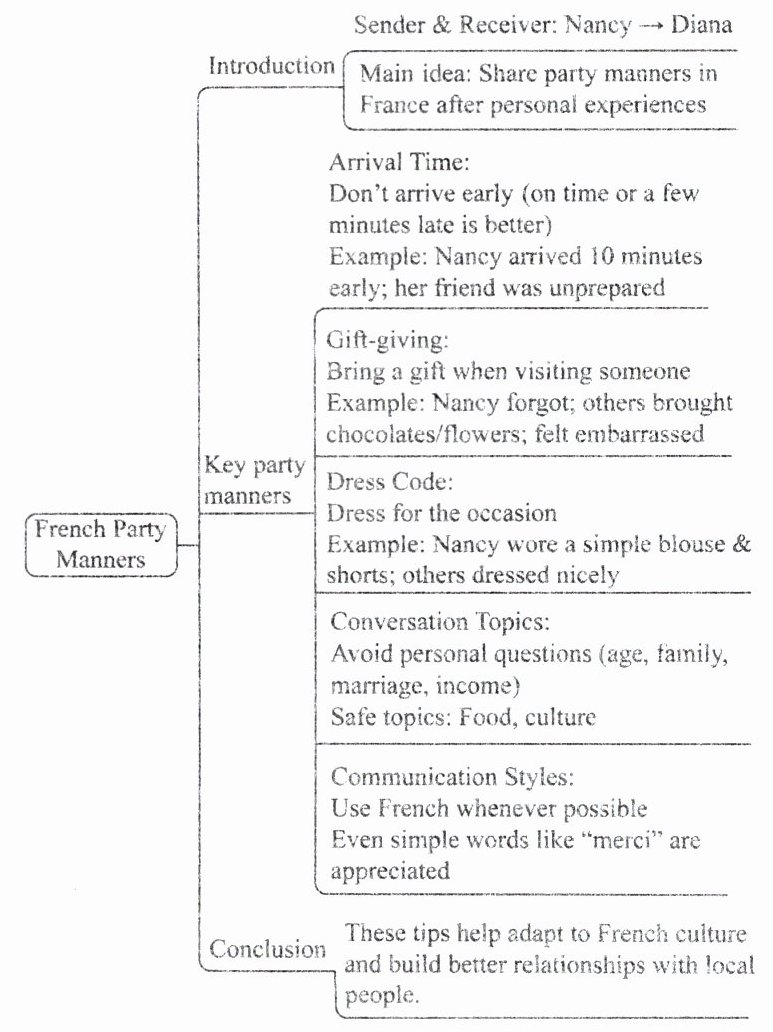
Task 2 Answer the following question.
1. Where did Nancy's embarrassing experiences happen?
2. When is the proper time to arrive at a French party?
3. What should you bring when visiting someone in France?
4. How did Nancy feel when she wore a simple outfit at a party?
5. Why should you avoid personal questions at a French party?
Task 3 Think and write.
Write a short paragraph about adapting to new cultures. Use Nancy's experiences in Paris to show how to learn local customs.
Step 3 Post-reading
Task 1 Retell the passage according to the mind map.
Arrival Time:
Rule: Don't 1.. Be on time or 2..
Example: Nancy 3. once. Her friend was still preparing and felt surprised.
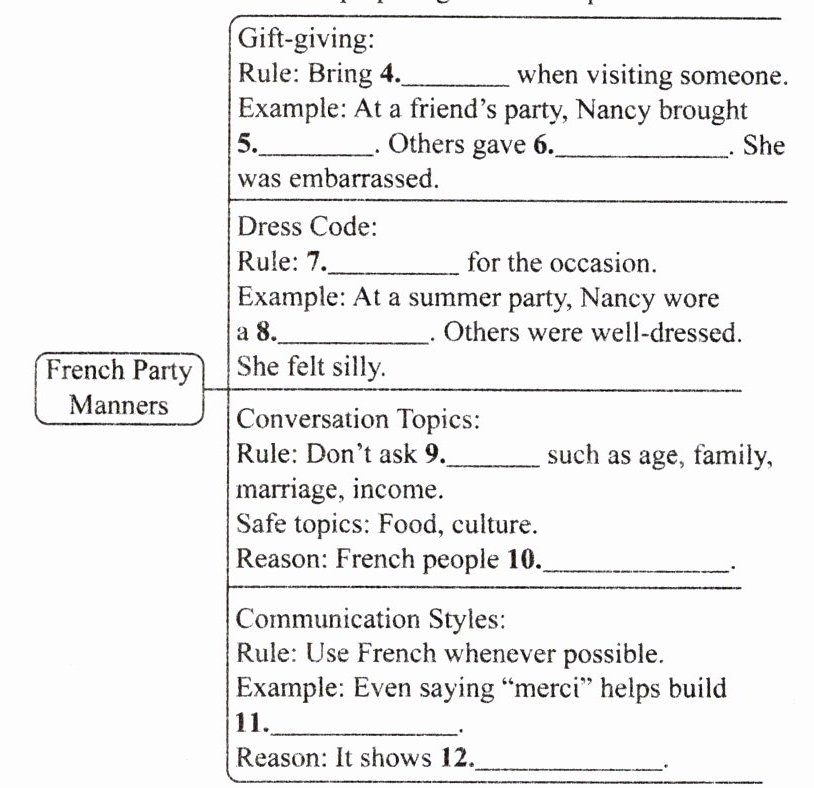
Task 2 Work in groups.
In groups, discuss the importance of understanding party manners for international students. Then, create a list of activities that could help students learn and use these manners effectively.
Step 1 Lead-in
Free talk. Look at the email on Pages 66~67 and answer.
What is Nancy's email mainly about?
Step 2 While-reading
Task 1 Understand the main idea.
Task 2 Answer the following question.
1. Where did Nancy's embarrassing experiences happen?
2. When is the proper time to arrive at a French party?
3. What should you bring when visiting someone in France?
4. How did Nancy feel when she wore a simple outfit at a party?
5. Why should you avoid personal questions at a French party?
Task 3 Think and write.
Write a short paragraph about adapting to new cultures. Use Nancy's experiences in Paris to show how to learn local customs.
Step 3 Post-reading
Task 1 Retell the passage according to the mind map.
Arrival Time:
Rule: Don't 1.. Be on time or 2..
Example: Nancy 3. once. Her friend was still preparing and felt surprised.
Task 2 Work in groups.
In groups, discuss the importance of understanding party manners for international students. Then, create a list of activities that could help students learn and use these manners effectively.
答案
Step 1
It's about party manners in France.
Step 2
Task 2
1. At a party.
2. It's better to be on time or a few minutes late.
3. You should bring a gift, like chocolates or flowers.
4. She felt silly because others were well-dressed.
5. Because French people value privacy.
Task 3
Learning local customs helps us adapt to new places. Nancy learned that in Paris, you should not arrive early to parties and always bring a gift. She also found that dressing well and avoiding personal questions are important. Using simple French words like "merci" can help build better relationships with local people.
Step 3
Task 1
1. arrive early
2. a few minutes late
3. arrived early
4. gifts
5. nothing
6. gifts like chocolates or flowers
7. Dress
8. blouse and shorts
9. personal questions
10. are quite private
11. closer relationships
12. respect for their culture
Task 2
1. It helps students avoid embarrassment (like Nancy's early arrival), show respect, and build friendships. Knowing rules about gifts, dress, and conversations makes parties more enjoyable.
2. (1) Role-play: Act out party scenarios (arrival, gift-giving).
(2) Group discussions: Share experiences and tips, like safe topics.
(3) Watch videos: See real parties to learn proper behaviour.
解析
【分析】本题为英语文本研读类题目,围绕Nancy分享法国聚会礼仪的邮件设置任务,解题思路如下:1. Step1需通读邮件概括主旨,抓住核心话题“法国聚会礼仪”;2. Step2 Task2为细节理解题,需定位问题对应的文本信息逐一作答;Task3需结合Nancy的巴黎经历,围绕“适应新文化”组织语言;3. Step3 Task1需根据文本内容补全填空,Task2需结合主题讨论并设计学习活动。
【解析】Step1:邮件核心是介绍法国的聚会礼仪,故主旨为It's about party manners in France.
Step2 Task2:1. 定位Nancy尴尬经历的发生地,答案为At a party.;2. 找到法国聚会的合适到达时间,答案为It's better to be on time or a few minutes late.;3. 明确拜访法国人家需带礼物,答案为You should bring a gift, like chocolates or flowers.;4. 定位Nancy穿简单服装的感受,答案为She felt silly because others were well-dressed.;5. 找到避免私人问题的原因,答案为Because French people value privacy.
Task3:结合Nancy的巴黎经历,围绕“适应新文化”组织语言,答案为Learning local customs helps us adapt to new places. Nancy learned that in Paris, you should not arrive early to parties and always bring a gift. She also found that dressing well and avoiding personal questions are important. Using simple French words like "merci" can help build better relationships with local people.
Step3 Task1:根据文本内容补全填空,依次对应答案为1. arrive early;2. a few minutes late;3. arrived early;4. gifts;5. nothing;6. gifts like chocolates or flowers;7. Dress;8. blouse and shorts;9. personal questions;10. are quite private;11. closer relationships;12. respect for their culture.
Task2:围绕“了解聚会礼仪的重要性及学习活动”作答,答案为1. It helps students avoid embarrassment (like Nancy's early arrival), show respect, and build friendships. Knowing rules about gifts, dress, and conversations makes parties more enjoyable. 2. (1) Role-play: Act out party scenarios (arrival, gift-giving). (2) Group discussions: Share experiences and tips, like safe topics. (3) Watch videos: See real parties to learn proper behaviour.
【答案】Step1: It's about party manners in France.
Step2 Task2: 1. At a party. 2. It's better to be on time or a few minutes late. 3. You should bring a gift, like chocolates or flowers. 4. She felt silly because others were well-dressed. 5. Because French people value privacy.
Task3: Learning local customs helps us adapt to new places. Nancy learned that in Paris, you should not arrive early to parties and always bring a gift. She also found that dressing well and avoiding personal questions are important. Using simple French words like "merci" can help build better relationships with local people.
Step3 Task1: 1. arrive early 2. a few minutes late 3. arrived early 4. gifts 5. nothing 6. gifts like chocolates or flowers 7. Dress 8. blouse and shorts 9. personal questions 10. are quite private 11. closer relationships 12. respect for their culture
Task2: 1. It helps students avoid embarrassment (like Nancy's early arrival), show respect, and build friendships. Knowing rules about gifts, dress, and conversations makes parties more enjoyable. 2. (1) Role-play: Act out party scenarios (arrival, gift-giving). (2) Group discussions: Share experiences and tips, like safe topics. (3) Watch videos: See real parties to learn proper behaviour.
【知识点】英语阅读理解、跨文化交际、英语写作
【点评】本题围绕英语文本研读展开,涵盖主旨概括、细节理解、写作及讨论任务,考察学生的文本理解能力和跨文化意识,是英语学习中贴近实际应用的综合类题型。
【难度系数】0.7
