

 登录
Ⅵ. 任务型阅读
阅读并根据下面的短文,在表格中的空格里填入一个最恰当的单词或回答问题。
(南京模拟改编)Have you ever noticed this? Whether in stores or parks, the women's restroom always seems very busy. Not only do users crowd inside, but long lines often stretch outside as well. Meanwhile, going to the men's restroom appears much smoother. People come and go quickly, and you hardly see long lines waiting outside.
The reasons are varied. First, men's and women's needs in restrooms are not the same. A study from the World Toilet Organization shows that, due to physical(身体的) differences, the typical time women spend in the restroom is about 2.3 times longer than that of men. Some users may need extra time for personal care or for caring for accompanying children.
To accommodate(顾及) these additional
needs, women's restrooms are often designed with less space per user than men's. This makes the traditional 1:1 ratio between men's and women's restroom space unfair. Liang Ji, an expert from the China Association of Urban Environmental Sanitation, suggests that a 1:2 ratio would be more effective.
In recent years, public awareness of this problem has grown. To address it, we should start by raising public understanding. When using public spaces, everyone should consider others' needs while meeting their own.
In addition, more cities should be encouraged to support female-friendly restrooms. Reports show that some public restrooms in Shenzhen, Guangdong, have already adopted a 1:2 ratio of male-to-female restroom spaces and have also added smart screens to help visitors check available spaces.
In Changsha, Hunan, two extra women-only restrooms have been added to a railway station's public restroom areas. During a trip to Jilin Province, I also noticed a public restroom that included a well-designed rest area where visitors could read books or charge their phones, making the waiting time more comfortable.
These well-planned public services have received a lot of praise. But more importantly, when women feel more comfortable and valued, our cities will become more welcoming and peaceful places to live.
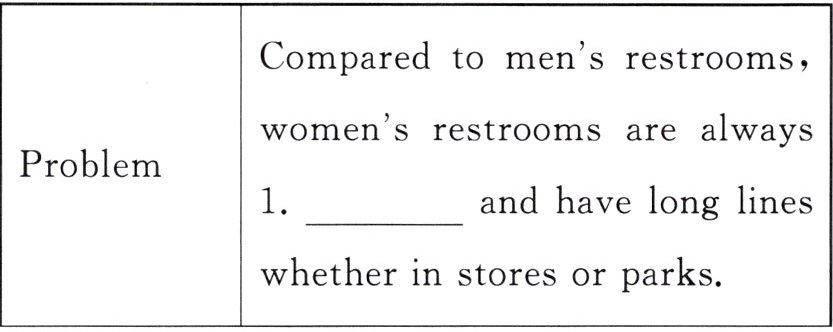
Problem
Compared to men's restrooms, women's restrooms are always 1.
Varied 2.
• Because men and women are physically 3.
• In some cases, women use the restroom for the purpose of taking care of children or personal care.
How to solve the problem
• Help the public 4.
• Take both others' needs and their own into consideration.
• Adopt a 1:2 ratio of male-to-female restroom spaces and help visitors check available spaces by 5.
• Set up extra women-only restrooms.
• 6.
People's opinions
People think 7.
According to the article, how many provinces have the awareness to solve the problem?
8.
新考法 开放性试题 What do you think is the best way to solve the problem?
9.
阅读并根据下面的短文,在表格中的空格里填入一个最恰当的单词或回答问题。
(南京模拟改编)Have you ever noticed this? Whether in stores or parks, the women's restroom always seems very busy. Not only do users crowd inside, but long lines often stretch outside as well. Meanwhile, going to the men's restroom appears much smoother. People come and go quickly, and you hardly see long lines waiting outside.
The reasons are varied. First, men's and women's needs in restrooms are not the same. A study from the World Toilet Organization shows that, due to physical(身体的) differences, the typical time women spend in the restroom is about 2.3 times longer than that of men. Some users may need extra time for personal care or for caring for accompanying children.
To accommodate(顾及) these additional
needs, women's restrooms are often designed with less space per user than men's. This makes the traditional 1:1 ratio between men's and women's restroom space unfair. Liang Ji, an expert from the China Association of Urban Environmental Sanitation, suggests that a 1:2 ratio would be more effective.
In recent years, public awareness of this problem has grown. To address it, we should start by raising public understanding. When using public spaces, everyone should consider others' needs while meeting their own.
In addition, more cities should be encouraged to support female-friendly restrooms. Reports show that some public restrooms in Shenzhen, Guangdong, have already adopted a 1:2 ratio of male-to-female restroom spaces and have also added smart screens to help visitors check available spaces.
In Changsha, Hunan, two extra women-only restrooms have been added to a railway station's public restroom areas. During a trip to Jilin Province, I also noticed a public restroom that included a well-designed rest area where visitors could read books or charge their phones, making the waiting time more comfortable.
These well-planned public services have received a lot of praise. But more importantly, when women feel more comfortable and valued, our cities will become more welcoming and peaceful places to live.
Problem
Compared to men's restrooms, women's restrooms are always 1.
busy/crowded
and have long lines whether in stores or parks.Varied 2.
causes
of the situation• Because men and women are physically 3.
different
, women tend to spend more time in the restroom.• In some cases, women use the restroom for the purpose of taking care of children or personal care.
How to solve the problem
• Help the public 4.
understand
the situation.• Take both others' needs and their own into consideration.
• Adopt a 1:2 ratio of male-to-female restroom spaces and help visitors check available spaces by 5.
using/adding
smart screens.• Set up extra women-only restrooms.
• 6.
Design/Improve
the rest area of the restroom to make the waiting time more comfortable. For example, visitors could read books or charge their phones there.People's opinions
People think 7.
highly
of these well-planned public services. It's important to make our cities welcoming and peaceful places to live.According to the article, how many provinces have the awareness to solve the problem?
8.
3/Three.
新考法 开放性试题 What do you think is the best way to solve the problem?
9.
Adopting a 1:2 ratio for restroom spaces.(开放性试题,答案合理即可)
答案
【语篇解读】本文是一篇说明文,主要探讨了公共场所女性卫生间排队现象的原因及解决方案,并强调通过合理规划和人性化设计提升城市公共服务的包容性。
1. busy/crowded 2. causes 3. different 4. understand 5. using/adding 6. Design/Improve 7. highly 8. 3/Three.
9. Adopting a 1:2 ratio for restroom spaces.(开放性试题,答案合理即可)
