

 登录
登录
A. 阅读邮件,完成下列各题。
Dear Peter,
I'm glad to hear that you're coming to China this summer! I hope to see you soon. Now let me tell you about our customs in my country.
First, when we meet people, we usually shake hands and smile. It's polite to greet others warmly, and we often talk about general topics like the weather or travel plans. Second, for table manners, don't stick chopsticks into your food, and don't point at people with them. Also, wait until elderly people start eating. Third, if you visit a family, bring small gifts (like fruit or tea) to show respect. Always knock before entering the house. When you are in another country, it is very important to respect the local culture and customs. If you have any questions, feel free to ask!
Welcome to China—I hope you'll have a wonderful time here!
Yours,
Teng Fei
1. 根据上下文,你能猜出文中画线词“greet”的中文意思吗? greet:
2. 请从文中找出中国“餐桌礼仪”的两个要点。
(1)
(2)
3. 从文中找出拜访中国家庭时的两个礼貌做法。
(1)
(2)
4. 请用一句话总结对待不同的习俗的看法(不超过20词)。
5. 请用“First…,Second…,Third…”句型仿写句子,介绍你了解的中国习俗。
First, we when meeting the elders; Second, we at dinner; Third, we when visiting friends.
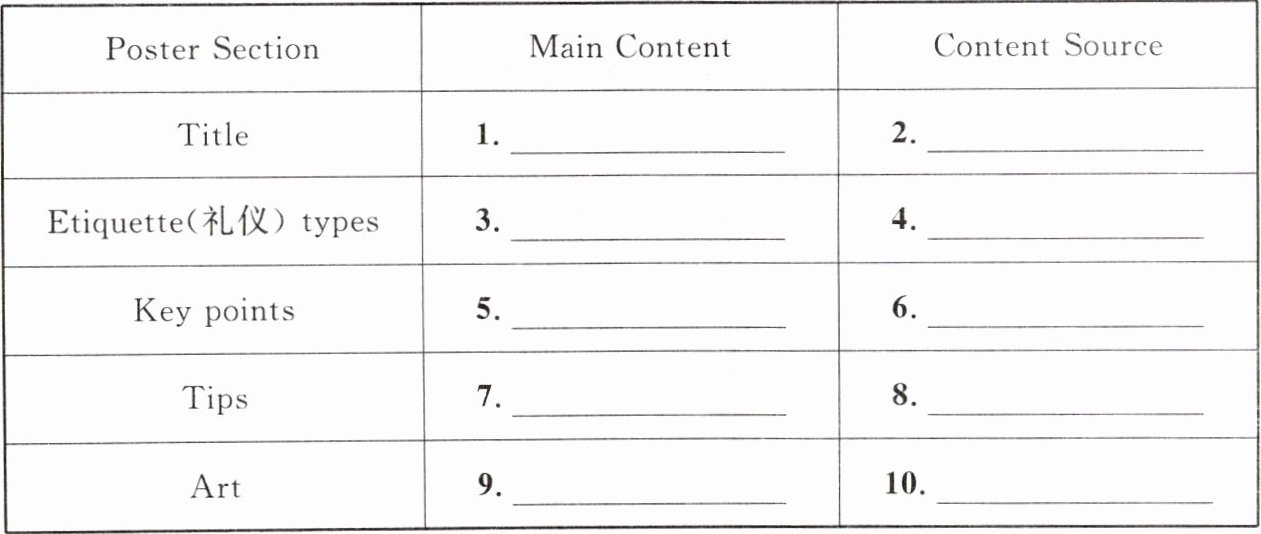
B. 梳理海报框架。
Dear Peter,
I'm glad to hear that you're coming to China this summer! I hope to see you soon. Now let me tell you about our customs in my country.
First, when we meet people, we usually shake hands and smile. It's polite to greet others warmly, and we often talk about general topics like the weather or travel plans. Second, for table manners, don't stick chopsticks into your food, and don't point at people with them. Also, wait until elderly people start eating. Third, if you visit a family, bring small gifts (like fruit or tea) to show respect. Always knock before entering the house. When you are in another country, it is very important to respect the local culture and customs. If you have any questions, feel free to ask!
Welcome to China—I hope you'll have a wonderful time here!
Yours,
Teng Fei
1. 根据上下文,你能猜出文中画线词“greet”的中文意思吗? greet:
2. 请从文中找出中国“餐桌礼仪”的两个要点。
(1)
(2)
3. 从文中找出拜访中国家庭时的两个礼貌做法。
(1)
(2)
4. 请用一句话总结对待不同的习俗的看法(不超过20词)。
5. 请用“First…,Second…,Third…”句型仿写句子,介绍你了解的中国习俗。
First, we when meeting the elders; Second, we at dinner; Third, we when visiting friends.
B. 梳理海报框架。
答案
A. 1. 问候
2. (1) Don't stick chopsticks into your food, and don't point at people with them.
(2) Wait until the elderly start eating.
3. (1) Bring small gifts (like fruit or tea).
(2) Knock before entering the house.
4. We should respect and understand different customs.
5. shake hands and smile; wait until elder people start eating; sit properly
B. 1. Chinese Etiquette Guide for Visitors
2. 创作+邮件素材
3. Greetings, table manners, visiting a family
4. 邮件内容
5. Greet warmly (talk about weather/ travel); use chopsticks properly (wait for the elders to eat); bring small gifts (knock before entering)
6. 邮件内容
7. A small smile makes your greeting warmer.
8. 自己创作
9. 答案不唯一,合理即可。
10. 结合习俗内容创作
2. (1) Don't stick chopsticks into your food, and don't point at people with them.
(2) Wait until the elderly start eating.
3. (1) Bring small gifts (like fruit or tea).
(2) Knock before entering the house.
4. We should respect and understand different customs.
5. shake hands and smile; wait until elder people start eating; sit properly
B. 1. Chinese Etiquette Guide for Visitors
2. 创作+邮件素材
3. Greetings, table manners, visiting a family
4. 邮件内容
5. Greet warmly (talk about weather/ travel); use chopsticks properly (wait for the elders to eat); bring small gifts (knock before entering)
6. 邮件内容
7. A small smile makes your greeting warmer.
8. 自己创作
9. 答案不唯一,合理即可。
10. 结合习俗内容创作
