

 登录
Exploring space
Life of Taikonauts in Space
Read & answer: How is life in space different for astronauts?
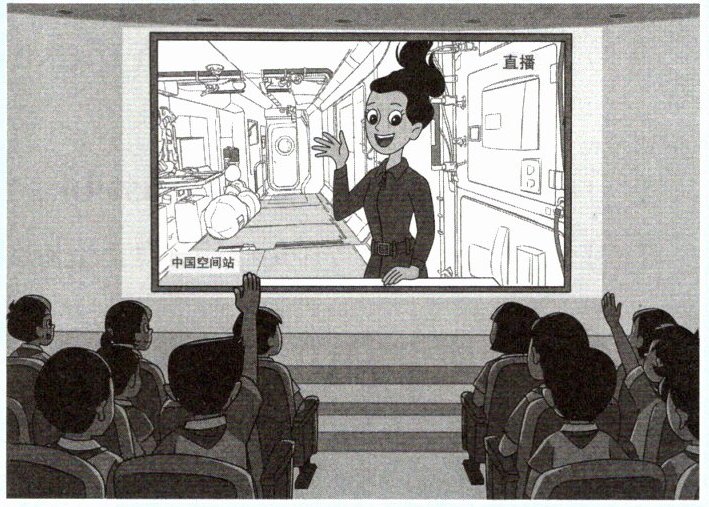
Taikonauts are Chinese astronauts. Their life in space is special and different. Eating in space is different. Food can float. So taikonauts use special bags and spoons. They cannot use plates like on Earth. They often eat dried food and drink water from bags. On December 9th, 2021, during the first Tiangong class from China’s space station, taikonaut Wang Yaping (on board the Shenzhou-13 mission) gave a live lesson to students on Earth. She showed how to drink water in microgravity. She put water in a sealed bag with a straw. When she gently squeezed the bag, the water moved into her mouth through the straw. If she had not used a bag, the water would have floated away as many small drops.
Taikonauts have many tasks every day. They check and repair machines, communicate with scientists on Earth, and do scientific experiments. Sometimes they go outside the space station to fix equipment—this is very dangerous work because they must wear heavy spacesuits and work in the vacuum of space.
To sleep, taikonauts strap themselves into sleeping bags on the wall or ceiling, because they would float around otherwise. They also exercise for about two hours each day on special treadmills and bikes to keep their muscles and bones strong in zero gravity.
The most wonderful part of the job is looking at Earth from the window. They can see vast oceans, green land, white clouds, and even the Moon and stars without any clouds blocking the view.
Ⅰ. Read and tick or cross. 读一读,判断对(√)错(×)。
(
(
(
(
(
Ⅱ. Read and group. 读一读,将以下航天员的太空生活场景(A~H)归入对应的类别。
A. use sealed water bags with straws
B. fix machines outside the space station
C. tie sleeping bags on the ceiling
D. enjoy the view of blue oceans and white clouds
E. do scientific experiments with scientists on Earth
F. exercise on space bikes and treadmills
G. eat dried food without plates
H. wear heavy spacesuits for spacewalks

Life of Taikonauts in Space
Read & answer: How is life in space different for astronauts?
Taikonauts are Chinese astronauts. Their life in space is special and different. Eating in space is different. Food can float. So taikonauts use special bags and spoons. They cannot use plates like on Earth. They often eat dried food and drink water from bags. On December 9th, 2021, during the first Tiangong class from China’s space station, taikonaut Wang Yaping (on board the Shenzhou-13 mission) gave a live lesson to students on Earth. She showed how to drink water in microgravity. She put water in a sealed bag with a straw. When she gently squeezed the bag, the water moved into her mouth through the straw. If she had not used a bag, the water would have floated away as many small drops.
Taikonauts have many tasks every day. They check and repair machines, communicate with scientists on Earth, and do scientific experiments. Sometimes they go outside the space station to fix equipment—this is very dangerous work because they must wear heavy spacesuits and work in the vacuum of space.
To sleep, taikonauts strap themselves into sleeping bags on the wall or ceiling, because they would float around otherwise. They also exercise for about two hours each day on special treadmills and bikes to keep their muscles and bones strong in zero gravity.
The most wonderful part of the job is looking at Earth from the window. They can see vast oceans, green land, white clouds, and even the Moon and stars without any clouds blocking the view.
Ⅰ. Read and tick or cross. 读一读,判断对(√)错(×)。
(
√
) 1. Taikonauts means Chinese astronauts.(
×
) 2. Taikonauts can use plates like on Earth for meals in space.(
×
) 3. There is strong gravity pulling water down inside the space station.(
√
) 4. Taikonauts sleep in sleeping bags fixed on walls or ceilings.(
√
) 5. Taikonauts spend about two hours exercising every day to keep healthy.Ⅱ. Read and group. 读一读,将以下航天员的太空生活场景(A~H)归入对应的类别。
A. use sealed water bags with straws
B. fix machines outside the space station
C. tie sleeping bags on the ceiling
D. enjoy the view of blue oceans and white clouds
E. do scientific experiments with scientists on Earth
F. exercise on space bikes and treadmills
G. eat dried food without plates
H. wear heavy spacesuits for spacewalks
答案
1. √ 2. × 3. × 4. √ 5. √
Eating: A, G Daily work: B, E, H Sleep & exercise: C, FWatch Earth: D
解析
【分析】本题分为判断正误和信息分类两部分。解题思路:1. 做判断正误题时,需先通读全文,定位每个小题对应的原文细节,将题干内容与原文表述对比,判断是否一致;2. 做信息分类题时,先明确四个类别(饮食、日常工作、睡眠与锻炼、观赏地球)的核心内容,再逐一匹配A~H的场景,归入对应类别。
【解析】一、判断正误解析:1. 原文明确“Taikonauts are Chinese astronauts”,与题干表述一致,故正确;2. 原文提到“They cannot use plates like on Earth”,与题干“能用盘子”矛盾,故错误;3. 原文指出太空是微重力环境,水会漂浮,空间站内无强重力拉水向下,故错误;4. 原文说明“taikonauts strap themselves into sleeping bags on the wall or ceiling”,与题干一致,故正确;5. 原文提到“exercise for about two hours each day”,与题干一致,故正确。二、信息分类解析:Eating类对应饮食相关场景,A(用带吸管的密封水袋)、G(吃无盘的冻干食物)符合;Daily work类对应日常工作任务,B(舱外修机器)、E(与地球科学家做实验)、H(穿宇航服太空行走)符合;Sleep & exercise类对应睡眠和锻炼场景,C(睡袋绑在天花板)、F(太空跑步机/自行车锻炼)符合;Watch Earth类对应观赏地球的场景,D(看海洋白云)符合。
【答案】1. √ 2. × 3. × 4. √ 5. √
Eating: A, G Daily work: B, E, H Sleep & exercise: C, F Watch Earth: D
【知识点】阅读理解 细节理解 信息分类
【点评】本题考查学生对太空生活相关英文文本的细节理解能力与信息归纳分类能力,题目难度适中,只要认真研读原文即可准确作答。
【难度系数】0.7
