

 登录
Ⅳ. Read and choose the right answers.
读一读,为下列句子选择恰当的答语。
() 1. What do taikonauts do on the space station?
A. They watch TV.
B. They do exercise to keep healthy.
() 2. How can we explore space?
A. We can explore space with telescopes and spaceships.
B. We can explore space with planes and cars.
() 3. Are there any aliens on Mars?
A. Yes, there are.
B. No, there aren't.
() 4. What is Mars called sometimes?
A. The red planet.
B. The blue planet.
() 5. What does Earth look like from outer space?
A. A red ball.
B. A big blue marble.
答案
1. B
2. A
3. B
4. A
5. B
2. A
3. B
4. A
5. B
解析
【解析】
1. 第1题:问句询问宇航员在空间站做什么,A选项“他们看电视”不符合太空站的任务设定,B选项“他们锻炼来保持健康”是宇航员在空间站的常规活动,选B。
2. 第2题:问句询问我们如何探索太空,A选项“我们可以用望远镜和宇宙飞船探索太空”符合常识,B选项的飞机和汽车无法用于太空探索,选A。
3. 第3题:问句询问火星上有没有外星人,目前没有任何科学证据证明火星存在外星人,应作否定回答,选B。
4. 第4题:问句询问火星有时被称作什么,火星因地表富含氧化铁呈现红色,被叫做红色星球,蓝色星球是地球的别称,选A。
5. 第5题:问句询问从外太空看地球是什么样子,地球表面大部分被海洋覆盖,从太空看像一颗巨大的蓝色弹珠,选B。
【答案】
1. B
2. A
3. B
4. A
5. B
【知识点】
太空常识
情景问答
词汇理解
【点评】
本题结合太空主题的常识考查英语情景问答能力,既检验学生对相关英语语句的理解,也考察基础的天文科普常识,题目难度适中。
【难度系数】
0.8
Ⅴ. Read and finish the tasks.
读一读,完成下列任务。
Earth Moon satellite telescope star spaceship
任务一:按要求将方框中的单词分类。
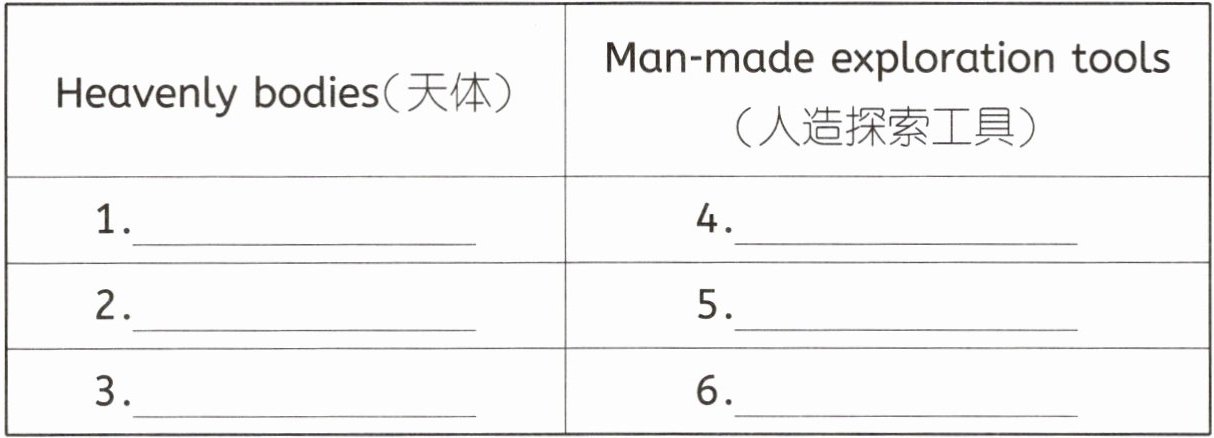
任务二:选择恰当的单词补全句子。
1. is our home. It has some beautiful names.
2. We can take a to travel to space.
3. A travels around Earth and sends messages from space.
4. We can look into space with a .
读一读,完成下列任务。
Earth Moon satellite telescope star spaceship
任务一:按要求将方框中的单词分类。
任务二:选择恰当的单词补全句子。
1. is our home. It has some beautiful names.
2. We can take a to travel to space.
3. A travels around Earth and sends messages from space.
4. We can look into space with a .
答案
任务一:
Heavenly bodies(天体):
1. Earth
2. Moon
3. star
Man-made exploration tools(人造探索工具):
4. satellite
5. telescope
6. spaceship
任务二:
1. Earth
2. spaceship
3. satellite
4. telescope
Heavenly bodies(天体):
1. Earth
2. Moon
3. star
Man-made exploration tools(人造探索工具):
4. satellite
5. telescope
6. spaceship
任务二:
1. Earth
2. spaceship
3. satellite
4. telescope
解析
任务一:首先明确分类规则,天体指宇宙中自然存在的星体,人造探索工具是人类制造的、用于太空相关探索的物品。先明确所有单词含义:Earth地球、Moon月球、satellite卫星、telescope望远镜、star星星、spaceship宇宙飞船,据此完成分类。
任务二:结合句子语境匹配对应单词:
1. 句意:____是我们的家园,它有很多美丽的称呼,符合地球的属性。
2. 句意:我们可以乘坐______去太空旅行,对应宇宙飞船的用途。
3. 句意:____绕地球运行,从太空传送信息,符合人造卫星的功能。
4. 句意:我们可以用______观测太空,对应望远镜的用途。
任务二:结合句子语境匹配对应单词:
1. 句意:____是我们的家园,它有很多美丽的称呼,符合地球的属性。
2. 句意:我们可以乘坐______去太空旅行,对应宇宙飞船的用途。
3. 句意:____绕地球运行,从太空传送信息,符合人造卫星的功能。
4. 句意:我们可以用______观测太空,对应望远镜的用途。
