

 登录
四、补全对话
A: 1.
B: Good idea! What animals do you want to see?
A: 2.
B: Dolphins! I like dolphins, too. They are very clever.
A: Yes, they are. 3.
B: I like most of the animals, but not bears.
A: 4.
B: Because they are dirty and lazy.
A: I don’t like lions. I think they are scary.
B: 5.
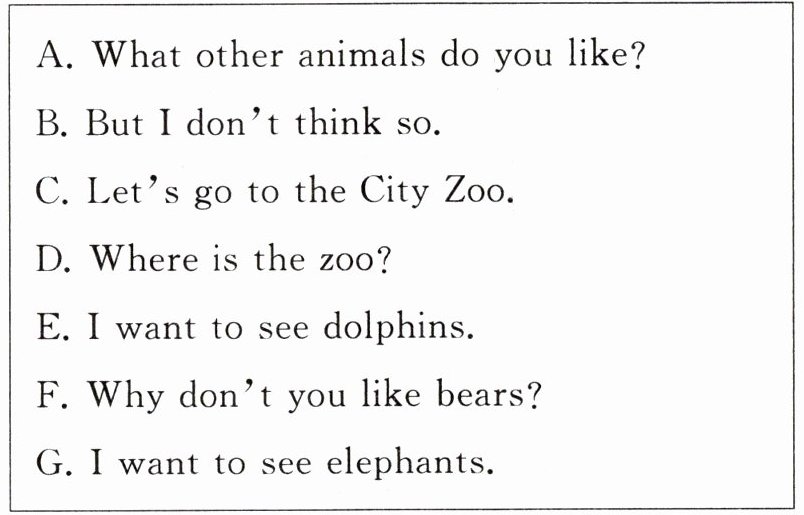
A. What other animals do you like?
B. But I don’t think so.
C. Let’s go to the City Zoo.
D. Where is the zoo?
E. I want to see dolphins.
F. Why don’t you like bears?
G. I want to see elephants.
A: 1.
C
B: Good idea! What animals do you want to see?
A: 2.
E
B: Dolphins! I like dolphins, too. They are very clever.
A: Yes, they are. 3.
A
B: I like most of the animals, but not bears.
A: 4.
F
B: Because they are dirty and lazy.
A: I don’t like lions. I think they are scary.
B: 5.
B
I like lions.A. What other animals do you like?
B. But I don’t think so.
C. Let’s go to the City Zoo.
D. Where is the zoo?
E. I want to see dolphins.
F. Why don’t you like bears?
G. I want to see elephants.
答案
1. C 2. E 3. A 4. F 5. B
解析
【分析】
做补全对话题需结合上下文的语境和逻辑关系,先通读对话明确主题为“去动物园看动物的交流”,再逐一匹配选项:第1空根据B的“Good idea!”判断是提议类语句;第2空结合B提到的“Dolphins”匹配对应内容;第3空根据B说的“喜欢大部分动物但不喜欢熊”判断是询问其他喜欢的动物;第4空根据B的原因回答匹配对应的提问;第5空根据A和B对狮子的不同态度判断是不同意的表达。
【解析】
1. 第1空:B回应“Good idea!”,说明A提出了一个提议,选项C“Let's go to the City Zoo.”(我们去城市动物园吧。)符合语境,故选C。
2. 第2空:B问“What animals do you want to see?”,后续提到“Dolphins”,说明A的回答是想看海豚,选项E“I want to see dolphins.”(我想看海豚。)符合,故选E。
3. 第3空:B说“喜欢大部分动物但不喜欢熊”,由此A询问对方还喜欢什么动物,选项A“What other animals do you like?”(你还喜欢其他什么动物?)符合,故选A。
4. 第4空:B回答“因为它们又脏又懒”,是解释不喜欢熊的原因,所以A的问题是询问为什么不喜欢熊,选项F“Why don't you like bears?”(你为什么不喜欢熊?)符合,故选F。
5. 第5空:A说不喜欢狮子,B说自己喜欢狮子,说明B不同意A的看法,选项B“But I don't think so.”(但我不这么认为。)符合,故选B。
【答案】1.C 2.E 3.A 4.F 5.B
【知识点】日常交际用语、补全对话
【点评】本题围绕“去动物园看动物”的话题展开,考查学生对日常对话逻辑的理解与运用,只要理清上下文的问答关系即可正确作答,是基础的情景交际类题目。
【难度系数】0.3
五、完形填空
Hello, I'm a Yangtze finless porpoise(长江江豚). The Yangtze River is
My family once nearly
Luckily, the government(政府)
My family is also
1. A. his B. her C. its D. my
2. A. died out B. found out C. looked out D. came out
3. A. water B. food C. air D. time
4. A. warm B. clear C. strong D. ill
5. A. also B. never C. only D. still
6. A. notices B. meets C. loses D. wins
7. A. pull B. visit C. move D. stop
8. A. rising B. swimming C. treating D. fishing
9. A. larger B. greener C. richer D. longer
10. A. trying B. moving C. growing D. living
Hello, I'm a Yangtze finless porpoise(长江江豚). The Yangtze River is
D
1 only home.My family once nearly
A
2. People caught a lot of fish in the river and made the water dirty. So we didn't have enough B
3 to eat and had no safe place to live. The river got "D
4", and we were in danger. In 2017, there were C
5 1,012 of us, even fewer than pandas!Luckily, the government(政府)
A
6 this, and does some things to protect the river. Over these years, big changes have taken place. Some factories C
7 far away from the river, and they can't discharge(排放) their litter into the water. The fishermen also stop D
8. So my home starts to get A
9.My family is also
C
10. I've got a few younger brothers and sisters! We sometimes jump in the air and say hello to people!1. A. his B. her C. its D. my
2. A. died out B. found out C. looked out D. came out
3. A. water B. food C. air D. time
4. A. warm B. clear C. strong D. ill
5. A. also B. never C. only D. still
6. A. notices B. meets C. loses D. wins
7. A. pull B. visit C. move D. stop
8. A. rising B. swimming C. treating D. fishing
9. A. larger B. greener C. richer D. longer
10. A. trying B. moving C. growing D. living
答案
1. D 2. A 3. B 4. D 5. C 6. A 7. C 8. D 9. A 10. C
解析
【分析】
这是一篇以长江江豚视角展开的完形填空,解题时需结合上下文语境、词汇词义辨析及固定搭配逐一分析:1. 由前文江豚的第一人称自称,判断对应物主代词;2. 结合江豚的生存危机,辨析短语含义确定家族状态;3. 依据人类捕鱼的行为,推断江豚缺少的资源;4. 结合江豚濒危处境,判断河流的拟人化状态;5. 结合数量对比,确定表数量的副词;6. 结合政府的保护动作,判断政府的行为;7. 结合工厂与河流的污染关联,判断工厂的行为;8. 结合渔民与江豚生存的关系,确定渔民停止的行为;9. 结合保护后的变化,判断家园的状态;10. 结合江豚新增兄弟姐妹的信息,判断家族的状态。
【解析】
1. 前文主语为江豚的第一人称“I”,需用形容词性物主代词“my”,故选D;
2. 短语辨析:died out意为“灭绝”,found out意为“查明”,looked out意为“小心”,came out意为“出版”,结合“生存危机”的语境,选A;
3. 由“People caught a lot of fish”可知江豚缺少食物,故选B;
4. 将河流拟人化,结合江豚濒危的处境,“河流生病了”对应ill,故选D;
5. 由“even fewer than pandas”可知数量“仅仅”1012,only表“仅仅”,故选C;
6. 政府注意到江豚的生存问题,notices意为“注意到”,故选A;
7. 工厂搬离河流以减少污染,move意为“搬迁”,故选C;
8. 为保护江豚,渔民停止捕鱼,stop doing sth.为固定搭配,故选D;
9. 保护措施实施后,江豚的家园范围扩大,larger意为“更大的”,故选A;
10. 由“younger brothers and sisters”可知江豚家族在繁衍,growing意为“繁衍增长”,故选C。
【答案】
1.D 2.A 3.B 4.D 5.C 6.A 7.C 8.D 9.A 10.C
【知识点】
完形填空词义辨析、上下文语境理解、固定搭配
【点评】
本文以长江江豚的视角讲述其生存现状与保护后的变化,语篇贴近环保主题,考查学生对词汇、语境逻辑的理解能力,难度适中。
【难度系数】
0.6
