

 登录
三、教材语篇回顾。根据所给中文或首字母的适当形式填空。
Easton LaChappelle was a 14-year-old student. He made a(n) 1. (机器臂)and showed it at a science fair. It was made from 2. (塑料块)and fishing line. One day, a girl named Jenny came to see his work. She had an artificial arm and shook hands with his robotic arm. Jenny was born without an arm. Her artificial arm was just a(n) 3. (简单的钩子)and cost 80,000. Children like her grow quickly and need new arms often. Easton was shocked. He thought his arm only cost 300. He wanted to help people like Jenny.
After the fair, Easton turned his room into a 4. l_________. He worked hard to 5. i_________ his robotic arm. When he was 16, he got a 3-D printer. With it, he 6. _________(发明)a new artificial arm. It could move by 7. _________(感应)brain signals. But the arm weighed 3.6 8. k_________. It was too heavy for a child. Easton kept working on it. He enjoyed 9. _________(解决)problems. When he was 23, he finally succeeded. His new design 10. w_________ only 0.5 kilograms and cost about 500.
Easton's 11. _________(发明物)helped many children. He didn't want to make money from it. He put his design online for free. People can download it and use their own 3-D printers to make the artificial arm. What a(n) 12. _________(有创造力的)and helpful idea!
答案
1. robotic arm
2. plastic blocks
3. simple hook
4. lab
5. improve
6. invented
7. sensing
8. kilograms
9. fixing / solving
10. weighed
11. invention
12. creative
四、语法聚焦。
A. 语法入门:动名词和动词不定式。
1. 动名词(Gerund)
定义:动词的“-ing”形式(即现在分词形式)用作名词。
特点: ①由“动词原形 + ing”构成。如:swimming, reading。
②在句子中起名词的作用。
例句:I enjoy reading books.(我喜欢读书。)
2. 动词不定式(Infinitive)
定义:动词的基本形式,通常由“to + 动词原形”构成。有时to可以省略,称为不
带to的动词不定式。
特点:①由“to + 动词原形”构成。如:to go, to study。
②否定形式:not to + 动词原形。
③可以表示目的、意图或将来的动作。
例句:I want to visit Beijing.(我想去北京参观。)
3. 区别:动名词强调习惯性或已经发生的动作,动词不定式常表示具体或未发生的动作。有些动词后只能接动名词,有些只能接不定式,需要记忆和练习。
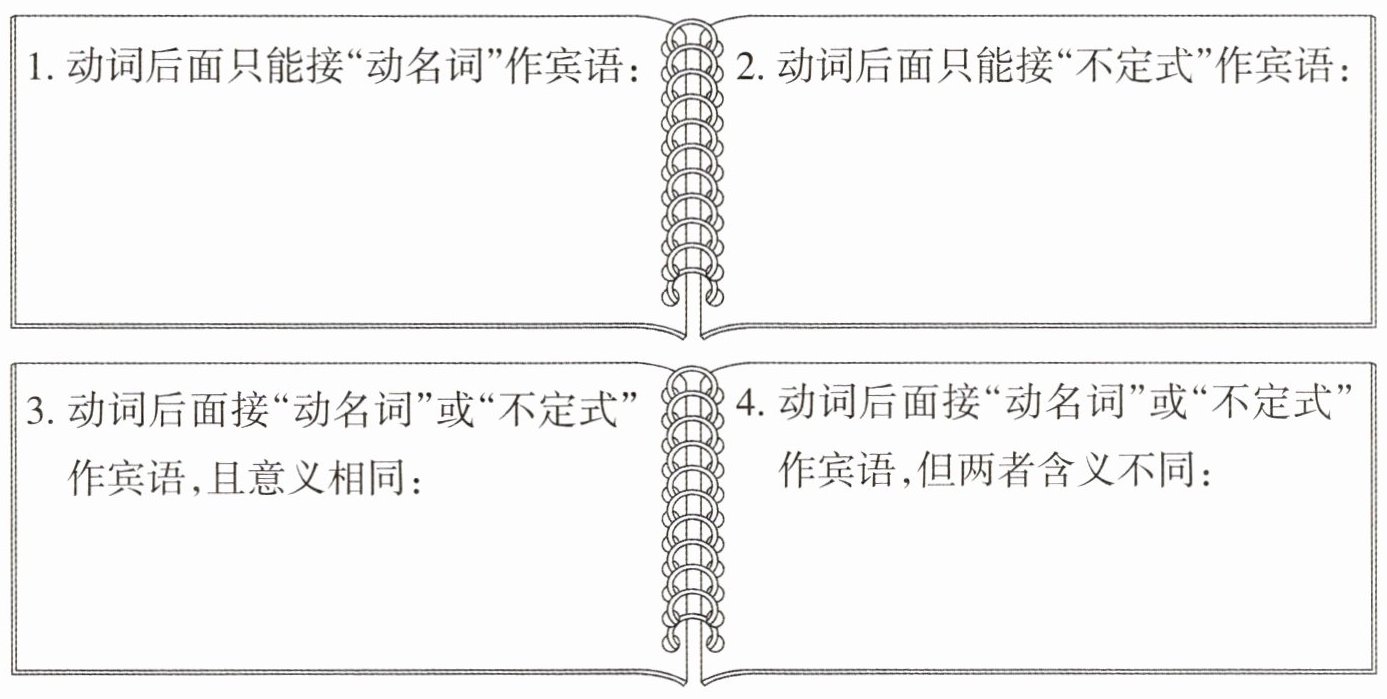
B. 规则初探:将下列动词放入相应的表格中。
keep stop decide finish remember enjoy want forget
imagine choose begin refuse hope start try
C. 连词成句。
1. tried, always, he, improve, to, his, work ( . )
2. want, money, make, he, didn’t, to, from, it ( . )
3. knocking, he, kept, drinks, over, his ( . )
4. decided, Lily, design, a, cup, with, three, legs, to ( . )
5. starts, it, to, shake, warn, to, the, users ( . )
6. hoped, he, to, apply, it, real, life, to ( . )
A. 语法入门:动名词和动词不定式。
1. 动名词(Gerund)
定义:动词的“-ing”形式(即现在分词形式)用作名词。
特点: ①由“动词原形 + ing”构成。如:swimming, reading。
②在句子中起名词的作用。
例句:I enjoy reading books.(我喜欢读书。)
2. 动词不定式(Infinitive)
定义:动词的基本形式,通常由“to + 动词原形”构成。有时to可以省略,称为不
带to的动词不定式。
特点:①由“to + 动词原形”构成。如:to go, to study。
②否定形式:not to + 动词原形。
③可以表示目的、意图或将来的动作。
例句:I want to visit Beijing.(我想去北京参观。)
3. 区别:动名词强调习惯性或已经发生的动作,动词不定式常表示具体或未发生的动作。有些动词后只能接动名词,有些只能接不定式,需要记忆和练习。
B. 规则初探:将下列动词放入相应的表格中。
keep stop decide finish remember enjoy want forget
imagine choose begin refuse hope start try
C. 连词成句。
1. tried, always, he, improve, to, his, work ( . )
He always tried to improve his work.
2. want, money, make, he, didn’t, to, from, it ( . )
He didn't want to make money from it.
3. knocking, he, kept, drinks, over, his ( . )
He kept knocking his drinks over.
4. decided, Lily, design, a, cup, with, three, legs, to ( . )
Lily decided to design a cup with three legs.
5. starts, it, to, shake, warn, to, the, users ( . )
It starts to shake to warn the users.
6. hoped, he, to, apply, it, real, life, to ( . )
He hoped to apply it to real life.
答案
B. 1. keep, finish, enjoy, imagine
2. decide, want, choose, refuse, hope
3. begin, start
4. stop, remember, forget, try
C. 1. He always tried to improve his work.
2. He didn't want to make money from it.
3. He kept knocking his drinks over.
4. Lily decided to design a cup with three legs.
5. It starts to shake to warn the users.
6. He hoped to apply it to real life.
