

 登录
(E)
Chen Lu was a middle school student who loved music more than anything else. However, she came from a poor family, so she couldn’t afford a piano or even regular music lessons. 56.
Every night after finishing her homework, Chen Lu would sit by her old radio and listen to classical music. She dreamed of playing the piano herself. One day, she saw a music teacher playing the piano in a park. The beautiful melody made her cry. 57.
The teacher was touched by Chen Lu’s love for music. Instead of asking for money, he decided to teach her free of charge. He told her, “True music is not about the instrument, but about the heart. ” Chen Lu practiced day and night. She used her fingers to practice on the surface of a desk, feeling the rhythm and beats. 58.
Years passed, and Chen Lu entered a national music competition for teenagers. It was a difficult competition against the best young musicians in the country. During her performance, she made a small mistake. 59.
When the last note faded, the hall was silent for a few seconds. Then, the audience erupted into thunderous applause. 60.
根据短文内容,将下面的句子还原到文中空白处,使短文内容完整、通顺。(每个选项只能用一次)。(5分)
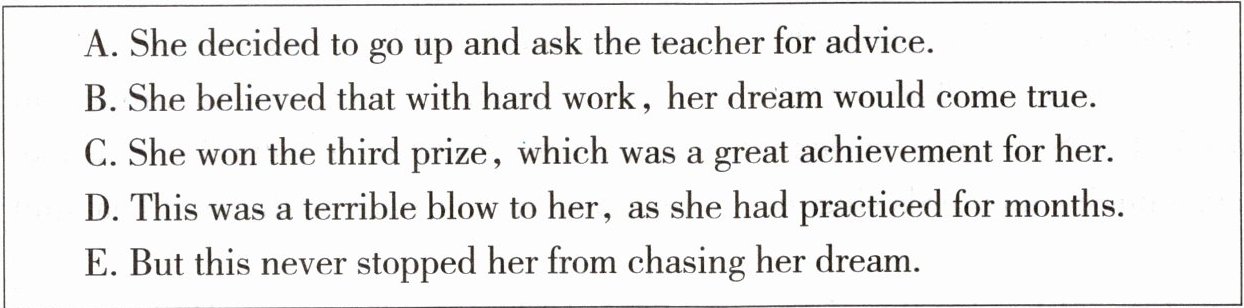
A. She decided to go up and ask the teacher for advice.
B. She believed that with hard work, her dream would come true.
C. She won the third prize, which was a great achievement for her.
D. This was a terrible blow to her, as she had practiced for months.
E. But this never stopped her from chasing her dream.
Chen Lu was a middle school student who loved music more than anything else. However, she came from a poor family, so she couldn’t afford a piano or even regular music lessons. 56.
E
Every night after finishing her homework, Chen Lu would sit by her old radio and listen to classical music. She dreamed of playing the piano herself. One day, she saw a music teacher playing the piano in a park. The beautiful melody made her cry. 57.
A
The teacher was touched by Chen Lu’s love for music. Instead of asking for money, he decided to teach her free of charge. He told her, “True music is not about the instrument, but about the heart. ” Chen Lu practiced day and night. She used her fingers to practice on the surface of a desk, feeling the rhythm and beats. 58.
B
Years passed, and Chen Lu entered a national music competition for teenagers. It was a difficult competition against the best young musicians in the country. During her performance, she made a small mistake. 59.
D
Instead of panicking, she closed her eyes and played with all her heart, pouring her love and gratitude into the music.When the last note faded, the hall was silent for a few seconds. Then, the audience erupted into thunderous applause. 60.
C
She didn’t win the first prize, but she won the special prize for“the most touching performance”. Her story inspired many people who loved music but faced difficulties.根据短文内容,将下面的句子还原到文中空白处,使短文内容完整、通顺。(每个选项只能用一次)。(5分)
A. She decided to go up and ask the teacher for advice.
B. She believed that with hard work, her dream would come true.
C. She won the third prize, which was a great achievement for her.
D. This was a terrible blow to her, as she had practiced for months.
E. But this never stopped her from chasing her dream.
答案
56.E 57.A 58.B 59.D 60.C
解析
【分析】
要解决句子还原题,需结合上下文的逻辑关系(如转折、顺承、因果等),分析每个空白处前后文的语境,匹配对应的选项:
1. 56题:前文提到陈璐家境贫困,买不起钢琴和音乐课,后文说她每晚听收音机学音乐,因此此处需要转折句,体现困难未阻挡她的梦想,对应E选项。
2. 57题:前文说她看到公园的音乐老师弹钢琴后被旋律打动,后文提到老师被她的热爱打动并免费教她,因此此处是她主动向老师求助,对应A选项。
3. 58题:前文描述她日夜刻苦练习的状态,后文是多年后参加比赛,此处需要体现她对努力实现梦想的信念,对应B选项。
4. 59题:前文说比赛中她犯了小错误,后文说她没有慌乱而是继续演奏,因此此处是错误带来的打击,对应D选项。
5. 60题:前文提到观众的掌声,后文说她没拿一等奖但获特别奖,此处需要说明她的获奖情况,对应C选项。
【解析】
1. 56空:前文“couldn’t afford a piano or even regular music lessons”与后文“listen to classical music”形成转折,E选项“But this never stopped her from chasing her dream”符合逻辑,故56选E。
2. 57空:前文“saw a music teacher playing the piano... made her cry”与后文“the teacher was touched... teach her free of charge”衔接,说明她主动求助,A选项“She decided to go up and ask the teacher for advice”符合语境,故57选A。
3. 58空:前文“practiced day and night... used her fingers to practice”体现刻苦,B选项“She believed that with hard work, her dream would come true”承接练习状态,体现信念,故58选B。
4. 59空:前文“made a small mistake”与后文“Instead of panicking”衔接,说明错误带来打击,D选项“This was a terrible blow to her, as she had practiced for months”符合逻辑,故59选D。
5. 60空:前文“audience erupted into thunderous applause”与后文“didn’t win the first prize, but won the special prize”衔接,说明获奖结果,C选项“She won the third prize, which was a great achievement for her”符合语境,故60选C。
【答案】
56.E 57.A 58.B 59.D 60.C
【知识点】
英语语篇逻辑、句子还原、上下文语境理解
【点评】
本题为句子还原型阅读理解题,考查学生对语篇上下文逻辑关系的把握能力,需结合语境的转折、顺承等关系匹配句子,整体难度适中,学生可通过梳理上下文逻辑完成作答。
【难度系数】
0.6
(F)
Suzhou Pingtan is a famous traditional Chinese performing art with a history dating back to the Song Dynasty. Rooted in Jiangnan culture, it is popular in Suzhou, Shanghai and southern parts of Jiangsu and Zhejiang provinces.
It is a special art mixing storytelling and singing, performed in the gentle Suzhou dialect. Usually, performers give shows alone, in pairs or trios, sitting on chairs all the time. They play two traditional Chinese instruments—the pipa and sanxian. With only a fan, a small gavel and a handkerchief as simple props, they tell lively stories without fancy stage clothes or decorations.
The stories of Suzhou Pingtan come from traditional Chinese folk tales, history and love legends. It is well-known for its soft tunes, delicate feelings and funny dialogues, winning the love of people for hundreds of years.
In the past, local people watched Suzhou Pingtan shows in old teahouses. Later, it was in danger of dying out as few young people learned it. Now, it is listed as a national intangible cultural heritage, and the country takes action to protect and pass it on. More young people start to learn this art.
Today, Suzhou Pingtan keeps its traditional beauty and also makes small changes to meet modern people's tastes. It becomes a window to show the charm of Chinese traditional folk art to the world.
根据短文内容,回答下列问题。
61. When did Suzhou Pingtan first appear?
62. What instruments are used in Suzhou Pingtan performances?
63. What props do performers use in shows?
64. Where did people enjoy Suzhou Pingtan in the past?
65. Why is Suzhou Pingtan protected in recent years?
Suzhou Pingtan is a famous traditional Chinese performing art with a history dating back to the Song Dynasty. Rooted in Jiangnan culture, it is popular in Suzhou, Shanghai and southern parts of Jiangsu and Zhejiang provinces.
It is a special art mixing storytelling and singing, performed in the gentle Suzhou dialect. Usually, performers give shows alone, in pairs or trios, sitting on chairs all the time. They play two traditional Chinese instruments—the pipa and sanxian. With only a fan, a small gavel and a handkerchief as simple props, they tell lively stories without fancy stage clothes or decorations.
The stories of Suzhou Pingtan come from traditional Chinese folk tales, history and love legends. It is well-known for its soft tunes, delicate feelings and funny dialogues, winning the love of people for hundreds of years.
In the past, local people watched Suzhou Pingtan shows in old teahouses. Later, it was in danger of dying out as few young people learned it. Now, it is listed as a national intangible cultural heritage, and the country takes action to protect and pass it on. More young people start to learn this art.
Today, Suzhou Pingtan keeps its traditional beauty and also makes small changes to meet modern people's tastes. It becomes a window to show the charm of Chinese traditional folk art to the world.
根据短文内容,回答下列问题。
61. When did Suzhou Pingtan first appear?
It dates back to the Song Dynasty.
62. What instruments are used in Suzhou Pingtan performances?
The pipa and the sanxian.
63. What props do performers use in shows?
A fan, a small gavel and a handkerchief.
64. Where did people enjoy Suzhou Pingtan in the past?
In traditional teahouses.
65. Why is Suzhou Pingtan protected in recent years?
Because it is a national intangible cultural heritage.
答案
61. It dates back to the Song Dynasty.
62. The pipa and the sanxian.
63. A fan, a small gavel and a handkerchief.
64. In traditional teahouses.
65. Because it is a national intangible cultural heritage.
解析
【分析】
解答本题需根据短文内容,定位每个问题对应的段落,提取具体信息作答:61题定位第一段关于苏州评弹历史的描述;62题定位第二段提到的表演乐器;63题定位第二段的表演道具;64题定位第四段过去人们观看评弹的地点;65题定位第四段评弹被保护的原因。
【解析】
61题:根据短文第一段第一句“Suzhou Pingtan is a famous traditional Chinese performing art with a history dating back to the Song Dynasty.”可知,苏州评弹最早出现于宋朝,答案为It dates back to the Song Dynasty.
62题:根据短文第二段“They play two traditional Chinese instruments—the pipa and sanxian.”可知,使用的乐器是琵琶和三弦,答案为The pipa and the sanxian.
63题:根据短文第二段“With only a fan, a small gavel and a handkerchief as simple props”可知,道具是扇子、小惊堂木和手帕,答案为A fan, a small gavel and a handkerchief.
64题:根据短文第四段“In the past, local people watched Suzhou Pingtan shows in old teahouses.”可知,过去人们在老茶馆看评弹,答案为In traditional teahouses.
65题:根据短文第四段“Now, it is listed as a national intangible cultural heritage, and the country takes action to protect and pass it on.”可知,因为它是国家级非物质文化遗产,所以被保护,答案为Because it is a national intangible cultural heritage.
【答案】
61. It dates back to the Song Dynasty.
62. The pipa and the sanxian.
63. A fan, a small gavel and a handkerchief.
64. In traditional teahouses.
65. Because it is a national intangible cultural heritage.
【知识点】
英语阅读理解(细节查找),中国传统艺术
【点评】
本题为英语阅读理解的细节信息提取题,难度较低,考查学生快速定位短文对应内容并准确提取答案的能力,只要认真阅读短文即可轻松作答。
【难度系数】
0.8
