

 登录
三、根据汉语意思完成句子
1. 中国将和其他国家合作开展更多深空探索任务。
China will
2. 幸运的是,船上的所有人都在船沉没前获救了。
Luckily, all the people
3. 通常来说,孩子们对周围的一切都感到好奇。
Generally speaking, kids
4. 人类在1969年首次踏上月球。
Humans first
5. 请带上伞,以防下雨。
Please take an umbrella with you
1. 中国将和其他国家合作开展更多深空探索任务。
China will
cooperate with
other countries to carry out more deep-space exploration tasks.2. 幸运的是,船上的所有人都在船沉没前获救了。
Luckily, all the people
on board
were saved before the ship sank.3. 通常来说,孩子们对周围的一切都感到好奇。
Generally speaking, kids
are curious about
everything around them.4. 人类在1969年首次踏上月球。
Humans first
set foot on
the moon in 1969.5. 请带上伞,以防下雨。
Please take an umbrella with you
in case
it rains.答案
1. cooperate with
2. on board
3. are curious about
4. set foot on
5. in case
解析
【分析】
本题为根据汉语意思完成句子的题型,需结合汉语提示、句子语境及时态要求,选择对应的固定短语填空。第1题“和…合作”对应固定短语,will后接动词原形;第2题需修饰“人”表示“在船上”,用固定介词短语;第3题“对…好奇”是固定搭配,结合主语和时态确定be动词;第4题“踏上”是动词短语,结合过去时间状语确定动词形式;第5题“以防”对应目的状语的固定短语。
【解析】
1. 表示“与…合作”用固定短语cooperate with,will后接动词原形,故填cooperate with;
2. 表示“在船上”修饰people,用固定介词短语on board,故填on board;
3. “对…好奇”是固定搭配be curious about,主语kids为复数,一般现在时be动词用are,故填are curious about;
4. “踏上”是固定动词短语set foot on,由时间状语in 1969可知用一般过去时,set的过去式仍为set,故填set foot on;
5. 表示“以防”用固定短语in case引导目的状语从句,故填in case。
【答案】
1. cooperate with 2. on board 3. are curious about 4. set foot on 5. in case
【知识点】
固定短语搭配;动词短语;介词短语
【点评】
本题考查英语基础固定短语的运用,需结合语境、时态准确填写,侧重基础短语的积累与运用,难度适中。
【难度系数】
0.6
四、阅读理解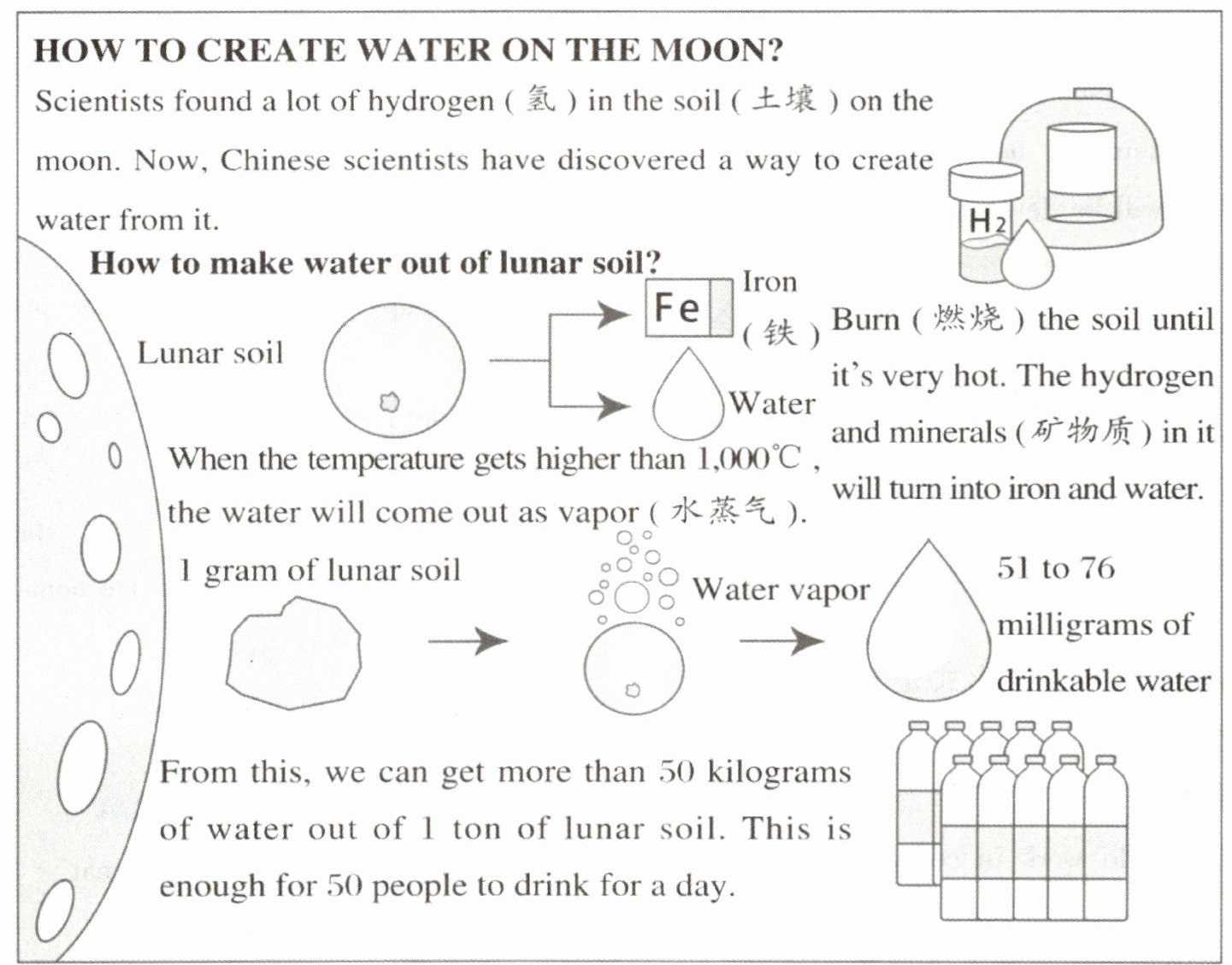
1. What did scientists find in lunar soil?
A. Water. B. Oxygen.
C. Carbon dioxide. D. Hydrogen.
2.
A. American scientists
B. Chinese scientists
C. French scientists
D. Russian scientists
3. How much water can be made out of one ton of lunar soil?
A. 50 kilograms.
B. 1,000 kilograms.
C. More than 50 kilograms.
D. More than 76 kilograms.
4. At what temperature does water come out from lunar soil?
A. $500°\mathrm{C}$. B. $750°\mathrm{C}$.
C. $900°\mathrm{C}$. D. Over $1,000°\mathrm{C}$.
5. In which section of a newspaper can we probably read the passage?
A. Science study. B. Star stories.
C. Space travel. D. Traditional culture.
1. What did scientists find in lunar soil?
A. Water. B. Oxygen.
C. Carbon dioxide. D. Hydrogen.
2.
B
discovered a way to create water from lunar soil.A. American scientists
B. Chinese scientists
C. French scientists
D. Russian scientists
3. How much water can be made out of one ton of lunar soil?
A. 50 kilograms.
B. 1,000 kilograms.
C. More than 50 kilograms.
D. More than 76 kilograms.
4. At what temperature does water come out from lunar soil?
A. $500°\mathrm{C}$. B. $750°\mathrm{C}$.
C. $900°\mathrm{C}$. D. Over $1,000°\mathrm{C}$.
5. In which section of a newspaper can we probably read the passage?
A. Science study. B. Star stories.
C. Space travel. D. Traditional culture.
答案
1. D 2. B 3. C 4. D 5. A
解析
【分析】
这是一篇科普类阅读理解,需根据原文细节逐一解答各题:1. 定位原文首句,查找科学家在月球土壤中发现的物质;2. 定位发现制水方法的科学家所属国家;3. 定位1吨月球土壤产出水量的描述;4. 定位水以水蒸气形式析出的温度条件;5. 根据文章内容判断所属报纸板块。
【解析】
1. 解析:根据原文“Scientists found a lot of hydrogen (氢) in the soil (土壤) on the moon.”可知,科学家在月球土壤中发现了大量氢,对应选项D。
2. 解析:根据原文“Now, Chinese scientists have discovered a way to create water from it.”可知,是中国科学家发现了从月球土壤制水的方法,对应选项B。
3. 解析:根据原文“From this, we can get more than 50 kilograms of water out of 1 ton of lunar soil.”可知,1吨月球土壤可产出超过50千克水,对应选项C。
4. 解析:根据原文“When the temperature gets higher than 1,000℃, the water will come out as vapor (水蒸气).”可知,温度超过1000℃时水以水蒸气形式析出,对应选项D。
5. 解析:文章围绕月球制水的科学研究展开,属于科学研究板块,对应选项A。
【答案】
1.D 2.B 3.C 4.D 5.A
【知识点】
阅读理解、细节理解、科普阅读
【点评】
本题为科普类阅读理解,重点考查学生提取原文细节信息的能力,题目难度较低,准确找到原文对应内容即可解答。
【难度系数】
0.7
