

 登录
八、阅读理解。
A
• Make phone calls
1980s 1G
• Make phone calls
• Send messages
1990s 2G
• Use the internet
• Listen to music
2000s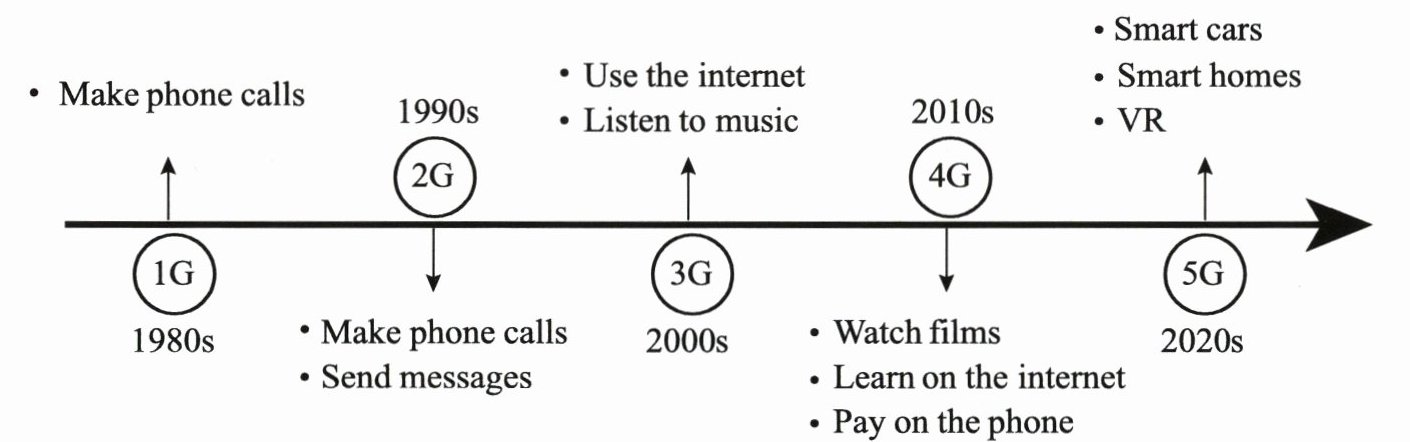 3G
• Watch films
• Learn on the internet
• Pay on the phone
2010s 4G
• Smart cars
• Smart homes
• VR
2020s 5G
(一)寻找每个时代的变化,选择正确的图片,将序号填在横线上。
C.
1. 1G:
2. 2G:
3. 3G:
4. 4G:
5. 5G:
(二)阅读材料,判断正(T)误(F)。
(
(
(
(
(
A
• Make phone calls
1980s 1G
• Make phone calls
• Send messages
1990s 2G
• Use the internet
• Listen to music
2000s
3G• Watch films
• Learn on the internet
• Pay on the phone
2010s 4G
• Smart cars
• Smart homes
• VR
2020s 5G
(一)寻找每个时代的变化,选择正确的图片,将序号填在横线上。
C.
1. 1G:
C
2. 2G:
A
3. 3G:
B
4. 4G:
D
5. 5G:
E
(二)阅读材料,判断正(T)误(F)。
(
F
)6. We start to use the internet in 5G.(
F
)7. We can watch cartoons on the phone in 2G.(
T
)8. We have classes on the internet in the 2010s.(
T
)9. We can pay money on the phone in 4G.(
T
)10. We can't watch films in 2G.答案
八、(A)(一)1. C 2. A 3. B 4. D 5. E (二)6. F 7. F 8. T 9. T 10. T
解析
【分析】
本题分为信息匹配和判断正误两部分,需先明确1G到5G各时代对应的时间及功能,再逐一匹配图片、判断句子对错。解题时先梳理材料中每个网络时代的核心功能,再对应问题要求分析:(一)部分根据功能匹配对应图片;(二)部分将句子表述与材料内容逐一核对,判断正误。
【解析】
(一)1. 1G(1980s)仅支持打电话,对应图片C,故填C;
2. 2G(1990s)支持打电话、发消息,对应图片A,故填A;
3. 3G(2000s)支持上网、听音乐,对应图片B,故填B;
4. 4G(2010s)支持看电影、网上学习、手机支付,对应图片D,故填D;
5. 5G(2020s)支持智能汽车、智能家居、VR,对应图片E,故填E;
(二)6. 材料中3G已提到“Use the internet”,并非5G,故填F;
7. 2G的功能仅为打电话、发消息,无看卡通的功能,故填F;
8. 2010s对应4G,材料中4G有“Learn on the internet”,故填T;
9. 4G有“Pay on the phone”的功能,故填T;
10. 2G的功能无看电影,故填T。
【答案】
(一)1. C 2. A 3. B 4. D 5. E
(二)6. F 7. F 8. T 9. T 10. T
【知识点】
英语阅读理解、信息匹配、判断正误
【点评】
本题围绕手机网络时代的功能展开,考查学生提取文本信息、匹配信息及判断正误的能力,题型基础且贴近生活,适合学生巩固阅读理解的基本解题方法。
【难度系数】
0.6
B
Do you like changes? Changes are everywhere. Every day we can find changes around us.
Do you notice(注意到) the nest in the tree? Some days ago, there were still some eggs in it, but now we can hear birds singing. Do you notice the beautiful flowers in the garden? But last Saturday, there were still some little buds. Do you notice the clothes shop near your school? There was a warm coat in the shop window last winter. Now there is a pretty red dress. Do you notice your classmates? Lily had long hair last week and she came to school with short hair this morning. Peter didn't wear glasses yesterday. But now he has a pair of black glasses. Changes make the world colourful.
阅读短文,选择正确的答案。
(
A. They change into fish.
B. They change into birds.
C. They become bigger eggs.
(
A. 花瓣
B. 叶子
C. 花蕾,花苞
(
A. Changes only happen in nature.
B. Changes make the world colourful.
C. Changes never happen around us.
(
A. They never change from winter to summer.
B. They change from a warm coat to a red dress.
C. They are always warm coats.
Do you like changes? Changes are everywhere. Every day we can find changes around us.
Do you notice(注意到) the nest in the tree? Some days ago, there were still some eggs in it, but now we can hear birds singing. Do you notice the beautiful flowers in the garden? But last Saturday, there were still some little buds. Do you notice the clothes shop near your school? There was a warm coat in the shop window last winter. Now there is a pretty red dress. Do you notice your classmates? Lily had long hair last week and she came to school with short hair this morning. Peter didn't wear glasses yesterday. But now he has a pair of black glasses. Changes make the world colourful.
阅读短文,选择正确的答案。
(
B
) 1. What happens to the eggs in the nest according to the passage?A. They change into fish.
B. They change into birds.
C. They become bigger eggs.
(
C
) 2. What does the underlined word "buds" most probably mean in Chinese?A. 花瓣
B. 叶子
C. 花蕾,花苞
(
B
) 3. What do we know about changes from the passage?A. Changes only happen in nature.
B. Changes make the world colourful.
C. Changes never happen around us.
(
B
) 4. What can we learn about the clothes in the shop window?A. They never change from winter to summer.
B. They change from a warm coat to a red dress.
C. They are always warm coats.
答案
(B)1. B 2. C 3. B 4. B
解析
【分析】
解题时需先通读短文理解主旨,再针对每道题的问题回到原文定位对应内容:第1题找鸟巢里蛋的变化,第2题结合花的语境猜测生词含义,第3题找关于“变化”的结论句,第4题找服装店橱窗衣服的变化,通过对比原文与选项得出答案。
【解析】
1. 细节理解题:根据原文第二段“Some days ago, there were still some eggs in it, but now we can hear birds singing.”可知,鸟巢里的蛋变成了鸟,对应选项B。
2. 词义猜测题:前文提到花园里的花,结合“last Saturday, there were still some little buds”可知,buds是花的初期状态,意为“花蕾,花苞”,对应选项C。
3. 细节理解题:原文最后一句明确“Changes make the world colourful.”,A选项“变化只发生在自然”、C选项“变化从不发生”均与原文不符,对应选项B。
4. 细节理解题:根据原文第二段“There was a warm coat in the shop window last winter. Now there is a pretty red dress.”可知,橱窗里的衣服从暖外套变成了红裙子,对应选项B。
【答案】
1.B 2.C 3.B 4.B
【知识点】
英语阅读理解、细节理解、词义猜测
【点评】
本题为英语阅读理解基础题型,围绕“生活中的变化”展开,重点考查学生提取原文细节、猜测生词的能力,整体难度较低,认真阅读原文即可解答。
【难度系数】
0.8
